Khalil Gibran has said, “We are limited, not by our abilities, but by our vision.”
Abraham Maslow has said, “In any given moment we have two options: to step forward into growth or step back into safety.”
The last time our denomination faced its limitations and stepped forward into growth was 38 years ago, in 1985. That’s when the current version of Article II was adopted through democratic process at General Assembly, by the thousands of Unitarian Universalists in attendance.
In that year, 1985, Ronald Reagan was President of the United States, and George H. W. Bush was Vice President.
In that year, a gallon of gas cost $1.09.
Michael Jordan was named the NBA’s “Rookie of the Year” in 1985. 1985 was when New York became the first state to require that all front-seat auto occupants wear seat belts, or face a $50 fine. 1985 was when Aretha Franklin, Billy Ocean, Chaka Kahn, and Daryl Hall & John Oates were among the biggest pop music artists. Popular Halloween costumes included Hulk Hogan, Elvira, Richard Nixon, and Ronald Reagan—in 1985.
That’s a long time ago. Would you agree?
A lot has changed since 1985. Of course, some things have stayed the same; some things are perennial and endure unchanged. But a lot has changed in 38 years.
So, our need as Unitarian Universalists is to step forward into growth. The need is for a New Vision.
General Assembly is again upon us, and at this General Assembly, the multitude of delegates gathering face-to-face or virtually in Pittsburgh will have the first opportunity to vote on whether or not to adopt a new version of Article II. Remember, Article II is sort of like our UU 10 Commandments. It’s the vision that rallies us together and gives us a shared identity. More precisely, it does no less than six things for us:
- It defines who we are in a legal sense
- It names our shared values and theology
- It serves as a shared cultural touchstone
- It lists concepts to teach and sources to draw from
- It serves as a personal code of ethics
- It provides language we can use to explain who we are to others and hopefully draw their interest
In other words, the value it adds for us is legal, theological, social, educational, personal, and evangelical in nature. So this is important, folks. The vote coming up next week is huge. And, depending on what happens, the second and culminating vote will take place at next year’s General Assembly.
I see this sermon as informing everyone of some of the main things to know about. As with every sermon, I am sharing my own perspective and point of view. West Shore will have multiple delegates attending General Assembly (either in person or virtually) who will vote on Article II, including myself, and I hope that this will be helpful as we begin imagining what the proposed revision of Article II might bring to our churches and to our denomination as a whole.
The main thing I’ll do here is share some surprises. The overarching one has to do with all of the deficiencies in the current Article II that became suddenly obvious to me when contrasted with the proposed revision. Reading the New Vision was like traveling to a different country, seeing new sights, tasting new flavors, which all served to enable a greater perspective on what’s in place currently. It’s not that home is all bad. Not at all. The current Article II has served us admirably. But, times have changed. The New Vision really is offering some incredibly positive things which speak to our needs now and to our hopes for the future.
One particular surprise has to do with how emotionally cool and formal the language of our current Article II is. At one point it says that the Unitarian Universalist Association “shall .. exercise its corporate powers”—but contrast this to the warmer language of “the Unitarian Universalist Association “will devote its resources to and use its organizational powers for….” The current version literally sounds like corporate-speak, but the newer version sounds more like a church.
Emotional coolness of language is also evident in how the current version of Article II speaks of “Principles.” The newer version replaces the language of “Principles” with “Values and Covenant,” and right there is the signal that our religion is not about individualism. It’s about how we live together in communities made possible through the promises we make to one another. Individuals who exist in abstract space can have Principles, but people who are bound together in mutual service to Love and Justice have Values that they Covenant to practice.
Finally, in the current Article II, we are asked “to affirm and promote” our Principles, whereas in the new version, each Value we are asked to practice in Covenant gets its own active, colorful verb: to honor, to celebrate, to work, to adapt, to cultivate, to declare. There’s some vibrancy here!
The New Vision is, in short, an invitation to greater emotional warmth and vibrancy….
Now, a second surprise: It has to do with the issue of our denomination’s purpose and the fact that the current version of Article II doesn’t articulate it fully. What it says is: “The primary purpose of the Association is to serve the needs of its member congregations, organize new congregations, extend and strengthen Unitarian Universalist institutions and implement its principles.” Sounds good enough. But when put side-by-side with the New Vision, you realize the incompleteness. The current version only names “proximate” purposes, that is, how the organization will work. But what about an answer to the main “purpose” question, which is why something exists, the end goal it’s trying to achieve? There’s no answer coming from the current Article II. But the revised version makes up for this. The New Vision says: “The purpose of the Unitarian Universalist Association is to actively engage its members in the transformation of the world through liberating Love.” Sure, the UUA can serve member congregation needs, it can organize new congregations, and so on. But what I really want to know is WHY? And only the New Vision gives the answer: the transformation of the world through liberating Love.
WOW!
Speaking of love…. Yet another surprise relates to the many values and practices that have come to be central to us as Unitarian Universalists which are only mentioned in passing in the current Article II and are not centered like they need to be. Love is one of them for sure, but let me mention a few others first.
Take “Covenant.” The word sums up all that is good in the saying “We need not think alike to love alike,” which is beloved wisdom held in the hearts of hundreds of thousands of Unitarian Universalists across our denomination. In the current Article II, the word “covenant” is part of the phrase “We covenant to affirm and promote…” and, honestly, it’s easy to skip right past it to get to the good stuff which is our Principles. But in the revised Article II, in the New Vision, the practice of covenanting gets its own paragraph: “As Unitarian Universalists, we covenant,
congregation-to-congregation and through our association, to support and assist one another in our ministries. We draw from our heritages of freedom, reason, hope, and courage, building on the foundation of love.” And then, with each of our Values comes a separate covenant statement. In the New Vision, our central practice of covenanting is not something you can just skip right past to get to the good stuff. It is the good stuff.
Another important concept that is just mentioned in passing in the current Article II is “culture.” In the current Article II version, “culture” is mentioned as follows: “Direct experience of that transcending mystery and wonder, affirmed in all cultures.” Ok. But in the proposed Article II, culture becomes a thing for us to acknowledge and address in all that we do, because culture is simultaneously a source of joy and beauty as well as a cause of terrible division and strife.
And so, in the New Vision, we are asked to celebrate the value of Pluralism, which is to “celebrate that we are all sacred beings diverse in culture, experience, and theology.” We are asked to work for the value of Justice, which is when we “work to be diverse multicultural Beloved Communities where all thrive.” As for the many sources of spiritual inspiration we draw from, we are asked to “respect the histories, contexts and cultures in which they were created and are currently practiced.”
As with covenant, culture is not a thing to be lightly passed over.
And now, let’s talk about love. One of the things that the Unitarian Universalist Association Board of Trustees charged the folks responsible for crafting the revised version of Article II to do was to address the issue of love. And I quote: “The Commission on Appraisal, in its report, Engaging Our Theological Diversity, cites Robert Miller’s study of Unitarian Universalism, stating ‘UUs ranked loving as an instrumental value and mature love as a terminal value more highly than did respondents from other groups, religious and nonreligious.’ Dr. Cornel West says that “‘justice is what love looks like in public.’ Our commitment to personal, institutional and cultural change rooted in anti-oppression, anti-racism, and multiculturalism values and practices is love in action, and should be centered in any revision of Article II.” Unquote. Now, note what’s happening here: a major recent report on where Unitarian Universalism stands theologically has found that love is a central value for UUs—and this makes us different from others. Love here is also linked to justice-making and to the 8th Principle imperative of fighting against racism and all oppressions. Love is central.
In the current Article II, the “transforming power of love” is mentioned only as part of the 2nd source, which is about “words and deeds of prophetic people.” That’s it. But in the New Vision, love takes center stage. CENTER STAGE! We’ve already seen that in the ultimate purpose statement for the UUA’s existence: “The purpose of the Unitarian Universalist Association is to actively engage its members in the transformation of the world through liberating Love.” And then there is this statement, again from the New Vision, which says it maybe even more strongly: “Love is the power that holds us together and is at the center of our shared values. We are accountable to one another for doing the work of living our shared values through the spiritual discipline of Love.” People, nothing in the current Article II comes close to the theological richness of what we are hearing right now. There is so much here to plumb, to deepen into, to celebrate. “Liberating love”–which is both a reality and power and which is also a discipline of daily practice.…
Make no mistake: this may be one of the greatest achievements of the New Vision–this theological richness. It may help us counteract a thing I call the problem of “social justicism”–which is where justice activism is seen as taking the place of spiritual growth and theological depth. The UUA’s recent Widening the Circle report itself calls this out–this problem of social-justicism–when it says, and I quote: “Justice-seeking practices of Unitarian Universalists are often not grounded on spiritual or ritual principles; instead justice-seeking takes the place of ritual and religious life. Justice practices cannot be used as surrogates for deepening our spiritual lives.” Unquote! Indeed, it is my belief that, unsupported by spiritual and theological depth, justice work becomes practically unsustainable and, in the end, does more harm than good.
Let me share one more surprise. I was surprised to see the degree to which the current Article II neglects to directly encourage the material building-up and sustaining of our congregations. Maybe the closest we get to that in the current Article II is the Second Principle: Acceptance of one another and encouragement to spiritual growth in our congregations; promising to one another our mutual trust and support. But let’s be frank: you have to read pretty hard between the lines to find anything here about people supporting congregational life through concrete gifts of time, talent, and money.
Not so in the New Vision. In the proposed Article II, you find a completely new value: generosity. “Generosity,” says the New Vision: “We cultivate a spirit of gratitude and hope. We covenant to freely and compassionately share our faith, presence, and resources. Our generosity connects us to one another in relationships of interdependence and mutuality.” And then, you have another value, that of Equity. Listen to this: “Equity. We declare that every person has the right to flourish with inherent dignity and worthiness. We covenant to use our time, wisdom, attention, and money to build and sustain fully accessible and inclusive communities.”
A comprehensive comparison and contrast of the current Article II and proposed revised Article II must make note of words that are in the current version and are absent in the revised one, and vice versa. I guarantee you, a word that appears nowhere in the current version is “money.” But there it is in the New Vision. And there it needs to be, because we have got to start wrapping our minds around how money is energy, and how church exists to channel energy of all sorts (including money) into acts of Liberating Love. Putting our energies in service to that. A better future immediately becomes possible, when more of us get that.
Preparing this sermon has been surprising. Honestly, I wasn’t sure what to expect from the New Vision. But I’m going to vote for it. Even though there are some things that concern me. Let me be as brief as I can in touching on some of these concerns.
One concern is the loss of specific named sources of our faith. In the current Article II, we name mystical experience, we name prophetic people, we name Judaism and Christianity, we name the world’s religions, we name science and Humanism, we name earth-based spirituality. The inspiration for our chancel screen comes directly from the current Article II. Yet, in the New Vision, there is no listing of specific sources. And, in one sense, I get it. Fact is, the Unitarian Universalist Bible is so big that only something as large as an Internet-based Wikipedia could hold it. The complete list of all our sources would go on for a very, very long time. The New Vision honestly acknowledges that. However, if Article II is meant to be educational and evangelical in nature, the loss of specific named sources makes it less helpful in these two regards.
My second concern is more serious. It relates to the New Vision’s statement about equity: “Equity. We declare that every person has the right to flourish with inherent dignity and worthiness.
We covenant to use our time, wisdom, attention, and money to build and sustain fully accessible and inclusive communities.” Now, I agree wholeheartedly with the New Vision’s affirmation that every person has the right to flourish. But when the New Vision goes on to suggest that our congregations need to be capable of including anyone in an unlimited way, here’s where I balk. You can interpret this to go far beyond ensuring physical accessibility. You can interpret this to mean absolute, unconditional acceptance of anyone who comes into this space, no matter what they might be bringing. But, what if the kind of person we’re talking about is a genuine bully who insists on having their own narcissistic way and creates chaos and confusion in their wake? Are you telling me that this church, in the spirit of equity, must give up healthy boundaries and not protect itself from destructive, toxic people? Absolutely unacceptable. The only kind of entity that could offer full, unlimited inclusion to absolutely anyone is God (if God exists). And no church has the powers of God. Churches are finite and mortal in their own way and need healthy boundaries and need to insist on accountability to healthy boundaries. The Equity value needs to be rewritten so that it does not encourage this sort of confusion. I just hear too many people blithely speak of how churches need to accept just anyone unconditionally. Once and a while, someone can come, and they can come into our midst like Donald Trump came into American political leadership. And look at where we are. Healthy boundaries and accountability to them make all the difference.
I have even more concerns, but there’s not enough time to explore them here. The biggest concern will be one that I explore in a future sermon. I will say here that this particular concern happens to be about every version of Article II that Unitarian Universalism has ever had, including the New Vision. More on this some other time.
For now, despite my concerns, I’ll vote yes.
All the current Principles are either explicitly mentioned or implicitly present in the New Vision.
That beautiful phrase “inherent worth and dignity” becomes, in the New Vision, “we declare that every person has the right to flourish with inherent dignity and worthiness.”
That beautiful phrase “interdependent web of all existence” persists as “We honor the interdependent web of all existence.”
That beautiful phrase “a free and responsible search for truth and meaning” continues on as “Our free and responsible search for truth and meaning.”
The New Vision carries forward what has been essential and inspiring in the current Article II, and it adds so much to this, of incredible value.
1985 was 38 years ago. Now our abilities are far greater than that 1985 vision allows for.
Now is the moment to step forward into growth.
Now, through a New Vision.
**
**
THE READING BEFORE THE SERMON–IN TWO VOICES
Anthony
A reading of the proposed revision of Article II of the UUA Bylaws
Judy
Oh lord….
Anthony
What?
Judy
This is going to be so boring
Anthony
No!
Judy
Convince me otherwise!
Anthony
Well, Article II is like the 10 Commandments–our Unitarian Universalist version of that…
Judy
Oh
Anthony
Except the ones we currently have may change pretty substantially
Judy
You mean the ones that are in the front of every one of our hymnals, and in the back of the order of service, and pretty much everywhere??
Anthony
Yeah! And you know what THEY say….
Judy
Who?
Anthony
THEY!
Judy
Rev. Anthony!
Anthony
Ok! Ok! A lot of people say this, but here’s one version, from the great writer Kahlil Gibran: “We are limited, not by our abilities, but by our vision.”
Judy
Whoa!
Anthony
I know! And the proposed revision of our UU version of the 10 Commandments will adjust our vision, sharpen it in some ways–which in turn will change how we see things and what we do. Not completely, but in some powerful ways….
Judy
I’m not bored anymore. Let’s start reading it.
Anthony
[Gives a thumbs up]
PROPOSED REVISION OF ARTICLE II
Section C-2.1. Purposes.
The Unitarian Universalist Association will devote its resources to and use its organizational powers for religious, educational, and humanitarian purposes. Its primary purposes are to assist congregations in their vital ministries, support and train leaders both lay and professional, to foster lifelong faith formation, to heal historic injustices, and to advance our Unitarian Universalist values in the world.
Judy
The purpose of the Unitarian Universalist Association is to actively engage its members in the transformation of the world through liberating Love.
WHOA! That’s completely new! And I like it!!
Anthony
I know!!
Let’s keep going:
Section C-2.2. Values and Covenant.
As Unitarian Universalists, we covenant, congregation-to-congregation and through our association, to support and assist one another in our ministries. We draw from our heritages of freedom, reason, hope, and courage, building on the foundation of love.
Judy
Love is the power that holds us together and is at the center of our shared values. We are accountable to one another for doing the work of living our shared values through the spiritual discipline of Love.
Anthony
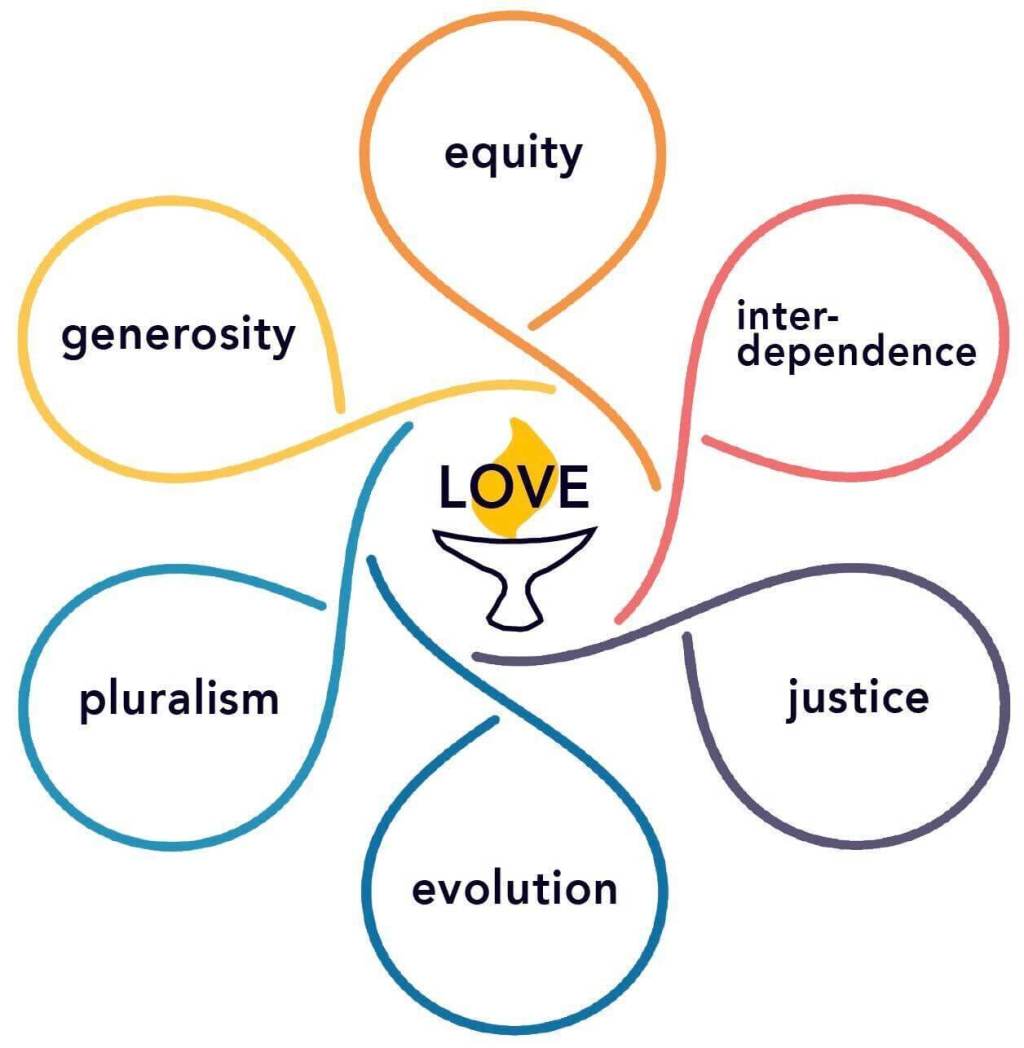
Inseparable from one another, these shared values are:

Judy
That’s a picture! There are no pictures in our current Purposes and Principles!
Anthony
Another change! The proposed revision is really different in some ways….
Continuing:
Interdependence. We honor the interdependent web of all existence.
We covenant to cherish Earth and all beings by creating and nurturing relationships of care and respect. With humility and reverence, we acknowledge our place in the great web of life, and we work to repair harm and damaged relationships.
Judy
Glad that that phrase about the “interdependent web of all existence” remains. I’ve always loved it.
Moving on:
Pluralism. We celebrate that we are all sacred beings diverse in culture, experience, and theology.
We covenant to learn from one another in our free and responsible search for truth and meaning. We embrace our differences and commonalities with Love, curiosity, and respect.
Anthony
Justice. We work to be diverse multicultural Beloved Communities where all thrive.
We covenant to dismantle racism and all forms of systemic oppression. We support the use of inclusive democratic processes to make decisions.
Judy
Transformation. We adapt to the changing world.
We covenant to collectively transform and grow spiritually and ethically. Openness to change is fundamental to our Unitarian and Universalist heritages, never complete and never perfect.
Even with all the changes, nothing I’m hearing strikes me as “not who we are.”
Anthony
Agreed. And, some of the changes are adding things that have always been there between the lines but need to be made more explicit. For example:
Generosity. We cultivate a spirit of gratitude and hope.
We covenant to freely and compassionately share our faith, presence, and resources. Our generosity connects us to one another in relationships of interdependence and mutuality.
Judy
Generosity is definitely not a word in our current Principles and Purposes–but it needs to be!
Ok, here’s the next:
Equity. We declare that every person has the right to flourish with inherent dignity and worthiness.
We covenant to use our time, wisdom, attention, and money to build and sustain fully accessible and inclusive communities.
Anthony
And did you hear that–the word “money”? Not in the current version either…..
And here is yet another change. Remember how the current version talks about Six Sources for our Unitarian Universalist faith? Check out how the new version addresses this:
Section C-2.3. Inspirations.
As Unitarian Universalists, we use, and are inspired by, sacred and secular understandings that help us to live into our values. We respect the histories, contexts and cultures in which they were created and are currently practiced.These sources ground us and sustain us in ordinary, difficult, and joyous times. Grateful for the religious ancestries we inherit and the diversity which enriches our faith, we are called to ever deepen and expand our wisdom.
Judy
You know? [pause] There’s something else THEY say.
Anthony
THEY again, huh?
Judy
“In any given moment we have two options: to step forward into growth or step back into safety.” Abraham Maslow the psychologist said that. And if all the proposed changes to Article II are about stepping forward into growth, then let’s step forward.
Anthony
THEY happen to be pretty wise…..
 Spiritflow
Leave a comment