Like the wings of a bird testify to the reality of air; like the gills of a fish testify to the reality of water; just so, the pain of lovelessness is a sign of the reality of that which feels missing and is desperately longed for.

–Anonymous photographer
“I was my father’s first daughter,” writes bell hooks in All About Love.

“At the moment of my birth, I was looked upon with loving kindness, cherished and made to feel wanted on this earth and in my home.”

–Anonymous child
“To this day I cannot remember when that feeling of being loved left me. I just know that one day I was no longer precious. Those who had initially loved me well turned away. The absence of their recognition and regard pierced my heart and left me with a feeling of brokenheartedness so profound I was spellbound.”

–Anonymous child
“Like every wounded child,” bell hooks says, “I just wanted to turn back time and be in that paradise again, in that moment of remembered rapture where I felt loved, where I felt a sense of belonging.”
But she could not turn back time. No one can.
If the three-year-old who drew this scene of turmoil and pain had grown up to become a famous artist, perhaps they would have echoed one of the most painful episodes in mythic history:

–Benjamin West, “The Expulsion of Adam and Eve from Paradise” (1791)
How terrible, the loss of that remembered rapture.
And this is not simply lovelessness in the personal sphere.

–Rene Magritte, “The Lovers II” (1928)
It’s not just lovelessness in the home.
Bell hooks says, “I noticed that all around me I heard testimony that lovelessness had become the order of the day. I feel our nation’s turning away from love as intensely as I felt love’s abandonment in my girlhood.” hooks wrote All About Love in the 1990s, which was a decade that saw the L. A. Riots (1992), the Branch Davidian apocalypse outside of Waco (1993), the implementation of “Don’t Ask Don’t Tell” in the military (1993), the Oklahoma City bombing (1995), and the Columbine High School massacre (1999).
Lovelessness in the nation. Lovelessness in our culture.
20+ years later, have we not seen just more of the same?

–Edel Rodriguez, “Trump Kid Golf” (2020)

–Banksy, “Capitalism Stock Market”

–Kambui Olujimi, “The 3rd Precinct Burns in Minneapolis” (2020)

–Ashish Vaishnav (2022)

–Rob Rogers (2016)
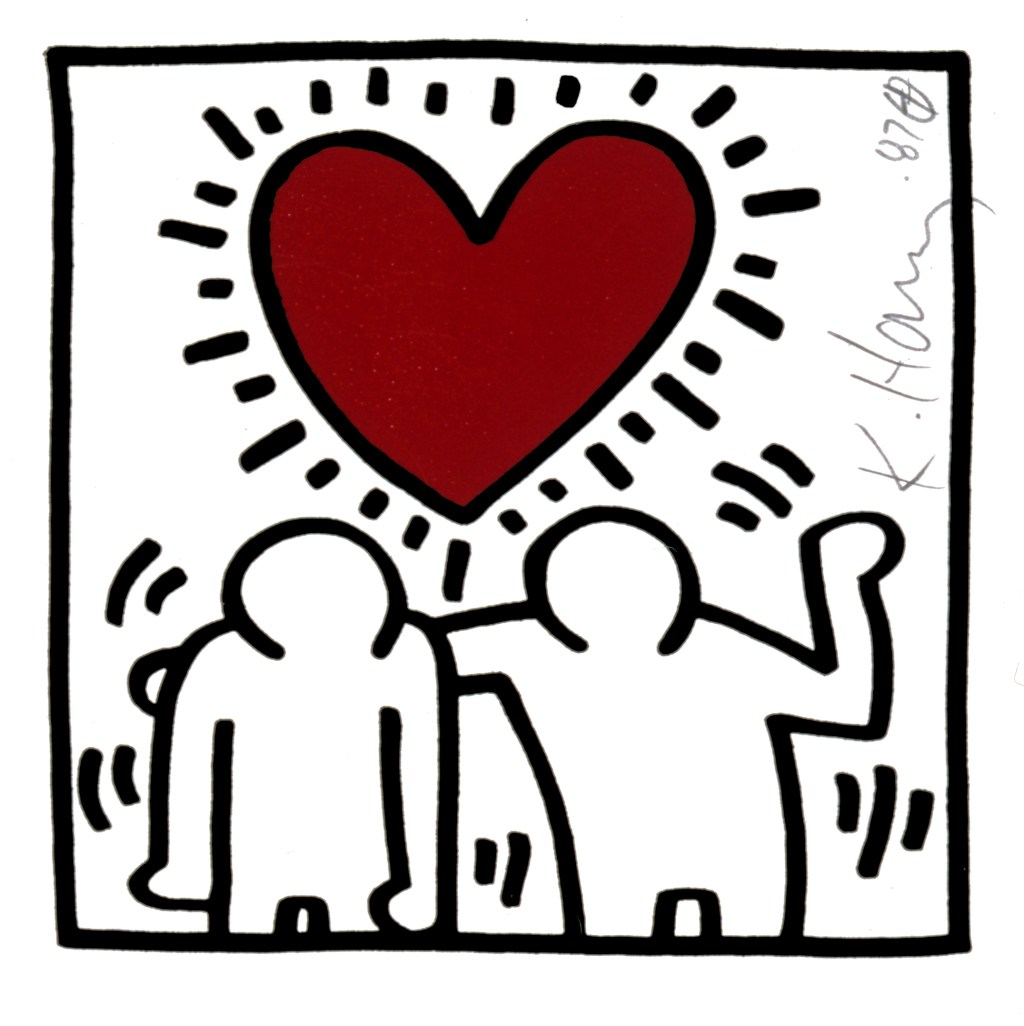
But again and again, the lovelessness in our personal lives and social/political lives hides the promise that the world could indeed be very different. Lovelessness testifies to the reality of love like wings testify to the reality of air and gills testify to the reality of water. Love is a secret music and our heart strings vibrate to it.

–Keith Haring
So it is without any exaggerated irony that bell hooks can say, “While ours is a nation wherein the vast majority of citizens are followers of religious faiths that proclaim the transformative power of love, many people feel that they do not have a clue as to how to love.” Again, bell hooks says, “Everywhere we learn that love is important, and yet we are bombarded by its failure. In the realm of the political, among the religious, in our families, and in our romantic lives, we see little indication that love informs decisions, strengthens our understanding of community, or keeps us together.” bell hooks is preaching it! “Awesomely,” she says, “our nation, like no other in the world, is a culture driven by the quest to love (it’s the theme of our movies, music, literature) even as it offers so little opportunity for us to understand love’s meaning or to know how to realize love in word and deed.”
What do you think?
It’s why bell hooks wrote All About Love. “I write of love,” she says, “to bear witness both to the danger in [the nation’s turning away from love], and to call for a return to love.” “Contemplating the practice of love in everyday life, thinking about how we love and what is needed for ours to become a culture where love’s sacred presence can be felt everywhere, I wrote this [book].”
The theme of love is also perfect for us as Unitarian Universalists, since we are in an historic time of giving newer and fresher language to the principles and values that hold us together as a religious movement. It just so happens that, in the new proposed version of Article II in the UUA Bylaws (which is where our theological identity statement resides), love is given as our central religious value. Love is at the center. To quote straight from the new proposed Article II, “The purpose of the Unitarian Universalist Association is to actively engage its members in the transformation of the world through liberating Love.” And then there is another statement which says it maybe even more strongly: “Love is the power that holds us together and is at the center of our shared values. We are accountable to one another for doing the work of living our shared values through the spiritual discipline of Love.”

–Awkward Selkie Designs (2023)
And so, the spiritual work before us, which this sermon entitled “The Search for Love in Art” kicks off and which we will engage over the next eight months, is to come to know love maybe more carefully and concretely than ever before. To correct misinformation. To develop love skills. To explore love as it impacts various aspects of our lives: parenting for love, what it means to love yourself, love and anti-oppression, love and simple living, community as a school for love, men and love, love and sex.
We’re kicking this all off with artworks which evoke some of the themes surrounding love. Let there be gratitude especially for the artworks which pull us back safely to shore when we feel like we’re drowning in despair. We heard bell hooks’ own story of this, from a day she was walking to work, and she was carrying heavy grief, but she saw the following declaration painted in bright graffiti colors: “The search for love continues even in the face of great odds.” (I couldn’t find a picture of the graffiti hooks is referring to, which is why I have no image to pair this statement with.) But whatever the graffiti looked like, it lifted her spirits every time she saw it. She says, “the affirmation of love’s possibility sprawling across the block gave me hope.”
I do have this image to share however. It’s a piece of street art, close to Ohio City where I live, and it makes me smile every time:

Let us give thanks for the reminders that we are not bereft of love, no matter how heavy the world might be feeling. “The search for love continues even in the face of great odds.”
But we seesaw back and forth, back and forth, between love and lovelessness. Like Up and Down. Like Hot and Cold. Like Yin and Yang.
The conditions that make for lovelessness are great indeed. Some have to do with internal obstacles of emotional woundedness. How we can be stuck in patterns of lovelessness so that no matter how much we want love, we keep on shooting ourselves in the foot. Part of this can be a lack of courage to take risks. Part of this can be the feeling of how love seems outside of anyone’s personal control. And so on.
Then there are the obstacles which are more about the external conditions of our lives. Abuse in the family. Toxic work environments. All sorts of patterns of oppression. Patterns of oppression which privilege male-identified people over female-identified people, or cisgender folks over transgender folks. Or the patterns of oppression which capitalistic-based consumer culture spreads over the entire world:

Then there is the cynicism towards love, preserved and passed on through popular culture. “When I travel around the nation giving lectures about ending racism and sexism,” bell hooks says, “audiences, especially young listeners, become agitated when I speak about the place of love in any movement for social justice. Indeed, all the great movements for social justice in our society have strongly emphasized a love ethic. Yet young listeners remain reluctant to embrace the idea of love as a transformative force. To them, love is for the naive, the weak, the hopelessly romantic.”

—Roy Lichtenstein, “Drowning Girl” (1963)
“Everywhere we learn that love is important, and yet we are bombarded by its failure.” Perhaps to the point that there are days we are like the person in Tip Tolan’s sculpture, entitled “Daily Prayer.”

–Tip Toland, “Prayer” (2010)
Our hearts spontaneously generate words of passionate prayer–pleading that we may know love, pleading that this world be changed for the better–but we don’t know who or what to pray to. So we pray to something. Anything. With vulnerability. With intensity. Even if just into the ears of a bird…..
Wherever you may find yourself today on the love continuum–you are feeling all the love, or you are feeling loveless, or you are somewhere in between extremes–wherever you are finding yourself today, one of the best first steps to take on the path of developing love knowledge and love skills is to learn a good definition of love. bell hooks is adamant about this. “Our confusion about what we mean when we use the word ‘love’ is the source of our difficulty in loving,” she says. She says, “Had I been given a clear definition of love earlier in my life it would not have taken me so long to become a more loving person.”
As the sermon that kicks off the entire All About Love series, this is the thing I want to leave you with today. A good definition. To oppose the unhelpful, bad ones.
Here’s a bad definition of love:
—Roy Lichtenstein, “Drowning Girl” (1963)
This is the popular definition of love as romantic feelings which come upon you and you have no control or choice in the matter. What’s portrayed here really is for the naive, the weak, the hopelessly romantic. It’s not the “liberating love” that can change the world.
Then there is this bad definition:

This definition of love allows for abusiveness in the relationship. “Often,” says bell hooks, “we hear of a man who beats his children and wife and then goes to the corner bar and passionately proclaims how much he loves them. If you talk to the wife on a good day, she may also insist he loves her, despite his violence.” bell hooks continues: “An overwhelming majority of us come from dysfunctional families in which we were taught we were not okay, where we were shamed, verbally and/or physically abused, and emotionally neglected even as we were also taught to believe that we were loved.” But here is the truth: “Love and abuse cannot coexist.”
So what is a better definition of love? What is the kind of definition that would melt away cynicism about love and be a foundation for developing real love skills?
How about this?

—Garcia Lam
Love as extending oneself in empathy for another.
Or consider this. Some of you may remember June of 2020, when Covid did not allow for the traditional downtown Pride March. So the parade took a different form that year. I was among the West Shore crowd and we rode cars through Lakewood and other neighborhoods, and I particularly liked what this car had to say.

Love comes in all colors.
And then there’s this:

—Mary Cassatt, “The Child’s Bath” (1893)
Huburt Humphrey once said, “The moral test of government is how that government treats those who are in the dawn of life, the children; those who are in the twilight of life, the elderly; and those who are in the shadows of life, the sick, the needy and the handicapped.”
I would submit that this moral test applies beyond government to all our dealings, whether public or private, whether large-scale or small-scale.
And then there’s this:

—Elizabeth Peyton, “Barack and Michelle”
This one is based on a photograph of the Obamas on the night of the 2008 presidential inauguration, when Barack became America’s first Black president. A historic, intensely moving moment. And both Barack and Michelle worked for it. Their love is about making the same choice every moment, every day: to care for each other through thick and thin. Just look at the tonal gradations of this piece. The roughness. As Washington Post art critic Sebastian Smee says, “What [artist Elizabeth Payton] conveys … is that beneath the celebrity, the power, the charisma — beneath even the illusion that we know public figures and in some sense feel we own them, even when the cameras are flashing and their images are being beamed live around the whole world — people remain what they are: fragile, tender, fraying, intense.” Yes, and in the midst of all that is “fragile, tender, fraying, intense” is the force of love to keep the relationship together and to keep the two people involved pulling together and not apart. Building each other up and not tearing each other down.
Let’s summarize. What is love? bell hooks says it is best defined as “the will to extend one’s self for the purpose of nurturing one’s own or another’s spiritual growth.”
Say it with me:
The will
To extend one’s self
For the purpose of nurturing
One’s own or another’s
Spiritual growth.
Wherever you happen to be on the love spectrum this morning–you are feeling all the love, or you are feeling loveless, or you are somewhere in between extremes–let this thought sink in today and beyond.
The will
To extend one’s self
For the purpose of nurturing
One’s own or another’s
Spiritual growth.
–Keith Haring
Let the path into All About Love–begin!
 Spiritflow
Leave a comment