In my home growing up, we had a glass-top coffee table in the living room, and tucked away underneath was our family Bible. I was five years old when I opened it up, out of curiosity. What was this huge book doing in the middle of the living room, in a place of pride (although I never saw anyone ever read it)?
More to the point: would there be pictures?
And there were pictures. This Bible happened to feature illustrations by the great French artist and engraver Gustave Dore. I can still feel my sense of wonder from all those years ago. The Creation of Light. The Ten Commandments. Scenes from Jesus’ ministry. But especially: the Book of Revelation. That book, which is all about the Apocalypse. The End of the World.
Revelation Chapter 6 verse 8: “And I looked, and behold a pale horse: and his name that sat on him was Death, and Hell followed with him. And power was given unto them over the fourth part of the earth, to kill with sword, and with hunger, and with death, and with the beasts of the earth.”

War between evil and good breaks out, and not just on earth. In heaven too. Revelation Chapter 12 verses 7 and 8: “Then war broke out in heaven. Michael and his angels fought against the dragon, and the dragon and his angels fought back. But the dragon was not strong enough, and they lost their place in heaven.”

The dragon loses, and, finally, the end of the world comes with the Last Judgment. The cosmic battle between good and evil comes to a close, and God sets to right all that has been wronged.
Pictures like this triggered something in me. I was only five, but I got what the pictures were saying. Vast and unthinkable forces are at work in this world. Calamity can come. Calamity need not be the last word, though–total positive transformation can take place. As writer Richard Bach once put it, “What the caterpillar calls the end of the world, the master calls a butterfly.”
I was so carried away by this scenario of the Apocalypse that, one day while I was out playing, I looked up at the sky, and it was a sky full of clouds similar to the Gustave Dore illustration entitled “The Last Judgment” in which there are tiers of clouds, and God and Jesus are at the top, and angels fly down from above, and great rivers of souls stream upwards to heaven or downwards to hell.

Those clouds in my real-world, Peace River sky–somehow they reminded me of the clouds in the Gustav Dore picture. And then for an instant, impossibly, I saw the two images become one. The Last Judgment, happening right now! Angels flying and souls streaming and God and Jesus above it all—RIGHT NOW in my Peace River, Alberta sky! All there!
But then I blinked, and in that exact moment, it all went away.
Nothing had happened, and everything.
Ever since, I’ve wondered about that moment. Overheated imagination? Hallucination? Nothing remotely like it has ever happened since (well, I DID hallucinate that the Browns would go all the way to the Super Bowl this year). But I come away from it all with a sincere appreciation of something that the comparative mythologist Joseph Campbell once said: “Mythology is no toy for children. Nor is it a matter of archaic, merely scholarly concern, of no moment to modern [people] of action. For its symbols … touch and release the deepest centers of motivation, moving literate and illiterate alike, moving mobs, moving civilizations.” “All the gods,” says Joseph Campbell, “all the heavens, all the hells, are within you”—and my first lesson in this came from a family Bible, tucked away underneath a glass-top coffee table, when I was just five.
But it just won’t stay tucked away. That’s the point. The End of the World myth of the Apocalypse is not a myth in the sense of being false but rather in the sense of expressing how humans are hardwired to experience the world. Humans are hardwired to yearn for total transformation. All the terror of the caterpillar is in that, and so is all the triumph of the butterfly.

The myth of this is in our spiritual DNA. That’s why it’s triggered again and again in so many ways.
So: how can we re-acquaint ourselves with this myth that is so very much alive within us? And, when it gets triggered, how can we best respond?
Let’s start with the observation that the myth of the Apocalypse is found worldwide. It’s definitely not restricted to the Christian Bible. In the Buddhist tradition, for example, we have a version of the End Times that envisions people as acting in increasingly bad ways. According to the Cakkavati sutta, there was a golden age in which people were fully wise and pure. Lifespans in the golden age could run as long as 80,000 years! But the golden age gave way to successively less wise and pure generations, until we are where we are now, when people live only up to 80+ years or so. And it will only get worse. The Cakkavati sutta predicts that humanity will degenerate even further–civilization will utterly disappear–and violence will reign. Life will be “solitary, poor, nasty, brutish, and short” (Thomas Hobbes). A few people will escape this carnage, though, and when the slaughter is over, they will come out of hiding and resolve to reverse the course of things. They will make a new start for humanity and slowly recover the wisdom and ethics that had been lost over the ages. The story ends with human life spans gradually increasing until they return to what they had once been: 80,000 years long.
This is Buddhism’s own End Time myth. Did you know that Buddhism had one? Isn’t that something? Just as with the Christian myth: all the terror of the caterpillar; all the triumph of the butterfly. The main difference is how the Buddhist myth sees time as cyclical. Humanity hits rock bottom, but then comes renewal, and a new stage begins. By contrast, in the Christian End Time myth, time is like an arrow. One way, one direction. Clear beginning, clear end.
We also see time’s arrow in a much older tradition, called Zoroastrianism, which scholars say is the original source of the ideas found in Christian scripture.

According to Zoroastrianism, the world is a battleground between the Army of Light and the Army of Darkness. No one can stay neutral–there is no Switzerland possible in this story. Everyone must choose a side. At times, things are going to look very bad for the Army of Light. It will seem that they are about to lose big time. But don’t despair, and don’t flee to join the other side. There will be one final battle in the end, and the Army of Light will defeat the Army of Darkness for good, for all time. Those who chose to fight for the Army of Light will have their reward. Those who chose to fight for the Army of Darkness will have their punishment, for all eternity.
That is how everything ends. End of story.
Now, let’s pause here for a moment. What we’re seeing is how world mythology affirms a yearning for total transformation in all ages, deep in every human heart. Even as the stories telling it are many, and in some ways different, the basic underlying theme is the same, and universal. Whether time is cyclic or time is an arrow; whatever the heavens and hells look like, or the gods and monsters involved: the underlying theme is just as Dr. King once said: “There is something in the soul that cries out for freedom.” There is something in the soul that can’t help but express this yearning in big dramatic symbols.
Perhaps this explains the compulsion to pronounce new end time prophecies and predictions, even though every prediction from the past has been proven wrong, and every time, the world has refused to end. Every time. As a character in Jeanette Winterson’s novel The Stone Gods says, “History is not a suicide note — it is a record of our survival.”
And yet, undaunted, new prophets of doom arise. Just more evidence that what’s driving things is not so much factual as mythic.
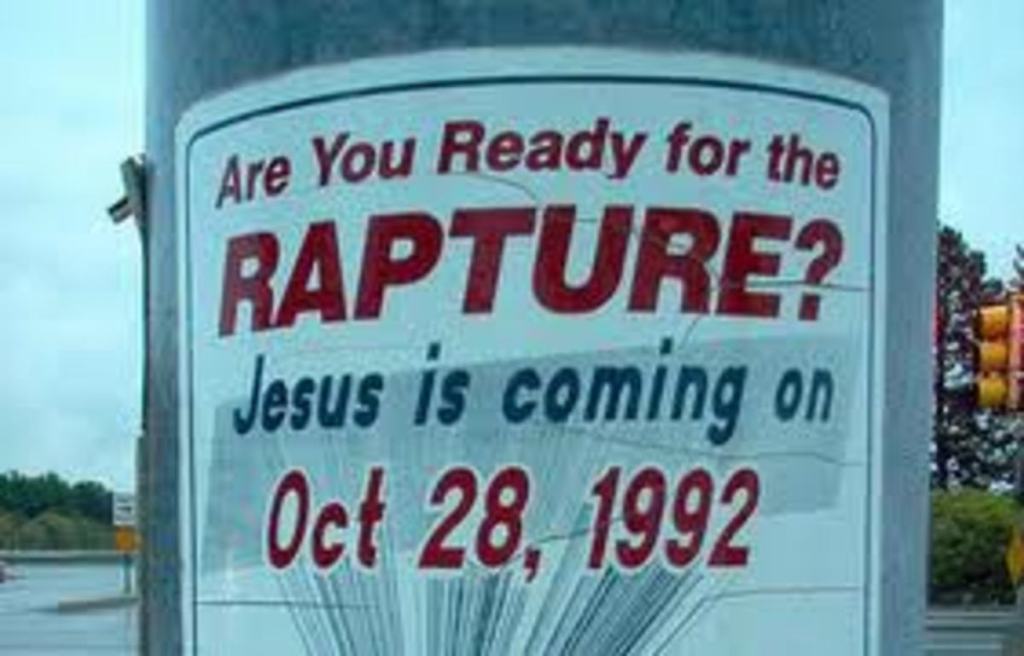
Let’s run through a brief history of this. The history of Christianity is littered with people trying to crack the code of the book of Revelation and merge their historical moment into that book’s storyline. They make solemn predictions, and they are never right. The Apostle Paul–the guy who just happened to write most of the New Testament–told fellow Christians to get ready. This was around 49CE. The End was going to happen soon. But it didn’t. Decades later, someone authoritative wrote in Paul’s name so as to do damage control. In this later Biblical book (entitled 2 Thessalonians) the fake Paul wrote, “Now concerning the coming of our Lord Jesus Christ and our assembling to meet him, we beg you, brethren, not to be quickly shaken in mind or excited, either by spirit or by word, or by letter purporting to be from us, to the effect that the day of the Lord has come.” That’s what fake Paul said–doing damage control in the wake of the real Paul’s wrong predictions.
But the predictions kept coming. The gods and monsters within won’t be denied. In 1553, Michael Stifel, a German mathematician, mounted the pulpit in Martin Luther’s church to announce his calculation that the end times would begin promptly at 8am on October 19, 1533. Two hundred years later, English preacher George Bell mounted his pulpit to announce his calculation that Jesus Christ would descend from heaven to earth on February 28, 1763. Less than one hundred years later, American William Miller (founder of the 7th Day Adventists) announced that The End would take place on October 22, 1844.

This time, this time, all would be different. Of course.
And it’s not just religious folks doing the predicting. Secular folks do it too. So, for example, take the British statesman Winston Churchill in 1923. In the shadow of what then was called the War to End All Wars but what we know today as World War I, Churchill wrote an essay entitled “Shall We Commit Suicide?”

“Certain somber facts emerge solid, inexorable, like the shapes of mountains from drifting mist,” Churchill wrote. “Mankind has never been in this position before. Without having improved appreciably in virtue or enjoying wiser guidance, it has got into its hands for the first time the tools by which it can unfailingly accomplish its own extermination.” Churchill here was predicting the invention of war machines that could soon wipe out all human life on Earth. “Might not a bomb no bigger than an orange,” he said, “be found to possess a secret power to destroy a whole block of buildings–nay, to concentrate the force of a thousand tons of cordite and blast a township at a stroke?” Churchill wrote this in 1923: decades before the invention of the Atomic Bomb.
Incredible.
Today, pessimism about humanity’s future is just as dire. Just as deep. Tyler Austin Harper, an assistant professor of environmental studies at Bates College, says that “It’s visible everywhere in what has come to be known as the polycrisis.” (Yup, you heard that right. “Crisis” is just not robust enough to describe these days. Thus: “polycrisis.”) Harper goes on to explain: “Climate anxiety … is driving new fields in psychology, experimental therapies and debates about what a recent New Yorker article called ‘the morality of having kids in a burning, drowning world.’ Our public health infrastructure groans under the weight of a lingering pandemic while we are told to expect worse contagions to come. The near coup at OpenAI, which resulted at least in part from a dispute about whether artificial intelligence could soon threaten humanity with extinction, is only the latest example of our ballooning angst about technology overtaking us. Meanwhile, some experts are warning of imminent population collapse. Elon Musk, who donated $10 million to researchers studying fertility and population decline, called it “a much bigger risk to civilization than global warming.” Politicians on both sides of the aisle speak openly about the possibility that conflicts in Ukraine and the Middle East could spark World War III.”
That’s Tyler Austin Harper. And let me add yet another layer to the “polycrisis.” Do you know why so many evangelical Christians love Donald Trump, despite the fact that he is as unChristian as you can get? It’s because they see him as a serious player in the war between the Army of Light and the Army of Darkness. Their reading of the Bible teaches them that, in the past, God gave leadership authority to people of shady morals. God used their evil to serve good. So God has given leadership authority to Donald Trump now. “God,” says a real video posted recently on Truth Social, “had to have someone willing to go into the den of vipers. Call out the fake news for their tongues as sharp as a serpent’s. The poison of vipers is on their lips. So God made Trump.” And Trump will lead the fight against the Army of Darkness.
They sincerely believe that if Trump loses, the country will be utterly destroyed.
This is the apocalypticism of the Right–but the Left has its apocalypticism as well, with its climate anxiety and other terrors (including how the Left sincerely believes that if Trump wins the election, the country will be utterly destroyed.)
Have I made my point yet? That the myth of the End Times is alive and well–and this on all political sides? And, that you don’t even have to identify as religious for that ancient yet endlessly compelling story from Zoroastrianism to be structuring how you’re thinking about things? Army of Light vs. Army of Darkness and all that?
So let’s now turn to the final question before us: when the myth of the End Times hardwired within us gets triggered, and like Winston Churchill we are writing our own version of his essay “Shall We Commit Suicide?”—when we’re caught up in that, how can we press pause on our desperation and find a more constructive way of thinking and acting?
First of all, those who see themselves as too enlightened to get caught up in doomsday fantasies must be more humble. Today, the same people who scoff at True Believers might find themselves indulging in books like Cormac McCarthy’s The Road, or Stephen King’s The Stand. In one, an unknown disaster has wiped out most of humanity, and father and son journey through the wastelands of a dying world. In another, a plague sweeps through America killing almost everyone, leaving only a handful of survivors. Books like these and so many others, movies, television shows, on and on—all have the power to touch us the way they do only because the myth lives within and primes us to respond the way we do. The Day After, a TV show that first aired on November 20, 1983, blew people away, religious and nonreligious alike:

What unites us, whether we are True Believer or not, is our common humanity. We all are capable of feeling the horror of ultimate endings—and we all long for new beginnings too.
Second, we must never forget that we are dealing with a myth, and that we must not literalize it. It’s not about the literal, objective world around us. It’s about what it’s like to be human and to face our fears. It’s the spiritual struggle of you and me, to be beings who are stuck in caterpillar-like structures that are limiting, and we know that freedom lies in becoming butterflies–but oh! the shock of getting from here to there! Oh, the risks! And oh! the hard work…..
But when you see the myth of the End of the World as a literal roadmap, you end up like the Millerites, who utterly checked out on their lives. What they did was sell everything they had and then, on that fateful day of October 22, 1844, they donned white ascension gowns, they climbed up to their rooftops, and they waited there for Jesus to take them home.

Day passed, and then night, and on that new day of October 23, 1844, in the wake of Jesus not coming to take them home, they had to face facts: they would have to return to the regular world of here and now–and what was that going to look like, since now they owned nothing?
Even worse is when the imagery of Army of Light vs. Army of Darkness stirs up such powerful emotions that you enter into that cosmic battle frame of mind. You will see yourself as fighting for the Army of Light (of course!), and your conflict with the opposition will cease to be mere conflict and will become total combat, total warfare, total jihad against the Other with whom you disagree—for you see that Other as inhuman, as part of the Army of Darkness, and there can be no compromise, no quarter. For example, back on February 22, Donald Trump spoke at the National Religious Broadcasters convention in Nashville, and it was all about the battle for America’s future, and he explicitly identified the enemy as liberals, who (he said) are hell-bent on persecuting Christians (as if you can’t be both liberal and Christian). Liberals vs. Christians, Christians vs. liberals. Two warring armies.
Sometimes, however, the enemy need not be so very different from oneself. Some liberal activists can seek to assert “power over” other fellow liberal activists because, in their opinion, they’re better: purer, more aware, more virtuous. So, in the end, we have liberal activists demonizing other liberal activists. We have power grabs, ego rivalries. The differences between them may be, in truth, negligible, tiny, a tempest in a teapot. But that doesn’t stop the proverbial circular firing squad from forming. Which also means that all the good energy that could be put into doing real work gets squandered by this internal strife and people end up disillusioned. It happens in UU churches all the time. It has happened in this church. Church at times has become the obstacle rather than the vehicle for positive change. I know people who have left West Shore for exactly this reason. The Army of Light vs. Army of Darkness logic exploding in our faces.
It’s distressing. It’s terrible.
When the End Times myth possesses us, we either check out of our lives, or we enlist as a soldier in the Army of Light and demonize those with whom we disagree–and it only serves to grease the skids to calamity. Far better to recognize, with humility, that the End Times myth lives within us and no one is so enlightened that they can’t be triggered. But when it is triggered, we must reframe the meaning of that energy, we must remember what Dr. King said, that “There is something in the soul that cries out for freedom,” and we must respond to that cry with redoubled efforts in this world. We refuse to check out of our lives, give up and indulge in apathy. And, we refuse to go the opposite extreme and divide the world into the Army of Light and the Army of Darkness (no matter how deliciously simplifying that might feel). We refuse either extreme. What we do instead is show up. We show up with others and work together. We don’t let perfection be the enemy of progress. And then we step back and let go of results.
Finally, the third thing. The third thing to do when the End of the World myth has been triggered in us. It’s this: we never forget how generations past thought that they were to be the last. Whatever the challenges of their day, they saw the ugliness and they saw the threats and they concluded: We are in the Last Days. This is it. This is the moment. Ours is just not unique among all the generations that came before. We need to stop indulging ourselves by thinking that our forefathers and foremothers never felt the oncoming rush of ultimate disaster and ruin as we do today. Over and over again, they felt this oncoming rush. Yet the human species has persisted, every time.
Again, it’s what the character in Jeanette Winterson’s novel The Stone Gods says: “History is not a suicide note — it is a record of our survival.”
So let’s stop burdening the challenges of our time with the additional weight of End of the World fears. Let’s stop freaking ourselves out!
Remember what I said today, come the Presidential election this Nov. 5.
Remember!
Let’s stay focused.
Let’s stay patient.
Stay calm, and carry on.
Keep bending the arc of the universe towards justice.
Life is a marathon, not a sprint!

 Spiritflow
Leave a comment