
Someone asks, “What is Unitarian Universalism?” “What do Unitarian Universalists believe?”
What do you do?
People are going to ask. It’s inevitable, in this world in which folks are generally not familiar with what those two very long words strung together, “Unitarian Universalism,” mean.
I think elevator speeches (brief statements between 30 seconds and 2 minutes) are valuable, and I encourage you to craft one for yourself, if you’ve not already.
But as for this sermon: not an elevator speech. The goal right now is not an instant download, but something more developed, something deeper.
This is a sermon about the seven beautiful, essential ideas which animate our faith tradition currently, in this day and age. Each one, shortened, could suggest a great elevator speech, so keep that in mind if you’re still working on yours.
But for us right now: an adventure of ideas. An adventure of beliefs.

The seven essential Unitarian Universalist beliefs.
Essential #1: The basic spiritual problem is ignorance.
Other religious groups, now, might envision the basic spiritual problem as a free-roaming supernatural entity called Satan, the archetypal classroom bully. These same folks might also point the finger at something called Original Sin, which is a flaw permanently established in the human heart, rendering people helplessly blind to the right and the good. Original Sin is analogous to the situation in which your car’s GPS system is broken. It keeps on telling you where to go, but the directions are always wrong.
The solution can only be the intervention of some supernatural agency. Christ’s sacrificial death. The “Blood of the Lamb.”
This is not how Unitarian Universalists see things. There is indeed a basic spiritual problem to acknowledge and address, but it doesn’t stem from a supernatural evil entity or from a fundamental brokenness in the human heart. It stems, rather ironically, from fundamental goodness.
The UU conviction is this: people always aim to act rightly, as best as they understand what “acting rightly” means in whatever situation they happen to find themselves. It’s an ancient belief, held by thinkers like the Greek philosopher Socrates. “No person does evil knowingly” is the way he put it. Human motivation is always fundamentally positive.
The problem is that a person’s understanding of what the right thing to do is, in the moment of their decision and action, can be narrow, incomplete, or just plain wrong. It’s like the child who sees a hot burner on the stove, who sees its redness, and he is curious, he wants nothing more than to touch it…. The result of this child’s ignorance will be immediate. The feedback will be horrible pain. The underlying intention was nothing bad. But understanding was lacking, and dreadfully so.

But the ignorance of which I speak–the basic spiritual problem we must face–is not simply the failure of individuals. No person is self-made. Ignorance has a collective dimension, and people as they are growing up are socialized into seeing the world through perspectives that can be enormously, tragically flawed. To the person, how they’ve been taught to see the world will feel natural and normal. But if they were able to step out of their shoes and step back, get a bigger perspective, they’d realize they were caught in a trap and didn’t know it.
Let me illustrate with the story about the woman who would always cut off both ends of the roast she was cooking. One day her daughter wondered out loud about why her mom did this. Her mom replied, “I’m not sure, actually. I learned this way from my mom. It’s what she always did.” The daughter, very curious now, reached out to her grandmother. “Grandma, when mom makes a roast, she cuts off both ends. She says that’s how you always did it. But why?” Her grandma’s reply echoed her mother’s: “Because it was how I was taught!” Luckily, the daughter’s great-grandmother was still alive and well, and so she reached out to her. Hearing the question, the great-grandmother laughed out loud. “I cut off both ends of the roast because it was always bigger than the pan I had back then. I had to cut them off to make the roast fit!”
That’s the story, and it always makes me laugh. But then I think of the real forces of collective ignorance that get passed down (unthinkingly!) from generation to generation, which have caused endless misery: forces of tribalism, forces of racism, forces of sexism, forces of militarism, forces of greed. The people who benefit from such forces think that all will be well. But all will not be well. The gold they get from such evils is but fool’s gold. Everyone suffers.

The basic spiritual problem is ignorance. There is no need to invoke supernatural forces to explain our human predicament, or to invoke some fundamental brokenness of the human heart.
Which leads to…..
UU Essential #2: The solution to spiritual ignorance is found in many sources of wisdom, which are everywhere and easily available.
Other religious groups like to paint a picture of scarcity. The wisdom that liberates, the truth that sets us free, comes (they say) from only one historical person, only one historical tribe, only one historical book.
But that’s not UU.
Ralph Waldo Emerson, a Unitarian from the 19th century, got into serious trouble one day in 1838 when he addressed that year’s graduating class of Harvard Divinity School. He spoke very bluntly about this problem of spiritual scarcity. His particular target was the traditional Christian idea that Jesus is God. All that God is, so the idea goes, is tied up in Jesus. Jesus is God.
But Emerson argued that this is nothing but spiritual idolatry. Not only must it invalidate all other sources of wisdom, it also reinforces a person’s ignorance about themselves. The fact is, said Emerson, all people are born with divine potentials, and the purpose of life is to learn how to develop and express them, to use them to bless Creation. There is an Inner Light in you and me, and it is always already whispering insight and healing into our ears, if only we could hear. But we will be distracted from hearing if the only one who gets to be divine is Jesus. It is far more rational, and far better, concluded Emerson, for people to see Jesus as only an inspired teacher. Jesus is a shining example of a human being who fully actualized his divine potentials for living. So let us learn from him. And not just from him. Let us learn from the example of women and men from all countries and in all times, who have shown what sainthood and saviorhood truly look like.
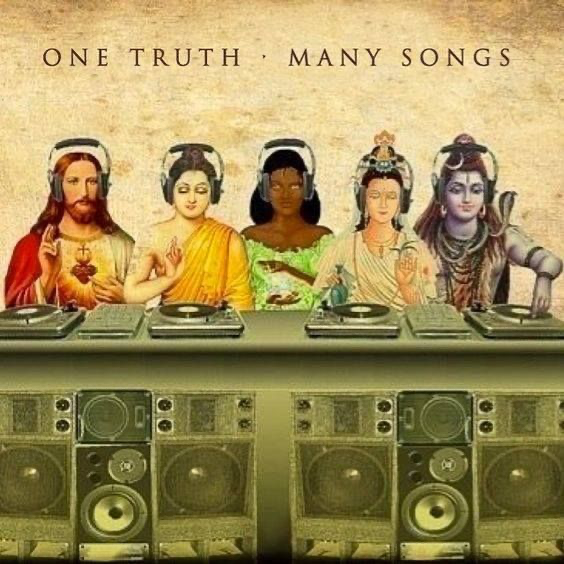
In 1838, this was not a popular opinion. At all. It’s not popular today. But it’s what UUs believe. There is no scarcity of spiritual truth. Transforming wisdom comes from the Inner Light within us. It also surrounds us. It comes from the best that’s available in all the world’s historical religious traditions. It comes from artists and writers and poets. It comes from science. It can also be sensed directly in nature and in the cycles of the seasons, the yin and yang of day and night and life and death. It was Shakespeare who once spoke of “sermons in stones.” Absolutely. Absolutely.
For UU’s, if there is any issue with this superabundance of available wisdom, it’s this: when you have an entire Blue Boat Home ocean to drink from, where do you begin? What parts do you drink from?
The answer, inevitably, depends upon what particular struggles you find yourself facing. Into what small corner of the Universe has God planted you, and given that context, what is needed from you? Your life comes with certain limiting factors, and that’s what guides you as you draw from the Ocean of available spiritual truth.
So now we turn to…
UU Essential #3: The individual must be proactive in claiming their spiritual potentials.
Now, for a tradition like Buddhism which speaks of the all-importance of “right effort” in religion, this essential is a given.
Yet it was not so in Christianity. Up until the 1500s, for example, the practice of infant baptism was unquestioned. But how can there be “right effort” from infants who, by definition, are not “of age” and are incapable of making spiritual choices–nevermind choices which come from a place of deep integrity?
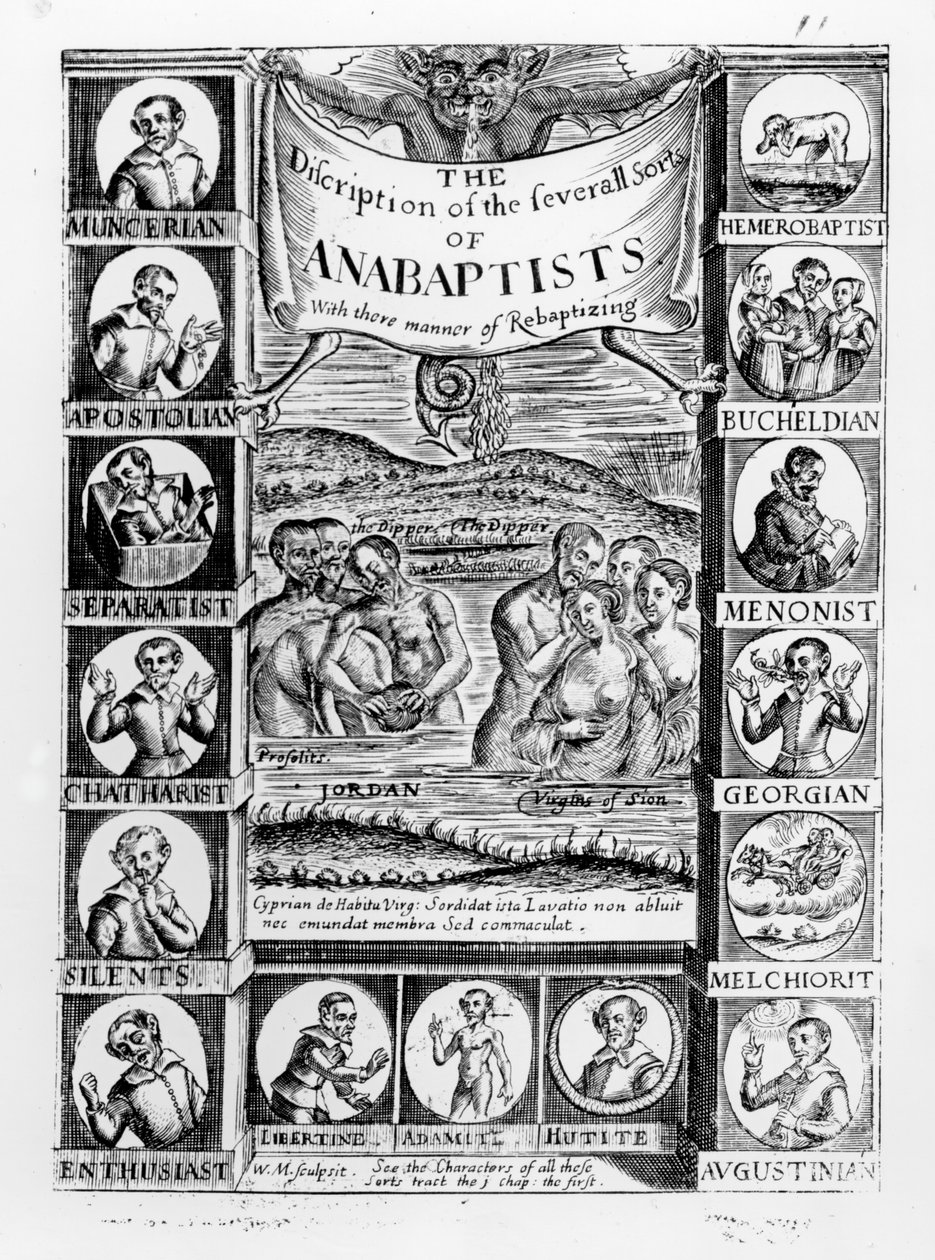
The Christian troublemakers who balked at infant baptism were called “anabaptists.” Anabaptism was a reform movement beginning in the 1500s which argued that it is wrong for anyone unable to consciously choose their faith to be baptized. Infant baptism should stop and baptism should be available only to people of sufficient age and maturity who know what they are committing themselves to. If you were baptized as a baby, you need to be rebaptized for the baptism to truly take.
Fast forward from those days to now, and the problem of right effort has been utterly transformed. It’s no longer about opposing wrong-headed church traditions. For everyone–however you identify yourself religiously–the problem of right effort is about how to unplug from the superficial but very intense rush and gush of daily life. American life seems calculated to keep people busy–entangled in the immediate–like a spider caught in a web. It’s one reason why we Unitarian Universalists feel the need for “elevator speeches” to begin with–because if you aren’t quick enough, people stop listening.

American life rewards worldly accomplishment. American life aims people towards professional and financial success. Even children are aimed this way, as their parents encourage them to stay busy excelling in sports or developing other skills so that, years later, their resumes might stand out to college admission committees, enabling them to get into the school of their dreams. But they’re on the treadmill by the time they’re five or so! It happens at the expense of free time, boredom time, daydreaming time which, in their own way, are tremendously nurturing and open the door to the spiritual. In this way, kids and adults navigate daily schedules that are simply exhausting. There’s not even time to meet your next-door neighbor or go to church on Sunday. How to do that, when your life already feels like a stretched-out rubber band ready to snap?
It takes sincere effort to swim against such tides. It’s a defensive type of effort. Add to this a need for even more effort–but of a positive, proactive, creative type. This more positive effort is all about taking steps to claim the spiritual inheritance that one has been given–by the Universe, by God or Goddess, by a Source that is larger than us.
Consider an analogy. This spiritual inheritance every person is born with: it’s like being born with musical talent. At first, the talent is pure potential. But then comes the need to bring it down to earth. So you start by trying instrument after instrument to get a sense of which one feels like the best fit. Say you eventually decide on the violin. Beautiful. But have you ever heard a beginner playing a violin? The ear-splitting racket that results? The road to learning how to play a violin is long and hard. The potential is there, but it must be worked out. For the person who feels entitled to instant success–which American culture plants in all our hearts–there will only be frustration. Don’t fall for that trap. You’ve got to put in the sweat equity. And no one can do it for you. You yourself must step up. There must be “right effort” from you in the spiritual venture.
Do you hear all the times I’ve said the word “must”? I’m not trying to be a killjoy. It’s just that there’s nothing passive about the spiritual yearning in us for ultimacy. It’s not inert. From Day 1, the yearning is there. Children who may not be able to intellectually understand a religious creed may nevertheless be outdoors in the midst of trees and sky and feel a mystical unity with all things. They feel that vastness and it rings a spiritual chord within. It happens to children all the time. Often enough, though, the parent tells them to stop being foolish, and so the natural mystical sensibility gets cut off. The child learns to disown it so that they can remain pleasing to the parent, upon whom the child’s physical wellbeing depends.
Yet the mystical sensibility doesn’t disappear. It continues to exist, but maybe it gets felt as anxiety instead. Maybe it haunts the soul, like a ghost. Often enough, what happens is that it is projected upon religious or political leaders who promise fake salvation of one kind or another. So well-intentioned people get on board, and it feels spiritually fulfilling to them, it feels like home. Yet from the outside looking in, what you see is a Christian Nationalist. What you see is someone who is ready to kill for God. You see someone whose thirst for infinity has been co-opted by social forces of tribalism, violence, and greed.
What I’m saying is that the individual must be proactive in developing themselves spiritually because, otherwise, the spiritual talent we are born with becomes poison. If the spiritual instinct we are all born with is not properly educated, it can create terrible problems. What is supposed to be best about us becomes worst.
But in all this talk about the critical need for individual proactivity in religion, we must not forget the equally critical need for community, which leads to
UU Essential #4: The individual’s spiritual potentials require an empathetic and nurturing environment to be developed.
No person is self-created. I’ve said it before and I’ll say it again. Do-it-yourself-ism in spirituality is foolishness. Nature needs nurture in the form of other people: caregivers, teachers, mentors, communities like this one.

Remember the child I mentioned a moment ago, who had a mystical experience in nature and the parent shut them down?
But the individual, in pursuit of expressing their unique spiritual design, can be shut down by so many other kinds of environments.
If there is no separation of church and state, then people will feel compelled, upon fear of punishment, to adopt a certain religious stance. But it will be a false spiritual identity that blocks the true one of their hearts.
Furthermore, if there is no freedom of the pulpit and freedom of the pew (meaning that the preacher is forced to preach the party line and the folks in the pew are obligated to swallow whatever the preacher says), again, the result is a false spiritual identity that covers up the true.
This is why, from Unitarian Universalism’s institutional beginnings in the 1500s, we stood for the separation of church and state, together with freedom of the pulpit and freedom of the pew.
It’s also why UUism’s oldest remaining churches exist in Transylvania, which is currently the northern region of the East European country of Romania. Our ancestors, who affirmed freedom of choice in religion, were murdered right and left. Left and right. For various reasons, the only place in Europe that proved safe for UUism’s ancestors was Transylvania.
I’ll be the first to crack vampire jokes, upon hearing that the oldest existing UU churches are in Transylvania. But don’t forget the sobering story that lies beneath. Very sobering indeed.
Again and again, the individual needs a safe harbor which supports them in their process of spiritual unfoldment. That, right there, is the purpose of the UU church. The church’s program of worship, music, and the arts is to inspire a person emotionally and intellectually to love the idea of spiritual growth and to commit themselves to it. Religious education programs are meant to expose a person to what is best in literature, the arts, science, and also the historical religions. It does this in concert with schools, libraries, museums, arts institutions, universities, and so on. Then there is participation in the democratic dimensions of congregational life (like volunteerism, or voting, or financial giving)–all of which strengthen a person’s sense of belonging to community and is an antidote to loneliness as well as the delusion of do-it-yourselfism. And then you have participation in special groups and workshops which are more finely-tuned to a person’s interests and spiritual style and are key to helping them grow into their uniqueness.
The Renaissance artist Michelangelo once said something about the art of sculpture which has always struck me as true to the art of the UU church. Michelangelo said, “The sculpture is already complete within the marble block, before I start my work. It is already there, I just have to chisel away the superfluous material.” Similarly, each individual comes with a spiritual design already implanted within them, and the job of the UU church is to chisel away at whatever covers it up, so that it can be freed.
That’s a UU understanding of the purpose of church.
But with all this emphasis on spiritual individuality, I hasten to add the next UU Essential:
UU Essential #5: There are limits to individual expression.
When belief (of any kind) leads to abusive behavior, either self-imposed or directed towards another, it must be constrained. Abusive behavior is when
(1) you take something from another person without their informed, freely-given consent;
(2) or, you spread gossip and falsehood about another person and thereby damage their public reputation–you just assume they’re guilty without even trying to be fair
This is abusive….
(3) Or, through verbal or physical violence, you bully others, you rob others of their sense of safety and dignity;
(4) or, through your words and actions, you reinforce prejudicial stereotypes, you reinforce systemic oppression;
This is abusive. And we could go on, counting all the ways of abusiveness.
But the point is: this is not acceptable. Such forms of personal expression are not acceptable. There are limits.
In a UU church context, we define these healthy boundary limits through what we call Covenants. A Covenant is formed through conversations about what people need for their community to be life-affirming and of positive service to the expression of the Soul.
Here at West Shore, one very brief Covenantal statement is painted in big letters above Baker Hall. It says “We need not think alike to love alike.”
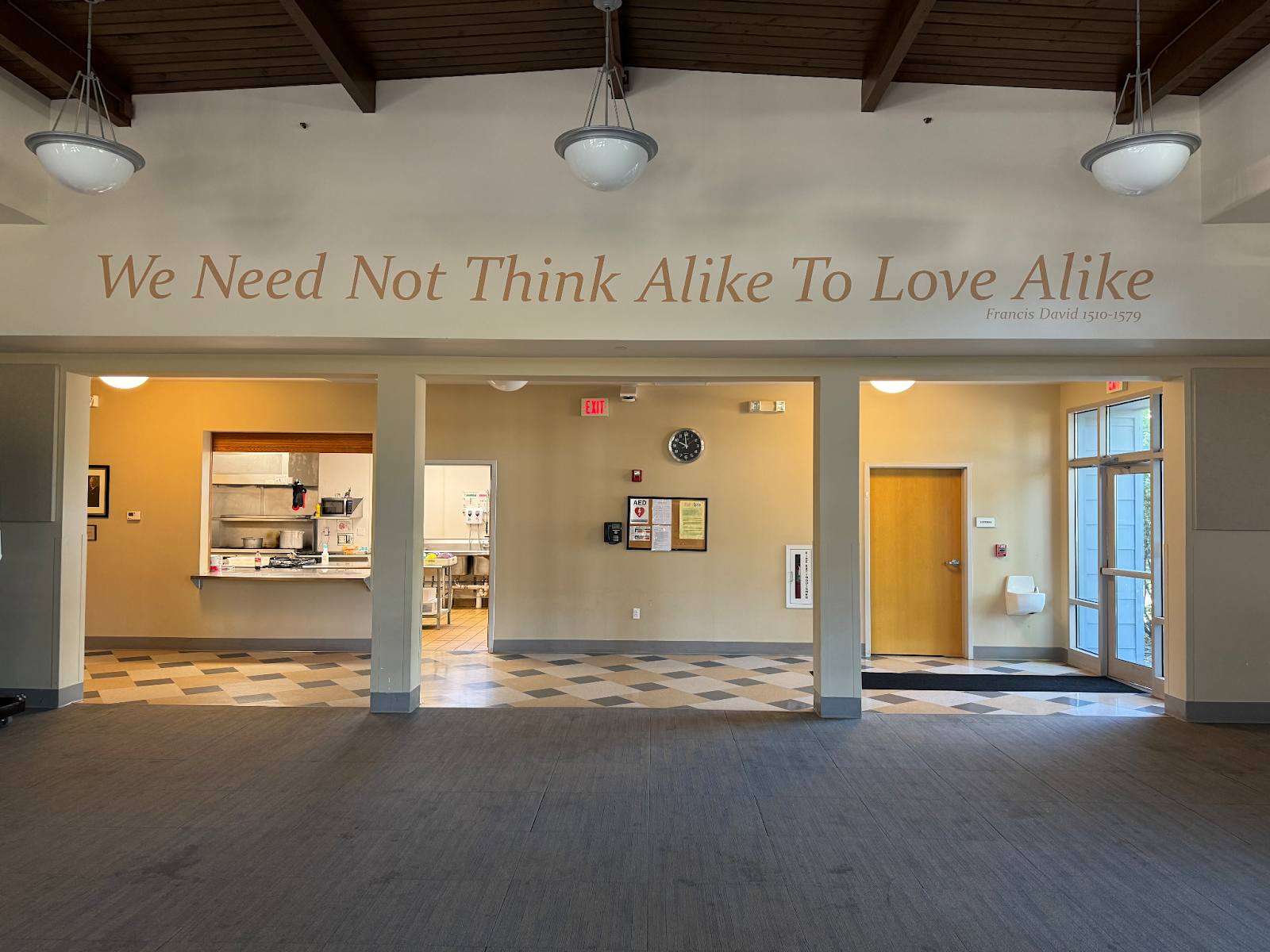
That is typically UU. We give public and explicit permission for people to embrace freedom of choice in religion. You can believe in Jesus or not believe. You can read the Bible or read The New York Times or both or neither. You can be a Buddhist UU, a Taoist UU, and Atheist UU, or even a Buddhist-Taoist-Atheist UU with a sprinkling of Paganism on top. You can! But what you are not allowed to do is pretend that your spiritual liberty gives you a pass to be a bully towards others. Nope. No way.
Ok, we are almost there. The essentials of UU belief. One, two, three, four, five, and now….
UU Essential #6: Growth in spirituality is in the direction of an expanded sense of self.
Notice something about yourself. At times, you and I can be caught up in what I want to call the “ordinary inner conversation” which is an immersion in one’s sensations, emotions, and thoughts. The course of this can slowly meander through discomfort, disappointment, boredom, frustration, anger, sadness, regret, and so on. Other times it fixates on a worrisome thought, or a memory of being hurt. And so on.
This can all be tied to the social identities that one takes on as a member of some culture. Your gender (and the privileges or harms that come with that), or your race, or your age, or your ability, and on and on.
When a person is consumed by the “ordinary inner conversation” and exists at such a level, they are sleepwalking through life. Life, for them, is fundamentally ego-centered.
But deep within us–just as musical talent is given to some people and it resides deep within–there is a yearning to be larger than the cultural box one’s been stuffed in. There is a yearning to expand in one’s sense of belonging. Belonging to one’s family, belonging to one’s community, belonging to one’s country, belonging to all of humanity, belonging to the interdependent web of all existence, belonging to the Great I AM, or to the Divine, or to God. Each of these forms of belonging is like a circle, with the individual ego at the center and the progressively larger forms of life radiating outward, until you reach the Ultimate, the Eternal, the Infinite.

This is growth beyond narrow ego concerns, towards concerns that are larger. And what drives this growth is the miracle of Love. Love is the spiritual drive within us to grow. To become more compassionate and just. To care about this, and, in one’s caring, even to willingly sacrifice one’s individual self for a common good.
Love, it is said, is the “the will to extend one’s self for the purpose of nurturing one’s own or another’s spiritual growth.” Among other things, this definition suggests that love is something intentional and not accidental; that it’s the opposite of apathy and complacency; that it makes a person vulnerable to risk; that it’s not martyrdom–self-love is of equal value to love of another; and that the goal is holistic–it is growth of the highest and best in yourself and in others: mind, body, and spirit.
This is what UUism wants to unleash into life: love. The ancient poet Rumi put it like this: “Your task is not to seek for love, but merely to seek and find all of the barriers within yourself that have been built against it.” Exactly. Remove the barriers and set the love that is already there free. The result is expansion in a person’s sense of self, leading very naturally to the values which our Association (just this past Summer!) has identified as key to Unitarian Universalist identity: interdependence, equity, transformation, pluralism, generosity, and justice. Behaviors which we believe are the path to world community with peace, liberty and justice for all.
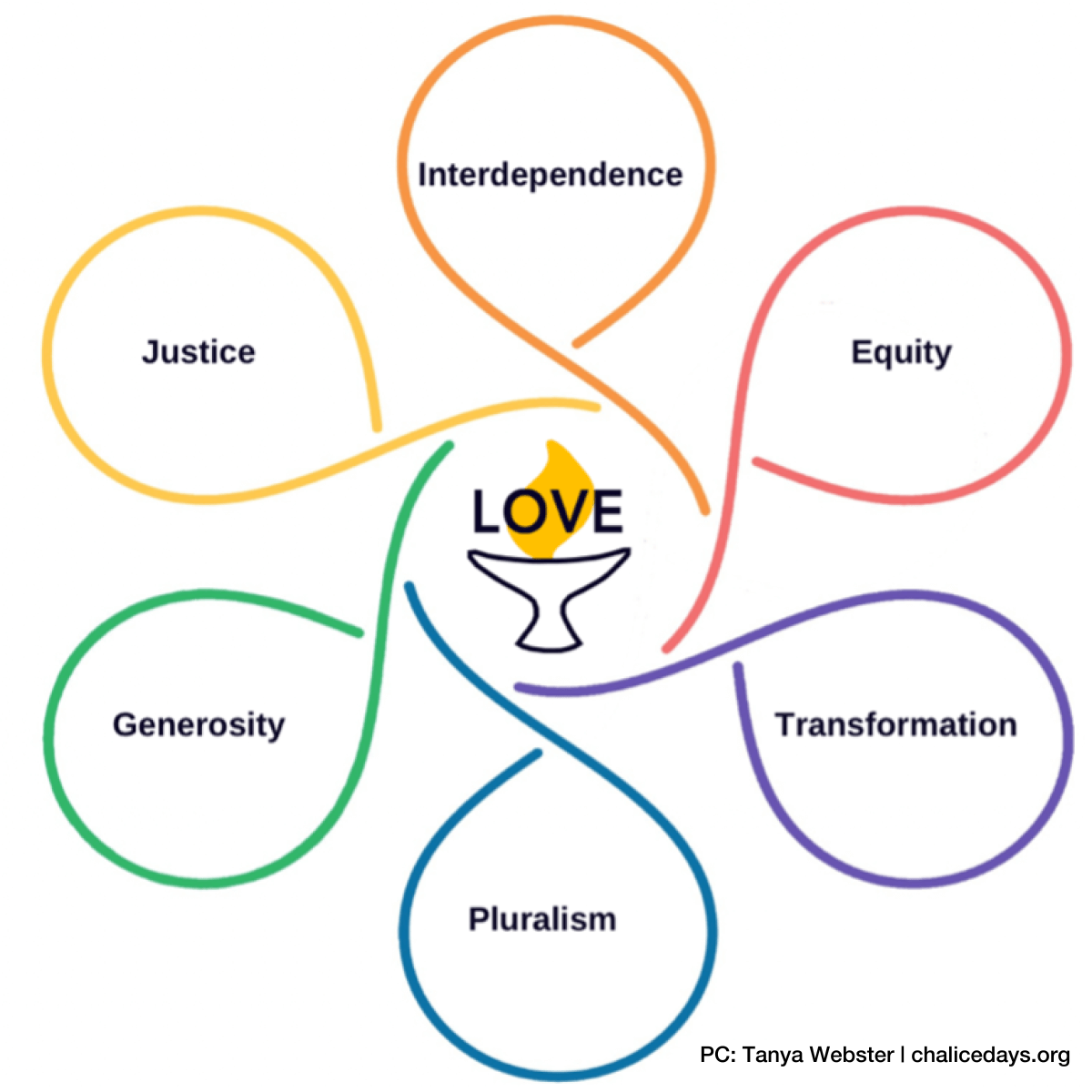
Yes. UUism is a religion that calls people to lives of service and activism. We talk politics. Yes we do. We write letters, we register voters and we vote. We do what we can with the terrible –isms that infect our world–racism, sexism, transgender phobia, homophobia and so on–and we work to eradicate poverty and greed and militarism and any and all such evils.
Because of love. Love is at the center. Love changes a person. You grow larger than you ever thought possible, and you can’t help but find a way to serve.
Which takes us to the final UU Essential:
UU Essential #7: The goal of spirituality is depth and richness in our living.
Often, the definition of spirituality that seems built into most Americans these days is this: the profession of commitment to certain specific religious practices and convictions. It can’t be spirituality you’re talking about unless you talk about God, or Jesus, or the Bible. It can’t be spirituality you’re talking about unless you talk about Hindu articles of belief and practice, or Buddhist, or Muslim, or Taoist. And so on.
Equally often, the goal of spirituality is seen as being saved so that one might enter Heaven in the afterlife.
This is not how UUism defines spirituality, or envisions its main goal.
Consider the everyday dilemma that the writer E. B. White speaks to: “I arise in the morning torn between a desire to improve the world and a desire to enjoy the world. This makes it hard to plan the day.”
Can you relate?
It’s a basic human dilemma. There is so much in the world to savor, and there is so much brokenness to save.
So, show me how you engage that dilemma. Can you find a healthy balance between the two? If all you can see is brokenness in the world, my friend, the real brokenness is inside you. But if all you are doing is focusing on pleasure, I call that selfishness, and Love is calling you to grow out of that.
As a UU, don’t merely tell me what you believe. Above all, show me your life. Show me the quality of your living here and now and not in some afterworld dimension.

The UU spiritual saint is one whose this-worldly quality of living demonstrates Compassion, Creativity, Curiosity, Confidence, Courage, Calm, Connectedness, Clarity, Presence, Persistence, Perspective, Patience. To this, add a dash of playfulness. Don’t forget a sense of humor.
That is spirituality to a UU.
Bad things happen in life. But this is how a person gets to see just what they’re made of. Awful things, if we just let them sit there and fester, drain us; but if we allow their energy to move us into some kind of creative work—if we tell stories about them or paint them or make a movie about them; if we find jobs that allow us to transform our hurt into healing for others; if we allow awful things to move us to organize and protest and promote a better social vision and raise more funds—if we can do this with the awful things of our lives, then we find the blessing in the curse.
In this life, here and now. Here and now.
That is UU spirituality.
It is the seventh and final UU Essential.
And now, to come to a close: You’ve perhaps heard this riddle before: how do you eat a whale?
One bite at a time.
And now the Unitarian Universalist whale has been eaten, and the meal is done.
 Spiritflow
Leave a comment