
A sermon dialogue between Rev. Anthony Makar and Director of Religious Education Meghan Ross
1. Personal Stories of Growing Up
Director of Religious Education Meghan Ross
Today, we begin with stories of growing up. As some of you may know, I grew up right here at West Shore. Somewhere, in a jumbled box of family photos and keepsakes, lies my baby dedication certificate, signed by Rev. David Cole. I participated in Religious Education here—sometimes regularly, sometimes sporadically—throughout my entire childhood.
I was a curious kid who loved playing outdoors and making up games with my best friend. She would even come to church with me from time to time. We spent hours exploring the woods near our homes, picking blackberries, catching tadpoles, and simply wandering.
At school, I was shy and never quite felt like I fit in. Aside from my best friend, I often felt awkward around other kids. Many of my closest companions lived in books—Ramona Quimby and Anne Shirley were among my favorites.
But church felt different. West Shore provided a space where I could truly be myself. I felt welcome here in a way I didn’t feel anywhere else.
High school youth group at West Shore, along with our district’s Youth Conferences, became especially important to me. Coming of age after the materialistic and self-centered 1980s, my UU youth experiences gave me a space to explore topics that weren’t common in my school life. It was here that I began to delve into my budding feminism and growing interest in LGBTQ+ rights. I found peers and adults who shared similar values, and this community became a space where I felt understood and supported.
Senior Minister Rev. Anthony Makar
Thanks for that Meghan!
One of my stories about growing up comes from when I was six years old. Back then, my favorite books in all the world were part of a series called How and Why. The Wonder Book of Dinosaurs. The Wonder Book of Stars. The Wonder Book of Weather. All were things that aroused curiosity in me. The Wonder Book of Sea Shells. The Wonder Book of Insects. The Wonder Book of Rockets and Missiles.
I confess that I was too impatient to actually read the words–or at least many of the words. The pictures were what grabbed me. The picture of Triceratops and his three enormous horns, together with the bony shield protecting his head, neck and shoulders. The picture of the Earth positioned in front of the yellow burning Sun, so as to illustrate their comparative sizes. The Earth flea-sized, the Sun impossibly giant….
I felt enlivened as I absorbed those How and Why books—that’s what I’m really trying to say. My imagination fired.
I really did want to know HOW and WHY!
That’s where the spark in my eye comes from when I think of Religious Education and what’s possible through it, for all ages and everyone. “Life becomes religious,” said Sophia Lyon Fahs, “whenever we make it so: when some new light is seen, when some deeper appreciation is felt, when some larger outlook is gained, when some nobler purpose is formed, when some task is well done.” This quote resonates for me as I hear about your experiences growing up in this church and how it nourished you. I recognize in you the same sense of wonder and thirst for knowledge that came very naturally to me, but I grew up without a church environment to support it.
Our backgrounds are different in this way. By the time church entered my life I was a teenager, and since it was a fundamentalist Christian church, the teaching method used was indoctrination. My church taught me that I was empty of wisdom and that its role was to stuff me full. Like a Thanksgiving turkey, it stuffed me full with the idea that God loved me but also that God was just waiting for an excuse to toss my soul into eternal hellfire and damnation. God was love and hate at the same time–acceptance and judgment at the same time. Just as confusing to me, really, as my situation at home and my mom’s borderline personality disorder which was sheer chaos to live with.
I absolutely do wonder what it would have been like to be two or four or six or seven or eight and grow up in a church community that wasn’t a love/hate place but just all love. To grow up learning that I was not empty but full of good things to be explored. That wonder and curiosity were things to be encouraged. That religion and How and Why go together like peanut butter and jelly….
But now, tell us about your philosophy of religious education….
2. Our Philosophy Of Religious Education
Meghan
“Religious education is a space where children, youth, and adults learn about and practice what it means to be a Unitarian Universalist. We engage in this through worship, classes, conversations, storytelling, art, music, and experiences that help each person live their values in everyday ways. At its core, religious education is about building relationships—within our families, our congregation, our community, and the world. It teaches us how to accept people as they are, embracing every part of their identity. It also creates a brave space for us to grapple with both the big and small questions about our lives and our place in the world.”
I wrote these words as part of a professional development course on Religious Education Philosophy. This is what I believe as a religious educator. The most important thing we can do for our congregation is to provide space and opportunities for people to explore, learn, and grow together in community.
Anthony
Agree, agree, agree! I would go so far as to say that everything we do at church really is a form of religious education! Absolutely everything. Caring and community; justice and outreach; worship, music, and arts; ways and means; and yes, religious education and engagement are all ways in which we are teaching and learning what’s of ultimate value. When, for example, we sing together the Land Acknowledgement in worship, you can’t tell me that that has nothing to do with faith formation. It is indeed a force in forming, shaping, supporting Unitarian Universalist character.
Separating Religious Education out as one among many programs is, in this sense, artificial. And yet we do it, pragmatically, because we need to. We need to have a way of talking about what happens with children, youth, and adults in classrooms and retreats and special programs that distinctively feel like … religious education!
Another philosophical point that comes to mind is that people are spiritually hungry. We need religious education experiences (in and beyond the classroom) because we hunger for intimacy and we hunger for ultimacy. “Spirit of Life, come unto me.” Spiritual hunger doesn’t wait for just Sunday. It’s all week long. And, single experiences of spiritual satisfaction are never enough. If you are physically hungry to the point of hangry, sure, a big meal will fill you up. But you’re guaranteed to get hungry again. Same thing goes with spiritual hunger. We always want more.
Which leads to a word of caution: given the hunger, people can be tempted to reach for what is easy or trendy or popular rather than for what is truly nourishing and right.
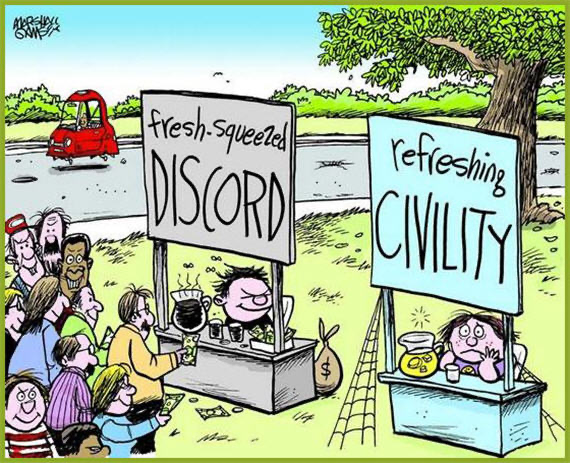
Spiritual hunger can be co-opted. Unless it is carefully cultivated, it can be shaped to serve bad BIG things. Imperialism, colonialism, nationalism, militarism, racism, sexism, greed, grievance, and on and on. All depend on (all contribute to) the twisting and distorting our powerful hunger for deep connection and meaning and intimacy and ultimacy. The result is that someone finds themselves stealing for God or killing for God instead of being the sort of peace that God really is. We must very carefully tend the spiritual hunger we are all born with. We don’t have a choice in this. The hunger is just there. It’s hardwired in. But it can be destructive if not cultivated intentionally to serve the ends of love and justice.
Thus the word of warning: we need religious educators like you to serve up spiritual meals that are truly nourishing and loving and just.
Which leads to our own Religious Education program here at West Shore. Why has it been important, do you think?
3. Why Our Re Program Is Important
Meghan
So, why is our religious education program important? What do we offer that you can’t get a home or online or in a book? I believe we offer space to do all the things that don’t or can’t always happen at school or in clubs or other groups. Children need to be able to talk to caring adults, the more the better, about their questions and worries. Why did my dog die? What is Islam all about? What values are important to me? How can I make the world a better place? What does it mean to be gay or trans or non-binary? In a time when more and more books are being banned and teachers are limited in what they can and cannot say in the classroom, we need to provide spaces for children to ask their questions. Parents and caregivers can’t do it alone.
I would like to share these words from UU minister Lowell Brook: “What Do Our Children Need on Sunday Morning?”
- They need to light a candle, and have a quiet moment to enjoy its mystery.
- They need to sing a song, to hear their own voice and other voices joined together, and to feel the feelings that are stirred by music.
- They need to hear a story and have a chance to share their own, remembering that we are each different and also very alike.
- They need to create something. Expressing themselves, whether using words or materials, helps to bind the different parts of ourselves and life together. That’s what religion is.
- They need to be with an adult who is interested in the world and who feels the privilege and responsibility of their trust—one who is glad to be with them, and regards them positively.
Into this safe and encouraging context, we may weave the content of our religious traditions. The history and common threads of our identity are important to be sure, but without this essential loving embrace the education will not be religious.
A child needs a community of people who know their name. They need to be in a space where folks are genuinely glad to see them. If you don’t know any of the folks in our congregation who are parents of young children, I encourage you to introduce yourself during coffee hour. I may be biased, but I think we have some pretty fantastic kids!
Anthony
“A child needs a community of people who know their name.” That’s well said. It truly is a precious thing. And so I want to give voice to my gratitude for those leaders who have guided us through the years in supporting and sustaining our religious education program as a whole.
In a sermon she gave in 2009, our longtime Director and then Minister of Religious Education, Rev. Midge Skwire, said, “If I remember correctly, Albert Einstein taught us about the conservation of matter. Nothing, he said, is ever lost. Solids may change to gasses, liquids to solids, but the sum total of matter is the same as when the universe began. So, too, are our lives both endless and changing. Even death can only change the state of our bodily mass. It cannot prevent the influence which we each have on others, the deeds we have done or not done, the beauty we have created and enjoyed. These continue on, incorporated into the minds and bodies of those who follow us. These are our Eternal Life.”
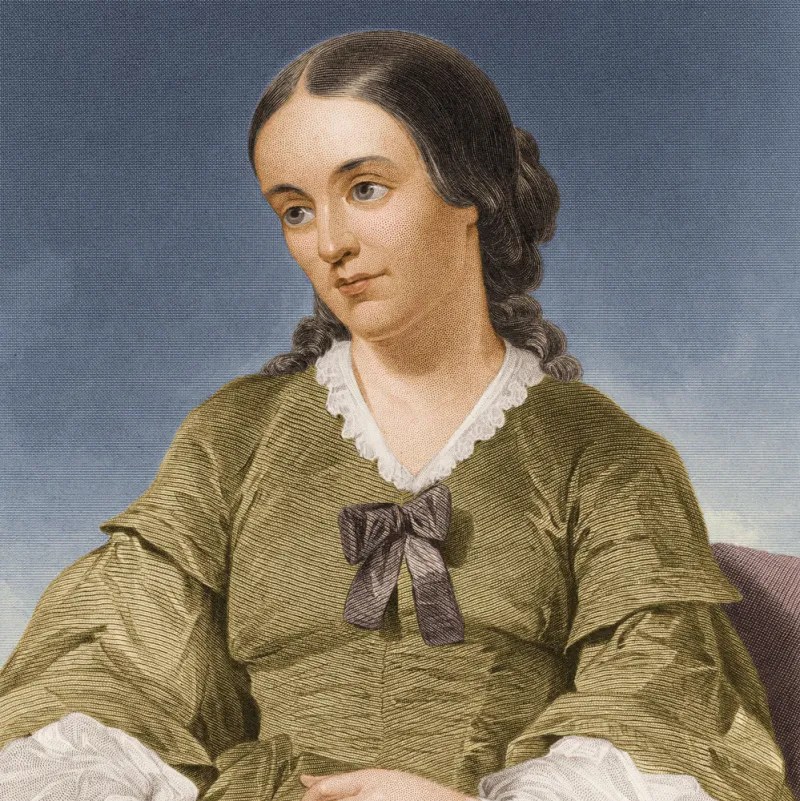
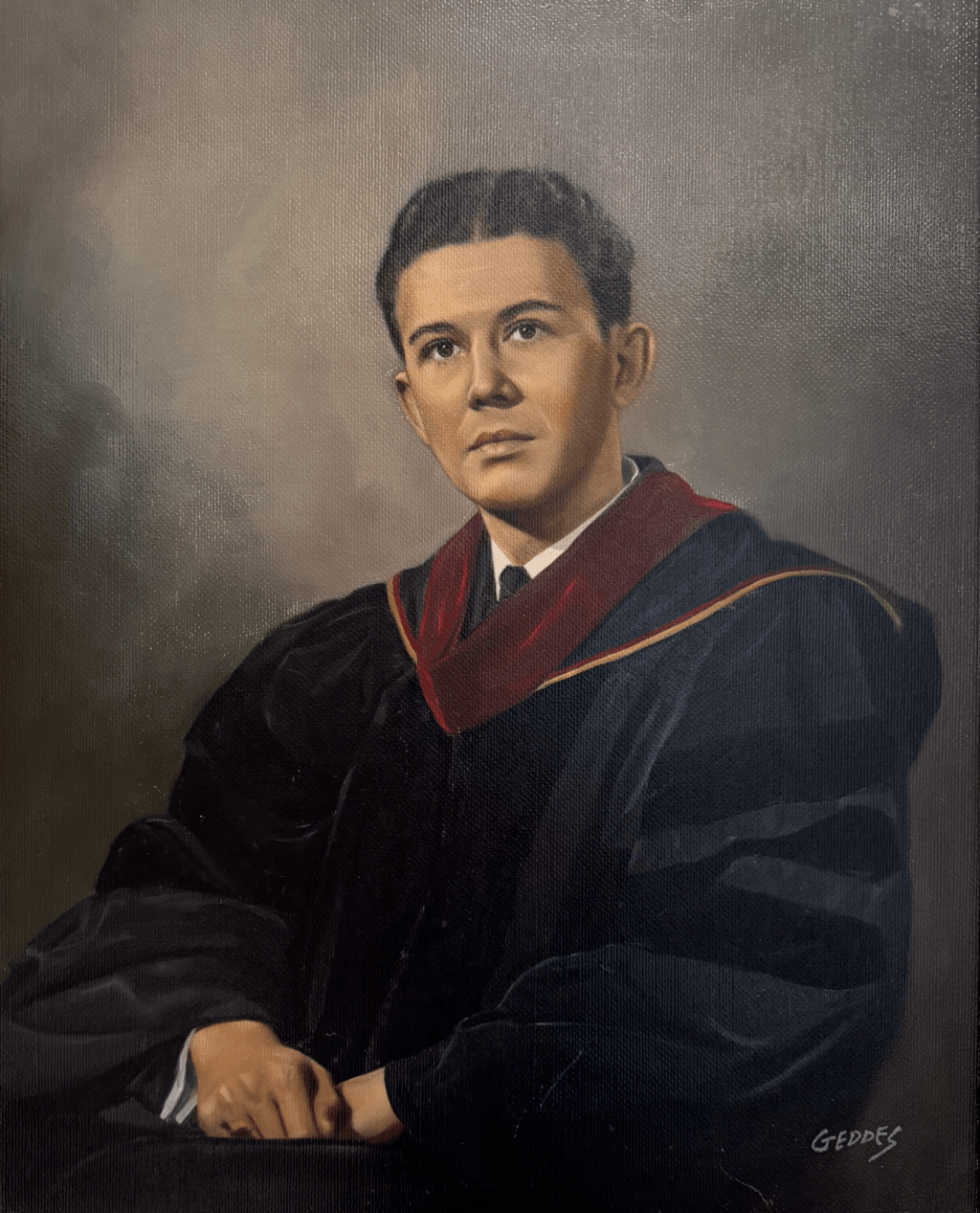
Look, then, at portraits of all our West Shore Directors of Religious Education, who live on, eternally, because of the love and beauty they created for countless lives of children, youth, and adults….
A quick note of gratitude to our West Shore Aesthetics Committee and especially to Dan Pruitt, whose loving care healed a little bit of water damage done to the portraits over all the long years. Dan also corrected the dates on the portraits and added Meghan’s!
And now, our West Shore Directors of Religious Education, who live on, eternally:

Elizabeth Sprague (1946-1951)

Roberta North Julian (1951-1958)

Marguerite Ashbrook (1958-1965)

Evelyn La Jeunesse (1965-1971)
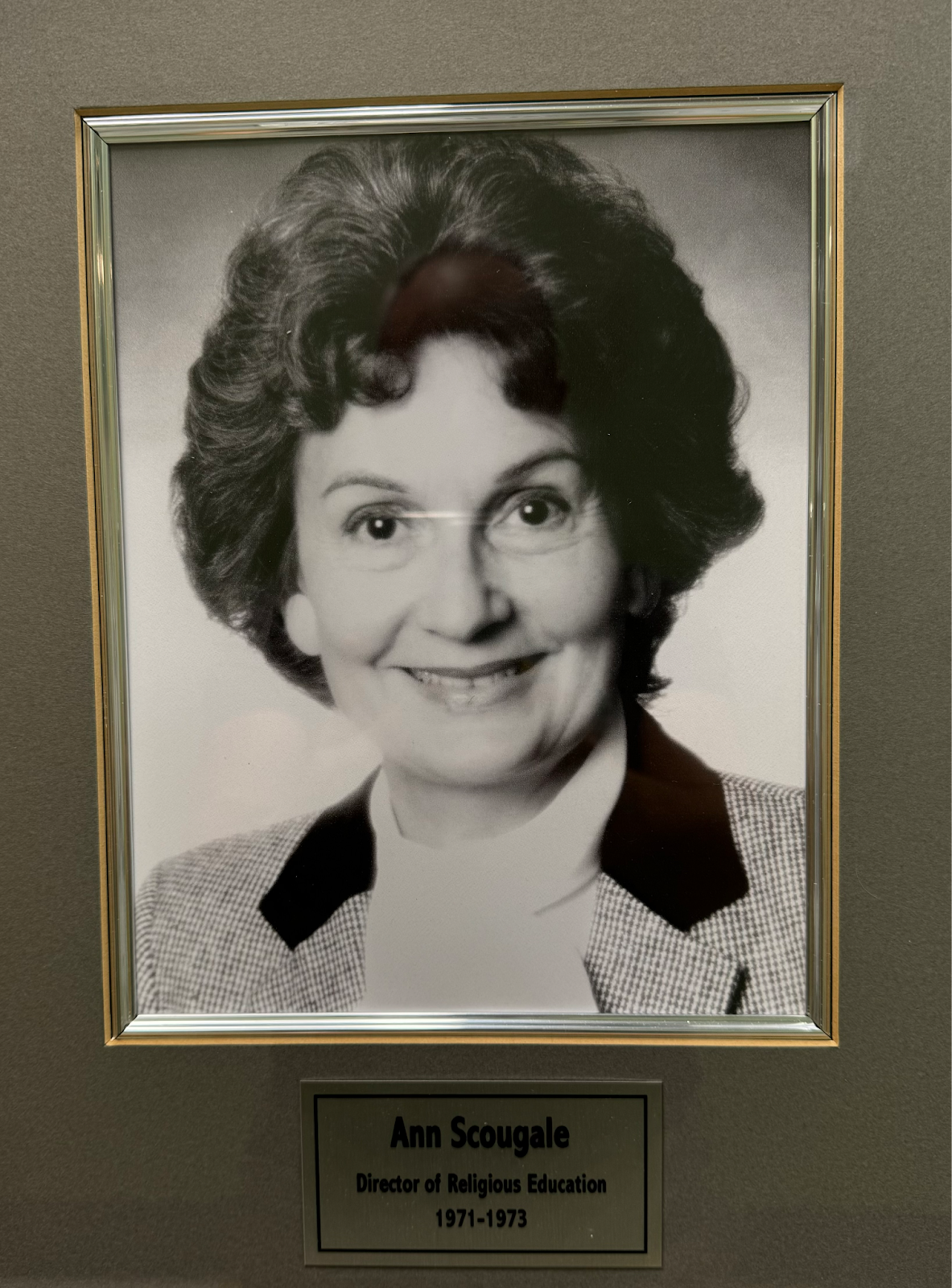
Ann Scougale (1971-1973)

Elizabeth Lockwood (1973-1976)

Rev. Midge Skwire (1976-2003)

Kathy Strawser (2004-2014)

Layne Richard Hammock (2014-2019)
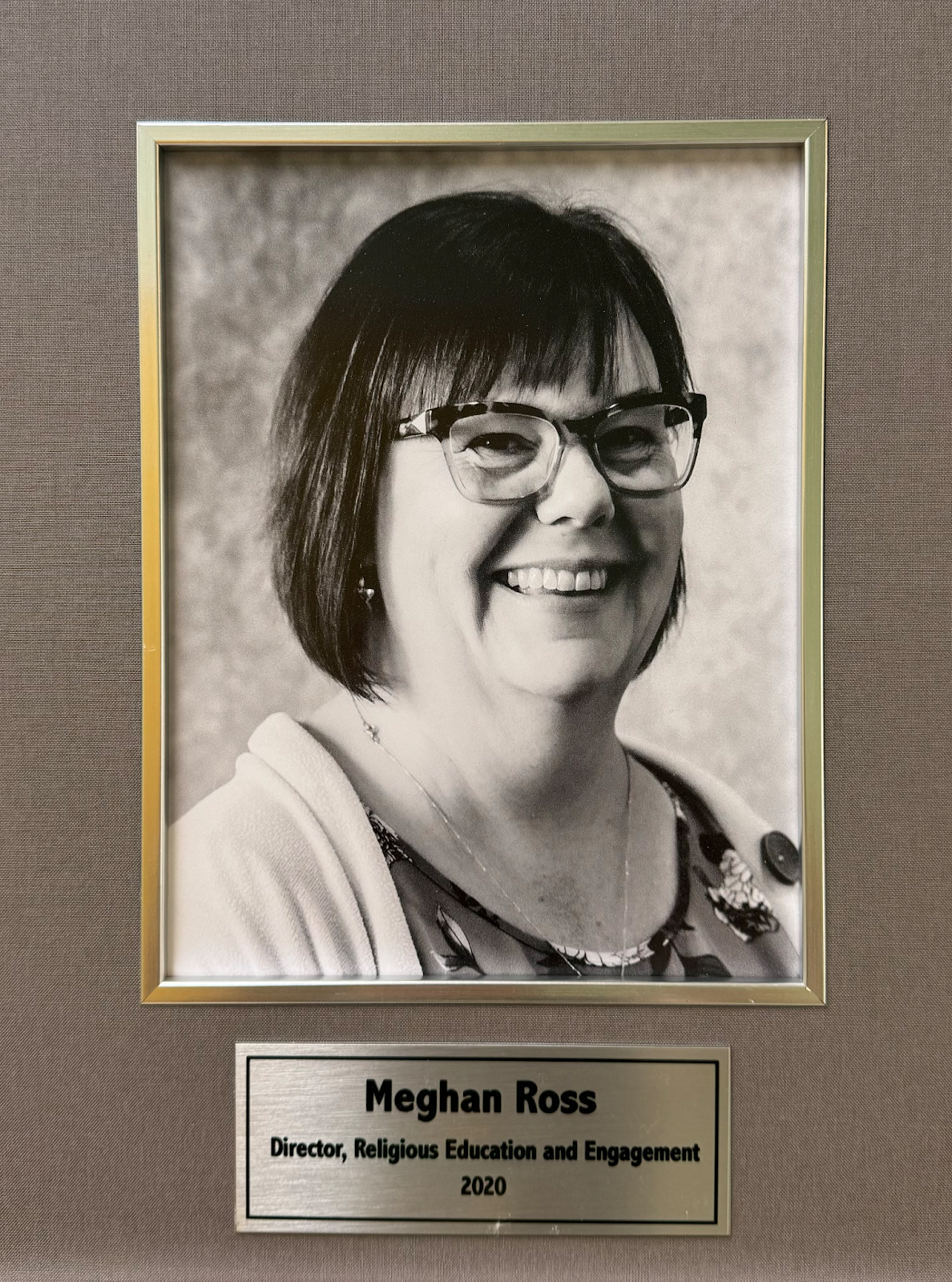
Meghan Ross (2020-)
We dedicate these portraits right now, with our gratitude and love for the faithful service of all these our Directors and Minister of Religious Education. Eternal life is indeed theirs, through their impact on countless people.
May I hear the congregation say AMEN?
Does everyone know, by the way, that over the years there has been a lively conversation among this bunch in the form of letters from outgoing DREs to the ones incoming? Letters of welcome to the position; letters of counsel and advice; letters of encouragement and gratitude.

Dear Ann, I am so glad that you applied for the job as RE director….
Dear Elizabeth
Dear Roberta
Dear Marguerite
Dear Evelyn
Dear Betty, How can I tell you about the joys and sorrows, the aspirin needed and the never enough time in a day to get everything done? I can tell you that I grew to cherish the church school at West Shore not just as Director, but first as parent, then a teacher, and now as a parent again. I invested a great deal there and gio a great deal in return, So, I find that West Shore will always be a part of me. With very best wishes and love….
Dear Midge, There is a maxim I saw on a bulletin board: “A posteriori advice is condescending and vain. A priori advice is presumptuous and vain.” Wanting to avoid, at almost any cost, being considered condescending, presumptuous or vain, I am going to let all my priceless advice go ungiven. Instead, I offer the hand of fellowship–it’s really a hug and a kiss–welcoming you into the ranks… I invite you into the fun and the frustrations, the anxiety dreams, the butterflies in the stomach, the beautiful achievements and the pure joy that sometimes sings through you.” Love, Betty
Love, Marjorie
Love, Kathy
Love, Layne
And now it’s your turn, Meghan.
Religious education is nothing without its leaders. Thank you for your leadership right now.
And now we turn to our future. What are your future hopes, Meghan?
4. Our Hopes for the Future
Meghan
So, what about the future here at West Shore? I have so many hopes for the future of our religious education programs! I hope we continue to provide top notch sexuality education through the Our Whole Lives programs. I hope we continue to offer opportunities for families to learn and talk about tough subjects like we do with our Playdates With a Purpose group. I hope we always offer classes that help our kids understand and articulate their values, expand their views of the world, and challenge them to be a force for good in their community.
But, what I hope for most is a community where our kids can just BE. They can just be themselves. They can just be safe. A place where they can ask hard questions and get thoughtful answers. I hope we have all kinds of amazing adults willing to volunteer with our children and youth. If you are a man, a women, a trans or non-binary person, straight or queer, a long-time UU or a newer member of our faith, black, white, and all the beautiful shades of brown, parent or childless, I want you on my team. Because our kids need to know all the wonderful ways to be a UU adult. They need adults to know them, and listen to them. In a world where we are increasingly disconnected, I want our kids to know that they always belong here. Always.
Anthony
For myself, I’d like to mention just one hope for the future of RE here at West Shore.
It amounts to a return to the past, actually. I was reading an RE brochure from 1959-1965

And in it I saw this: “We realize that the process of [spiritual development] is a slow, gradual, seven-day-a-week affair. Especially during children’s preschool years, a large part of this development goes on in the home. The direction it takes, its depth or lack of depth, depends very largely on how seriously parents assume their role as religious educators. It is impossible to live with small children and not answer numerous religious questions each day. Because of this, we place great stress on parent participation in the Church program of religious education. Parents who think that they can put their children in Sunday School for an hour or two a week to ‘get’ religious education will not be comfortable in a Unitarian Church. Our program is designed to appeal only to those who wish to enter with their children upon an adventure in religious growth.”
That’s the passage I read in our West Shore RE brochure from the late 1950s and early 1960s. But I think the sentiment is timeless.
The great news is that no parent, no primary caregiver, needs ever feel all alone in the awesome task of nurturing a child’s spirit. Meghan, you suggested this just a moment ago. RE programming aims to work side-by-side with parents. What happens here at church strives to provide effective models for what you might do at home. Topics raised here become opportunities for exploration during the week. And, if you volunteer to be one of our RE teachers, you are literally getting on the job training for being an educator beyond these walls. Even more than that, you are, as the brochure said, entering with children upon an adventure in religious growth which is your adventure, your own growth as well as that of the kids.
As one of our West Shore DREs said in her letter to her successor, “I can tell you that I grew to cherish the church school at West Shore not just as Director, but first as parent, then a teacher, and now as a parent again. I invested a great deal there and got a great deal in return, So, I find that West Shore will always be a part of me.”
Parents, in short, are key to RE. My hope is for more and more parents to really get this.
That’s one of my hopes for the future…..
And now, last words:
5. Last Words
Meghan
In closing, I would like to share these words from Connie Goodbread and Marie Harris:
“Faith development is all we do. Unitarian Universalism is all we teach. The Congregation is the curriculum.”
If faith development is all we do, then we are all learners
If Unitarian Universalism is all we teach, then we can know there is space for everyone and everything in our faith
If the congregation is the curriculum, then we are all teachers.
As an educator, I can’t resist the urge to give you homework. So, here it is: I want to invite you to think of all the ways you are both learner and teacher. And, how can all we do be Unitarian Universalism? For extra credit, find someone in coffee hour and share your thoughts.
Anthony
Meghan, it’s been a treat to share the pulpit with you this morning and explore different facets of religious education here at West Shore. Thank you!
For my last words, I offer one of Jay Leno’s favorite jokes. It goes like this. “I went to a McDonald’s yesterday and said, ‘I’d like some fries.’ The girl at the counter said, ‘Would you like fries with that?’”
Can’t you just see this in your mind’s eye? The McDonald’s employee just wasn’t listening. She’s sleepwalking through life. She’s numbed out.
The world can do that to a person.
The challenge is to break free and to become vital and alive. To be a person in your own right, making choices, living according to your best values.
Ultimately, it’s about taking back one’s freedom of imagination. “We are in an imagination battle,” says Adrienne Maree Brown, in her excellent book Emergent Strategy. “Trayvon Martin and Mike Brown and Renisha McBride and so many others,” she says, “are dead because, in some white imagination, they were dangerous. […] Imagination has people thinking they can go from being poor to a millionaire as part of a shared American dream. Imagination turns Brown bombers into terrorists and white bombers into mentally ill victims. Imagination gives us borders, gives us superiority, gives us race as an indicator of ability. I often feel I am trapped inside someone else’s capability. I often feel I am trapped inside someone else’s imagination, and I must engage my own imagination in order to break free.”
If Unitarian Universalist religious education is anything, it’s about breaking free. Breaking free in your mind so that you are free everywhere.
Let there be more and more freedom!
 Spiritflow
Leave a comment