December 22, 2024,
O Star of wonder, star of light, star with royal beauty bright,
That’s from one of the Christmas carols so many of us sing in my time, which starts,
We three kings of Orient are, bearing gifts, traversing afar,
field and fountain, moor and mountain, following yonder star
–which is you.

And there you are on my own Christmas tree. I took that picture right after Rachel and I had set it up and trimmed it. Five minutes later our cats were roaming within its branches and swatting at the ornaments like cat toys. Not that we hadn’t anticipated it. We made sure the ornaments are all plastic. We are resigned that it’s their house and we just live in it.
Happily, weeks later the tree still stands even though it’s looking a bit lumpy in parts. And you remain at the top, untouched by furry paws, shining your glorious heart out.
I’ve known you all my life, together with the “three kings of Orient” (who are more accurately called “Magi” which is the distinctive name given to Zoroastrian priests from ancient Persia who specialized in discerning the will of the Divine through astrology). In addition to them, of course, there’s Mary and the Baby Jesus, the shepherds, the angels, the animals, all in Bethlehem in Judea–the whole kit and kaboodle of every proper Christmas nativity scene.
I’ve known you all my life. But maybe not really. You know how it is when you think you know someone or something and then you come to realize that there’s way more to the story?
That’s what this letter is all about. There’s way more to you than what the Christmas carols say or nativity scenes show. I’ve come to realize that you are one of the genuine unsolved mysteries of the Bible. One respected astronomer, Mark Kidger, in his book published by Princeton University Press, describes you as “the greatest of all detective stories” and “perhaps the greatest of all astronomical mysteries.”
Whoa!
I suppose I should have already had an inkling about that, though. I mean, I remember a pristine Christmas Eve night in Edmonton, Alberta at my Baba’s house after we’d devoured her delicious Ukrainian dinner like the biblical locusts with which God plagued Pharaoh as a way to get his attention and set the enslaved Hebrews free. We ate our way straight through that deliciousness. And then we turned to opening all the Christmas gifts–yup, on that side of the family, Christmas Eve was the time to open gifts. So: ripped-up gift wrapping everywhere such that I couldn’t even see the floor. Opened boxes, untied string and ribbon, unattached bows like flowers scattered everywhere.
When I felt complete with playing with my new toys, I found myself gazing at the Star on top of my Baba’s Christmas tree which, that year, was entirely silver and festooned with white string lights and shiny balls of metallic blue. It was funky and cool. Now, my first grade teacher had written in my report card that I had a tendency to get lost daydreaming. And there I went, again. I found myself thinking about how you, the Star, led the Magi. Matthew’s Gospel describes you as going ahead of them and stopping over the precise place where Jesus was and that’s how they found him.
You, the original GPS.
In other words, you gave them enough of a clue to go to a certain, specific spot: there, not over there. It would have been like you shining over my Baba’s house in such a way that the Magi would have known not to go to Mr. Pauluk’s house next door or to the Jacula’s house across the way. And you did this from a height that was astonishingly high up.
But how can something so high up shine down like a streetlamp upon one small spot?
I felt like I was at the edge of a rational-mind realization which was threatening to overwhelm me, so I shut it down and went back to safety and my Christmas gifts.
But maybe, all these years later, I’m ready to open things back up and see where it takes me…..
I need to jump in feet first with the big question: did you really exist? Were you an actual event in our historical world?
For sure, the writer of the Gospel of Matthew–which is the one and only place in all of Scripture where you are mentioned–wanted you to be. Oh yes. His intent is very clear to anyone who has the doggedness to plow through Matthew Chapter 1 which is a boring genealogy (boring to people in my day at least) which wants to prove that Jesus comes from the bloodline of kings. From this, the reader turns to Chapter 2 and, all of a sudden, it’s a sky story. It’s a story about how an event in the sky led astrologers from Persia to come to Jerusalem, seek out the current King of Judea, and, right to his face, ask, “Where is the King?”
Rather impertinent, wouldn’t you say?
Folks in my time might not see the connection between Chapter 1’s boring kingship genealogy and Chapter 2’s fixation on astrology unless they understand this historical fact: that in ancient times, astrology was not about ordinary people. In my day, anyone can have a natal chart drawn up and read. In my day, astrology is for the masses. But in the times when the Gospel of Matthew was written (around 80-90 of the Common Era), astrologers like the Magi understood the stars to be divine words spoken to one and only one person: the King. Wrapped up in the King was the wellbeing of his entire nation. Astrologers sought to provide divine guidance to kings by interpreting the stars and planets to them, so that the gods would be pleased.
One of the most famous evidences of the linkage between astronomical events in the sky and the fate of Kings happened in 44 BC–around 40 years before Jesus was born (although the exact date of his birth is still, in truth, unknown). In 44 BC, several months after Julius Caesar had been assassinated, a great comet sped through the skies for seven successive days. Unlike you, O Christmas Star, everyone saw it. No one was in doubt of its reality. And the people of the time interpreted it to mean that Julius Caesar had become a God. Julius Caesar had become Divine. The politics of this led directly to his son, Augustus Caesar, becoming the very first Emperor of Rome.
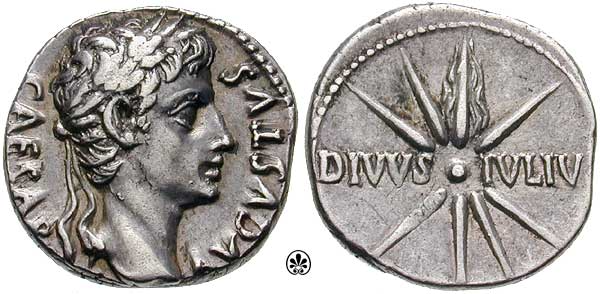
Romans literally put this on their money. Here is a coin from 18 BC. One side of the coin is the Roman Emperor, Augustus. The other side is the famous 44 BC comet and a Latin inscription that says, “divine Julius.” The people thought the comet was Julius Caesar’s soul, streaking through the skies.
It was another sort of star of wonder, star of light. The writer of Matthew would have known all about it. And on the basis of such already well-known cultural signposts, he made sure to put you, O Christmas Star, center stage in the story of Jesus’ birth as if to say, Here, then, is a sign in the skies proclaiming another kingship–the kingship of the baby Jesus.
Now, in the years following Matthew’s telling of your tale, it appears that your basic existence went unquestioned among the Jesus followers who would come to be called Christians. But what kind of existence? Were you a one-time miracle or were you something more naturalistic? The debate went back and forth.
As an example, consider what two early scholars of the Christian Church had to say. Origen, writing roughly around 200 years after Jesus’ birth, reasoned like this:
If, then, at the commencement of new dynasties, or on the occasion of other important events, there arises a comet so called, or any similar celestial body, why should it be matter of wonder that at the birth of Him who was to introduce a new doctrine to the human race … a star should have arisen?
Do you see how Origen’s attitude is in agreement with the ancient assumption that the language of the stars speaks about Kings?
Origen believed that you, O Star, were a naturalistic event. Contrast this, though, to what John Chrysostom had to say around 400 years after Jesus’ birth:
How then, tell me, did the star point out a spot so confined, just the space of a manger and shed, unless it left that height and came down, and stood over the very head of the young child? And at this the evangelist was hinting when he said, “Lo, the star went before them, till it came and stood over where the young Child was.
When I was at my Baba’s house, looking upon you, O Star, at the top of her funky silver tree, this was the very same doubt that entered my mind and shocked me so much that I had to shut it down. But a church Father wondered about it first. And he didn’t shut things down. His conclusion? You, O Star, were nothing natural at all.
You were a one-time miracle.
There are other possible conclusions to arrive at, honestly, but the thing to note is how people have been trying to solve your mystery from the start. From the beginning, the arguments have been back-and-forth, forth-and-back.
Despite your unsolved mystery, your profundity has made its impact on the past 2000 years of Christian culture and, arguably, world culture. For one thing, there’s the holidays. Now originally, January 6 was the day when multiple aspects of Jesus’ story were commemorated: his birth, your appearance in the heavens and the visitation of the Magi, his baptism, and his miracle transformation of water into wine at the Cana wedding. All four high points were celebrated in just one day! But it was at the Council of Tours in 567 that church leaders decided to separate things out. From then on, Jesus’ birth would be celebrated on Christmas Day, December 25, and your sign in the heavens and the coming of the Magi would be celebrated on Epiphany, January 6. Between the two was “The Twelve Days of Christmas.”
Honestly, for many people in my day, the birth of the Christmas holiday of December 25th (and its economic significance) has been far more important than the birth of the spiritual vision of Rabbi Jesus.
But I digress.
The cultural impact has been enormous, in ways big and small. I’ve already mentioned Christmas hymns. An example of something much smaller is Palmer Lake in Colorado which boasts a 500-foot-tall, 5-pointed, incandescent Star of Bethlehem on the side of Sundance Mountain.

As for the one and only town of Bethlehem in the West Bank of Palestine, you can stay at the Bethlehem Star Hotel, do some shopping at the annual Christmas Market on Star Street, have a coffee at Stars & Bucks Café, and visit Manger Square where images of the Bethlehem Star abound.
This impact is not going away, no matter what happens with your unsolved mystery, O Star of Wonder.
But let’s get back to that. It would take 15 centuries before the question of your reality would engage actual scientists. Johannes Kepler, the great German astronomer and mathematician who discovered no less than the three laws of planetary motion, brought you into his scientific sights. In 1614, he calculated that there had been a series of three conjunctions of the planets Jupiter and Saturn around the time of Jesus’ birth, and he thought that planetary conjunctions could create a brilliant flare-up of light in the sky. That brilliant flare-up: that’s how he explained you.
Well, he was wrong about that. But one take-away is that maybe you weren’t a single thing. Maybe your light was the product of the coming together of separate objects, like planets. Here’s where most art and all nativity scenes fail. They all make you out to be one thing. But maybe you weren’t.
For many people, the Great Conjunction of 2020, when Jupiter and Saturn came within 0.1 degrees of each other, seemed to suggest what might very well have happened long, long ago:
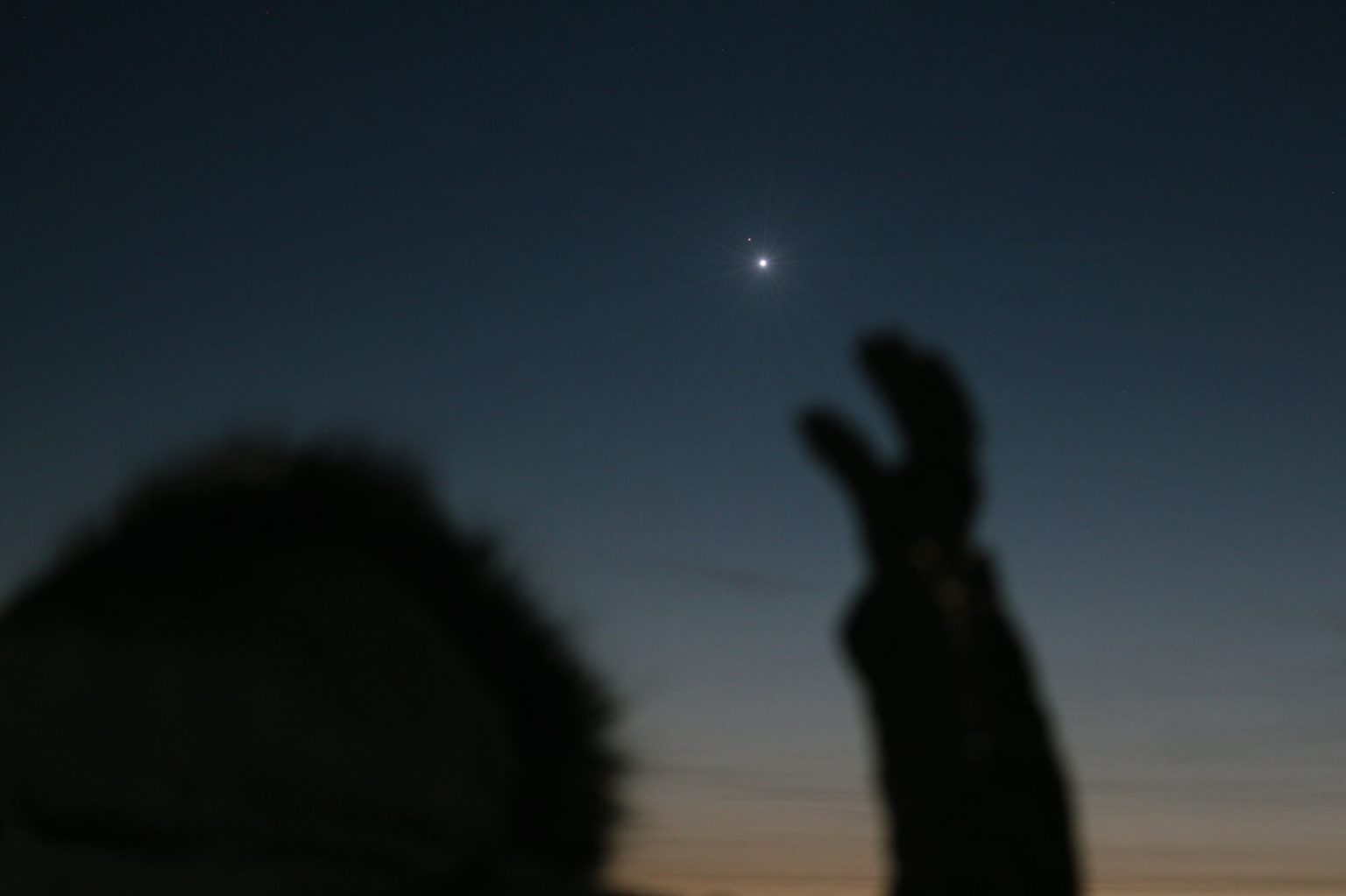
I promise, this letter would go on for days if I were to lay out all the astronomical theories. Someone like Ronald Kaitchuck, who teaches astronomy at Ball State University in Indiana and directs the planetarium there, knows them all. And, even after all his 40+ years of professoring, he can still say he hasn’t reached a definitive conclusion about what you, O Star of Wonder, might have been.
I do want to risk asking you, though: were you a UFO? Biblical descriptions of anomalous aerial phenomena, when you overlay them on modern-day UFO reports, seem to blend together as one. I mean, if you were a UFO, then my wondering (and John Chrysostom’s!) about how you could be high above in the heavens and yet zoom in to pinpoint Jesus’ birthplace would be instantly solved.
Reminds me of a funny cartoon in the New Yorker that portrayed you as an alien spaceship. Inside it, two little green men with spiky heads were looking down at the Wise Men and saying: “Who are those guys and why are they following us?
Ha!
Seriously, you really are a huge unsolved mystery. Why else would some folks reach for the UFO explanation?
Perhaps now is the time to do some frame-bending. What if the better way to think about you is that you’re more like a painting? Like this one:
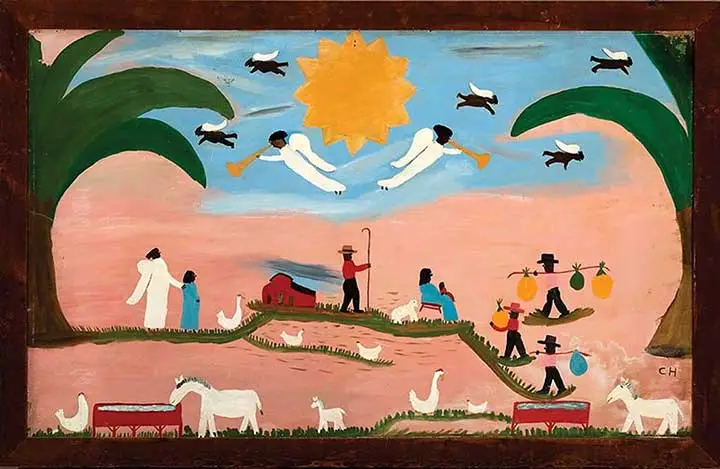
Clementine Hunter, who was a self-taught Black folk artist from Louisiana, painted this in 1957. This would have been 6 years before Dr. Martin Luther King Jr. preached his iconic “I Have A Dream” speech at the March on Washington in 1963. It would have been 7 years before the passage of the Civil Rights Act in 1964.
I suppose you can look upon this painting and, like a broken record, keep asking the question, Did this really happen? But you can also think outside the box and ask, instead, Does this painting touch me? Does it pull me out of my fears? Does it make me a more resilient spirit? When I look upon this painting and realize how prevalent the cruelty of Jim Crow was in 1957 and yet Clementine Hunter drew on the myth of you, O Star, to paint a scene where there is Love and Peace–Dr. King’s dream before Dr. King was able to preach it–when I think like this, what is born in me? What is born in my heart?
What if THAT was the question people asked of you, O Star?
In a couple of days it will be Christmas Eve again and, crossing fingers, the weather will be just as pristine as it was in Edmonton all those years ago when I found myself overwhelmed by doubts. My rational mind was taking me somewhere that my mythic mind didn’t want to go. To my mythic mind, you did as the Bible story said: from impossibly high up, you somehow managed to shine down like a spotlight on the specific place where Love would be born again in the form of baby Jesus.
To my rational mind, this was nonsense.
But on Christmas Eve this year, I will look up into the night sky here in Cleveland, Ohio, and I will gaze upon whatever stars show themselves, and a better truth will unfold. Starlight does not discriminate. Starlight shines upon the entire earth as though the whole thing were one big Bethlehem. The place where Love and Peace can be born won’t be narrowed down to a specific location. God can be born anywhere and at any time. Starshine says so.
Starshine is Universalist.
That is their poetry–your poetry, O Star—to those who truly have eyes to see.
Our world–it’s so muddled. Full of joy and full of woe. Full of beauty and intelligence and heroism and full of ugliness and stupidity and greed. So messy. The image of Bethlehem has always encapsulated just that. But the myth of Christmas Eve, if it is anything, is that Bethlehem is not cut off from new possibilities. The birth of some Christchild possibility (whether a person like Dr. King or a technology or a revolution) is always around the corner, beyond our knowing, but not beyond our faith. Not beyond our hope.
Dear Christmas Eve Star, it’s ok to me if your actual scientific reality forever remains an unsolved mystery. It’s ok. But I am still moved by the myth of you. I am sharing this letter to you with my congregation because I hope they will join me in that, in this season that feels so mixed up, in this world that feels so very much on edge.
Do you know the carol entitled “Let Christmas Come” by my colleague the Rev. John Hanly Morgan? Here is the last stanza:
Let Christmas come, its great star glow,
on quiet city, parks of snow;
let Christmas come, its table gleam,
love born again: the truth of dream.
Great star, let your glow be upon all of us, upon our total earth, so that we may be One, and Love is born again.
I am yours, sincerely,
Anthony


 Spiritflow
Leave a comment