
I’ll begin with a question: How many continents are there in our world? Do you know?
There are seven: Asia, Africa, North America, South America, Antarctica, Europe, and Australia.
And, in ancient cultures from all these seven continents, what you find is belief that reality–composed of both the material and spiritual–is like a tree.
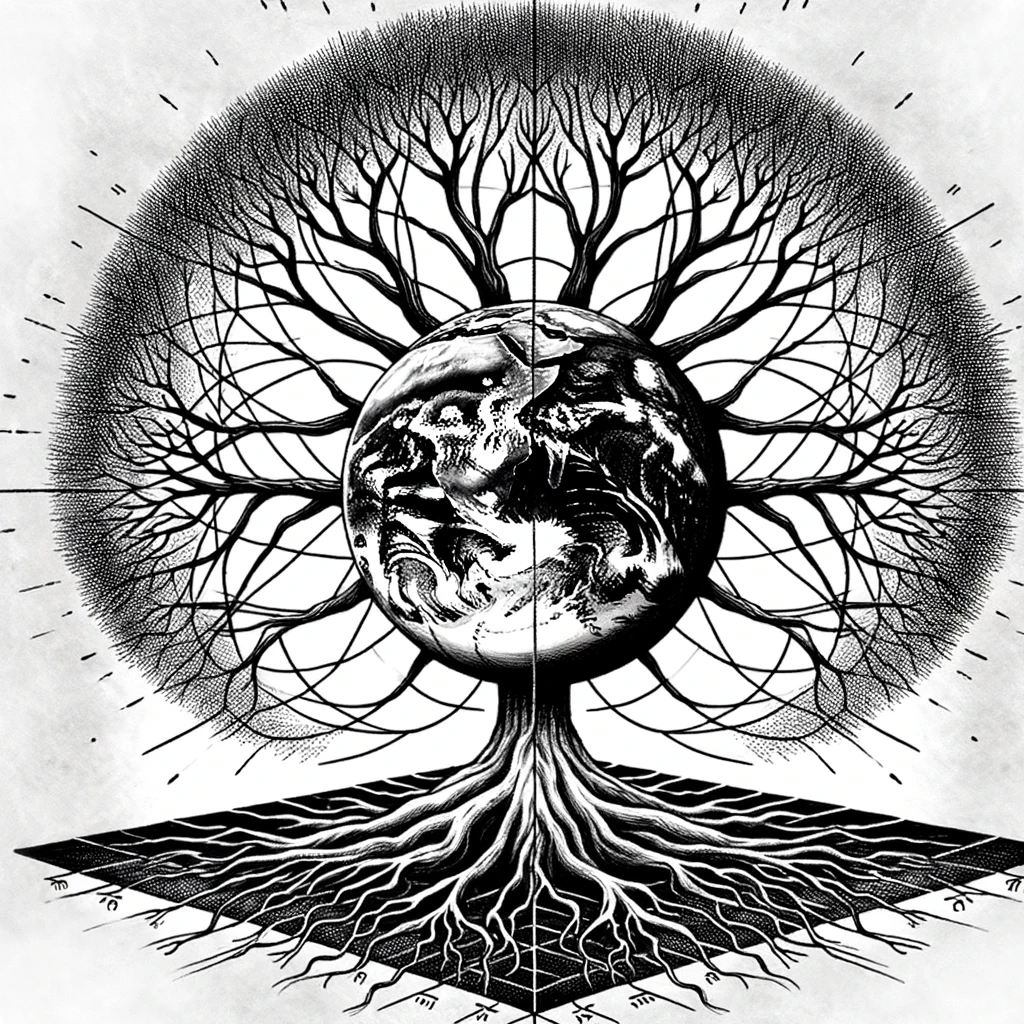
The uppermost branches are a world of Light, the roots are a world of Darkness, and the middle world–the Earth realm–is the point of balance between them.
In every continent, too, there were ancient technicians of the sacred, called shamans, who would enter into trance states and travel up or down the tree, in search of knowledge.
The Underworld, now, is not a place of punishment. That’s an idea mainly coming from certain kinds of Christianity. But it is where the souls of the dead dwell. It is that. Where the Ancestors dwell. And the Ancestors carry a profound wisdom borne of their achievements, their suffering, their mistakes, and their unfinished projects and open questions. At times, such wisdom was exactly what the shamans wanted to learn more about and share with the people. Other times, the knowledge shamans sought was more transcendent and prophetic in nature, and so they would reverse the direction of travel and ascend to the Light-bearing Upperworld.
Asia, Africa, North America, South America, Antarctica, Europe, and Australia all have their own ways of framing this.
But I want to tell you about how this was done by the ancient Slavic cultures of my genetic Ancestors. My people from Ukraine and its surroundings in Eastern Europe including Russia and Romania, with whom I share no less than 98% of my DNA (according to Ancestry.com).
I took the blood test. How many of you have done the same?
So my genetic ancestors from pre-Christian times: they spoke of a Lord of the Underworld whom they named Volos.
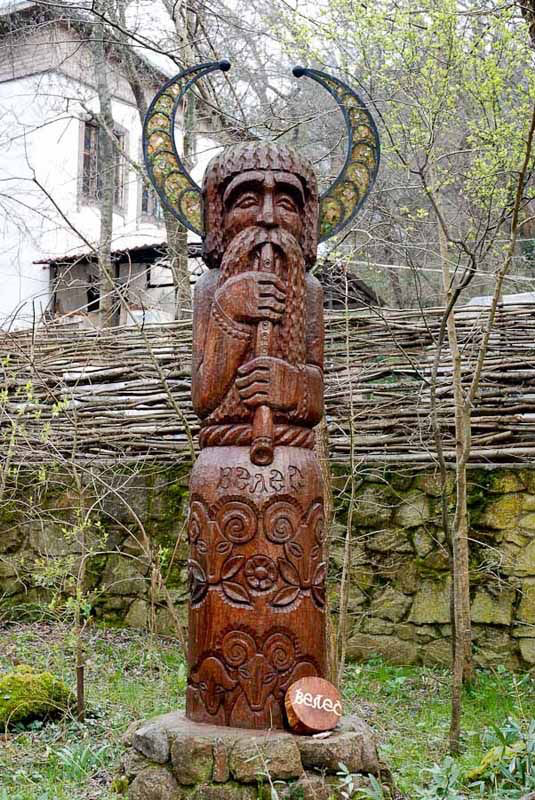
Volos is the Lord of Death, but he was also honored as the god of shepherds and flocks and all things agricultural. When I first heard this, I didn’t get it. He’s Lord of Death but also the god of all that sustains human life?
And that’s exactly it. That’s the genius of the pre-Christian Slavic worldview. Light shines down from the Upperworld but only to coax the seeds in the ground to come forth and rise upwards as plants which go on to sustain the lives of domestic animals as well as the lives of human beings.
The secret of continuing life, in other words, belongs to the Underworld. Honor the Ancestors and their good will ensures that people in the present will have a future.
Now, I have just offered one definition of the Ancestors: those whose bodies were the ultimate source of your own. One’s parents and grandparents and great-grandparents. Some people stop there, but others want to go farther back and broader as well, to include all of humanity and even all of nature. Because, do not all beings, by their very presence, make an impact and in this way are connected to you and to everything else?
Of course, people adopted into one’s family and one’s hearts become Ancestors as well–to be part of the family whether or not one is blood kin will have great impact on descendents down the line. Some people even count chosen family members whom one may never actually meet but their cultural influence is so important, you’d happily place them on your altar of Ancestors–like I would Ralph Waldo Emerson, or Henry David Thoreau.
Whether we are talking about the Ancestors in the narrowest sense of blood kin parents and grandparents etc., or whether we are happy to expand our sense of Ancestry way beyond that, the teaching of the ancient Slavs remains the same: the continued greening of the Earth depends honoring those who have come before: by knowing their stories, honoring their struggles, taking courage from their suffering and their persistence.
Permit me a moment to do honor to some of my Ancestors. Take a look:

The year is 1936. The man in the coffin is my Baba’s father, named Nicholas. He immigrated to Canada from Ukrainian Poland (probably in 1899) because the situation there and then was terrible. Dire. Poverty and violence and no opportunity to make things better. So he took his family all the way to Western Canada–Drumheller, Alberta–where he worked in a coal mine until his body failed him and he was bedridden for 14 years.
Take a closer look:

I don’t know who these specific people are, other than they were part of the same Ukrainian community. At this time in Canada, Ukrainians were spit upon. They were despised. They were the underclass. There’s a real sense that, throughout the entire history of the existence of Ukrainians anywhere in the world, they have been underdogs. Disrespected. The war with Russia since 2022 is but one of many evidences of this.
But when you look at their faces, do you see the strength and resilience, despite all?
It makes me wonder about my own life pattern of being attracted to underdogs and to understanding the feeling of what that’s like. Perhaps there is even some connection to my being a minister in the faith tradition of Unitarian Universalism which is so satisfying to those already within it yet so completely unknown to the larger world. I don’t think it’s unfair to say that, in the company of other traditions which gather millions and millions, we are the underdogs. A tiny religious community of people with gigantic, liberal hearts….
I’m just wondering how the way to my service in this movement was paved by coal-mining Ukrainians in Western Canada…..
It brings to mind a passage from Carl Jung’s Memories, Dreams, Reflections in which he speaks to being “under the influence of things or questions which were left incomplete and unanswered by my parents and grandparents and more distant ancestors. It often seems,” he says, “as if there were an impersonal karma within a family which is passed on from parents to children. It has always seemed to me that I had to answer questions which fate had posed to my forefathers, and which had not yet been answered, or as if I had to complete, or perhaps continue, things which previous ages had left unfinished.”
Does that resonate with you? How much of your life is a response to the unanswered questions or incomplete projects of your Ancestors?
But now let me say one more general thing about the Ancestors. Some will argue that they live on in the present in a paranormal sense, as spirits, and at certain times they visit. For example, there can be the sensation of a hand on one’s shoulder, bringing comfort, but you turn around and no one’s there. Or there is a scent that suddenly breaks upon you, and you always associate it with your grandfather. Or some Ancestor comes to you in a dream that is unlike any other dream: crystal clear, realer than real, and they bring a message to you, because they have never stopped caring.
Has that ever happened to you?
There is, in short, diversity to the concept of the Ancestors.
But whichever aspect of this diversity you personally plug into, the most basic conclusion to draw is that our sense of time is being radically expanded here.
A lot of people don’t give any of this much thought, though, these days. These days, people (especially First Worlders) do not experience themselves as parts of a larger timescape. We inhabit not the deep sort of time, but the shallow sort: short-term time. As Joanna Macy and Chris Johnstone say in our year-long study book, Active Hope, “Much of government planning works within a time frame of just a few years. When the long term is considered, the period looked at rarely stretches beyond a few decades. In major financial institutions, where the price difference between the morning and the afternoon can lead to profit or loss, even a few months into the future can seem farther ahead than is worth considering.”
That’s Macy and Johnstone. And the real concern is: when we live only within a short-term sense of time, we live only for ourselves and from ourselves. There is no respect even for the horrible mistakes of our Ancestors which become lessons for us and things to avoid doing.
We are contracted. Shriveled. Diminished.
There is a kind of nervous system enabling this. I’m speaking of all the addictive technologies that make it possible to do things faster and to do multiple things at the same time. Which ones come immediately to your mind? Microwaves? Smart phones? The Internet? Drive thrus that make fast food restaurants even faster?
There’s a cost to all this, and some have called it “hurry sickness.” It’s living in a sort of now characterized by anxiousness. It’s about being stressed out constantly. It’s feeling irritable almost to the point of sickness whenever a result is not instant but there’s a delay. Waiting in a line feels like a crisis. Doing only one thing at a time feels like a crisis. When an Internet download feels too slow–crisis. When an email newsletter requires you to scroll down to get all the information–if all the info isn’t available in a single glance–crisis!

Can you relate?
“Imagine,” say Macy and Johnstone, “what would happen if we applied the same thinking after planting a tender young date palm or olive tree. These trees can take decades to become fully productive, but once
they do they remain so for more than a century.” Yet we would never come to know that because, not having seen results after six months or a year (which to the hurry sick person is an eternity), we’d judge our tree planting venture to have been a waste and a failure.
The worst consequence of this time contraction–this sense of ourselves as living only for ourselves and from ourselves–is stated pungently by Roman Krznaric in his book The Good Ancestor: A Radical Prescription for Long-Term Thinking. He says, “We treat the future like a distant colonial outpost devoid of people, where we can freely dump ecological degradation, technological risk, and nuclear waste, and which we can plunder as we please.”
It’s so true. You know, people today get so grouchy about gas prices. These days, the average cost of a gallon of gas in America is around $3.10. It can get some folks screaming. But we need to know that if we don’t want to treat the future like a distant colonial outpost–if we want to treat it as a place where beloved future generations dwell–then we need to count all the costs of what we’re passing on. The real cost of gasoline, future consequences considered, is $15 a gallon.
We need to start paying the full price.
The artificial cheapness is just another reflection of how we today dwell in a shrunken, shriveled, diminished timescape.
It’s not who we are, truly, from the perspective of our Ancestors. Again, Macy and Johnstone: “When we move beyond thoughts of individual achievement and consider what our actions, if combined with the actions of others, can bring about, we open to a more gripping story.” We are not self-created. From out of the roots of the Ancestors, we grow into the limbs and leaves of the present.
And we build with the purpose of blessing generations yet to be born. They–the Ancestors–root us in their achievements but also their problems and incomplete projects, and the purpose of life is to receive these problems and projects and make our best contribution so that we leave the world better than we found it.
As the Jewish scripture, The Talmud, states, “Do not be daunted by the enormity of the world’s grief. Do justly now, love mercy now, walk humbly now. You are not obligated to complete the work, but neither are you free to abandon it.”
One of the unfinished projects which our distant Ancestors have handed down to us is right here: the human brain. Scientists tell us that our brains haven’t changed much over the past 30,000 years. The brain that’s in your skull right now is the same basic brain that was in the skull of the Ancestors.
Now, 30,000 years ago, the real dangers of life were immediate ones. That’s why it’s much easier for people today to recognize and respond to more immediate threats. But as for the long-term dangers that loom for us–like climate change–it’s just harder to wrap our minds around that. It’s just harder for people to take such threats seriously and to make proactive, present-day changes meant to avert future harms.
It’s harder, even when, for example, the fires of Los Angeles burn and everyone witnesses it and still, in many minds, the connection between this and long-term climate change is not made….
Now, lucky for our distant Ancestors, they did not have smart phones, and hurry sickness was not something they had to deal with. Yet even they were challenged to transcend the short-term bias that evolution put in their brains, and they did that through the mythology of the Tree of Life with its Underworld and Upperworld and Middleworld of Earth. This was their attempt at a solution. Volos was their attempt. Obviously it was not a final solution. Christianity (in the West at least) came and replaced it with a different vision of extended time, which was, in turn, shattered by our current modern secularism.
Today there is no consensus on how people see themselves as belonging to something beyond the immediate. Today, our speed-based technologies only strengthen the neurological pathways in our brains that focus on the short term.
We must know that we today are recipients of this ancient project of transcending the short term which our long long ago Ancestors started. It’s about how to live as a good Ancestor-to-be right now, with reverence towards the Ancestors of the past and respect for generations yet unborn.
Clearly, this project is unfinished.
If this project was easy, there would be no problem and I would be preaching a different sermon.
And so–do you want to save the world?
Then change your sense of self. Change your consciousness.
Escape from shallow time, short-term time, and expand into a sense of self that is spacious, generous, connected with the past and future.
You’ve heard the phrase, “Where your attention goes, energy flows”–yes?
Here is the equivalent idea but cast in the language of brain science: “Where attention goes, neural firing flows, and neural connection grows” (Daniel J. Siegel).

I am urging you: consciously and deliberately take up this unfinished project of The Ancestors. Escape the prison of the short-term. Experience your true reality as a being of extended time. Become a good Ancestor in the here and now!
When we do this, there’s a shuttling back and forth of empathic awareness. Where future generations are concerned, Macy and Johnstone suggest an imaginative exercise called Letter from the Seventh Generation. “Closing your eyes,” they say, “imagine journeying forward through time to identify with a human living two hundred years from now. You do not need to determine this person’s circumstances, only to imagine that they are looking back at you from the time they inhabit. Imagine what this person would want to say to you. Open your mind and listen. Now begin putting words down on paper as if this future one were writing a letter just to you that starts: ‘Dear Ancestor …’.” Macy and Johnstone conclude, “By giving future beings a voice, we bring them closer in a way that helps us be guided by their perspective. Hearing ourselves reply to them also helps us to step into a larger experience of time.”
Do you see the shuttling back and forth of empathic awareness? You reach either forward into the future, or back into the past, and what grows is empathy, care, compassion in the present moment.
It also means your brain changes. Neural pathways that enable your focus on the long term are strengthened; evolution’s short term bias becomes less of a problem.
Every time we sing our Sunday Land Acknowledgement is an opportunity to change our brains and our hearts.
We come to this good morning
remembering the journey of freedom.
The land we are on was once another’s.
We mourn the legacies of oppression.
Healing is our way forward.
Joy is the birthright of all.
The song rescues us from smallness; through the song we remember the hopes and struggles of the Ancestors in a broad sense, the cruelties they endured, the courage with which they faced them–and all of it is passed on like a baton to us, and now we run the next leg of the journey for the sake of healing and joy.
You look at the walls of this space–the world religion symbols behind me too–and they also remind us of the Ancestors. Not just the ancients from around the world, who hoped that their religious traditions would liberate the spirit and make the world a better place. But also the Unitarian Universalists who started West Shore church in Rocky River, Ohio.
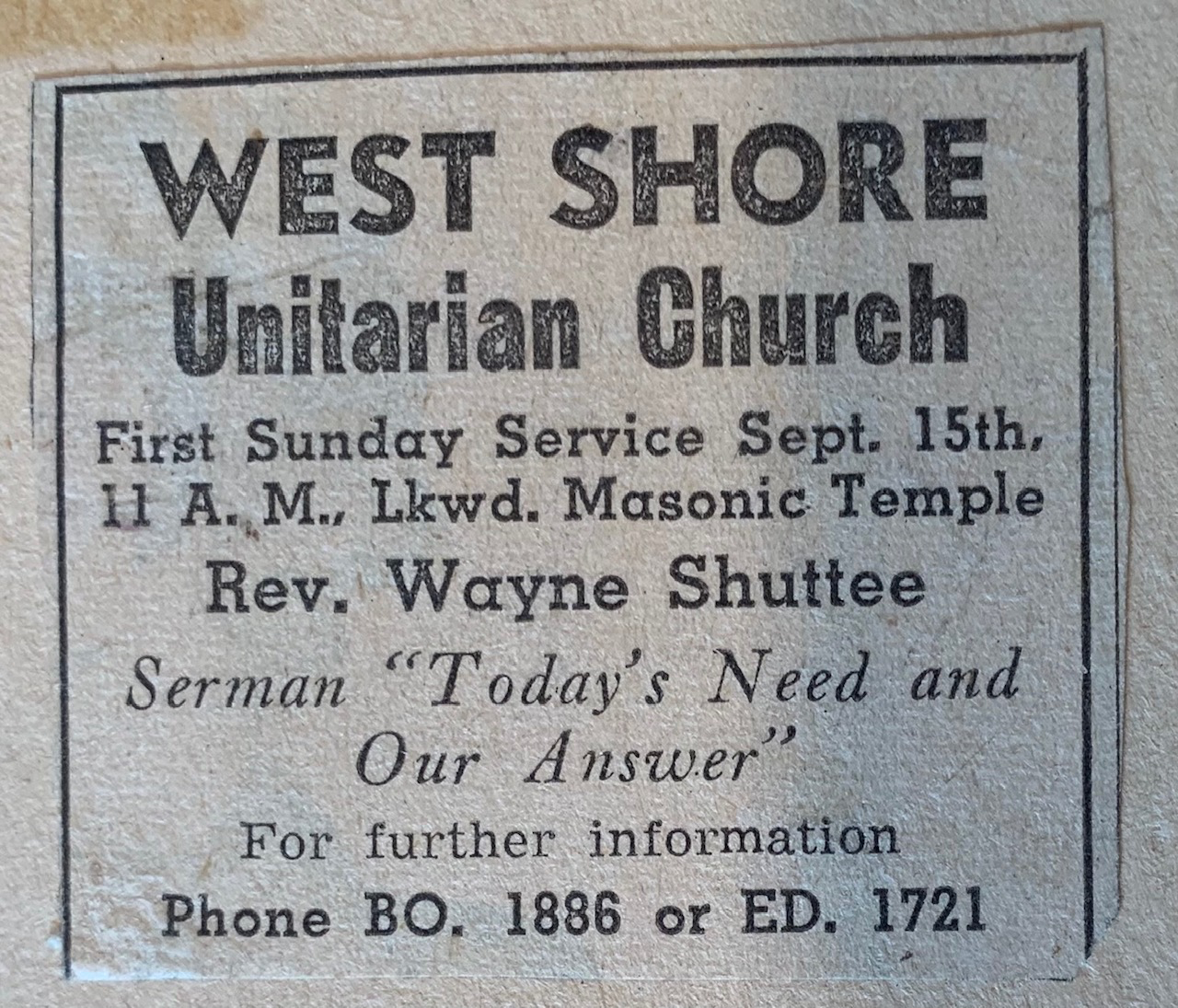
This is the newspaper ad for this church’s very first worship service in 1946, all of 79 years ago. Not too long afterwards, in the church’s November 26, 1946 newsletter, comes this statement from our religious Ancestors entitled “I Shall Dedicate Myself”:
This is my church. It is composed of people like me. We make it what it is.
I want it to be a church that is a lamp to the path of [seekers], leading them to Goodness, Truth, and Beauty. It will be, if I am.
It will make generous gifts to many causes, if I am a generous giver. It will bring other people into its worship and fellowship, if I bring them.
It will be friendly, if I am. Its pews will be filled if I fill them. It will do a great work, if I work.
It will be a church of loyalty and love, of fearlessness and faith; and a church with a noble spirit—if I, who make it what it is, am filled with these.
Therefore, with the help of God, I shall dedicate myself to the task of being all the things I want my church to be.
The Ancestors teach us: when there are growing pains, resilience and resolve must grow in equal measure, to answer the challenge. The times have never been easy. All times call for work and for sacrifice.
That is the only reason why we now exist. It really is true, what the ancient Slavs said about the Underworld. The secret of continuing life is to be found there, with the ones who went before us–whose achievements we build on and whose persistence despite suffering encourages us today.
We all know we are entering into a tough four years. Who knows what will happen.
So, among other things, we must expand our sense of time. Stop it with the sprint; we are running a marathon. We must reach back to the past and reach forward into the future. That’s where we will find inspiration. That’s where we will find courage. That’s where we will find power.
There is an old story told about a boy and his father who were walking along a road. At one point, they came across a large stone. The boy said to his father, “Do you think if I use all my strength, I can move this rock?” His father answered, “If you use all your strength, I am sure you can do it.”
The boy began to push the rock. Exerting himself as much as he could, he pushed and pushed. The rock did not move. Discouraged, he said to his father, “You were wrong, I can’t do it.”
The father placed his arm around the boy’s shoulder and said, “No, son, you didn’t use all your strength — you didn’t ask me to help.”
Let us ask the Ancestors for help, in the days to come.
At the very least, they help when we know their stories.
Whose past sacrifice, whose past courage, can light the way for you today?
Which fathers and mothers and mentors and guides and wise ones are a light to you?
We must use all the strength available to us.
Volos, come and teach us your wisdom.
 Spiritflow
Leave a comment