
Today we are befriending anger. Thus the Incredible Hulk…..

Do you know about this comic book character?
The quick story is that, one day, mild-mannered scientist Bruce Banner was in the wrong place at the wrong time. He was caught in a flood of gamma rays from an experimental bomb detonation. Ever afterwards, in stressful situations, he’d transform into the Hulk and go on destructive rampages.
Raaah!
Everyone say with me, in your best Incredible Hulk voice and manner, Raaah!!!
That’s what we want to befriend this morning. Anger triggered by stress. The feeling that stiffens our muscles and gets us muttering under our breath or cussing out loud. The feeling that gets us hot under the collar and makes us glare at others and grind our teeth.

What makes you angry?
Is it certain situations you find yourself in that feel intolerable, like chaotic traffic and drivers who don’t know how to drive?
Is it certain people who just set you off?
Is it you yourself, when you make a mistake?
Maybe it’s all the midges out there, swarming….
A few days ago I received an email from West Shore member Tim Smith, informing me that Ohio Republicans introduced a bill last Tuesday to designate the weeks between Mother’s Day and Father’s Day as “Natural Family Month.” Only families headed by two parents, one a biologically born male and the other a biologically born female, who have been together in a lifelong, monogamous way, would be celebrated. That’s how the Ohio Republicans define a “Natural Family” in House Bill 262. The goal is to [quote] “return the Natural Family to its rightful place as the Foundation of our American culture” [unquote].
What sorts of families, by the way, does this exclude as “unnatural”? Families headed by single parents, whether from the start or via divorce. Families headed by two moms or two dads. Families in which one or both parents are trans. Merged families, in which divorced parents come together to create a new family.
All are invalidated. All are wrong. One and only one kind of family gets to be right.
Learning about this made me really, really, really ANGRY.
Anger is provoked by things small and large, personal and political. These are days of anger for all of us. Maybe it’s always been like this, no matter who’s President or what the times bring. Frustration is part of the human condition. Everybody has something they want to control but can’t. Everyone’s been hurt. Everyone knows what it’s like to be treated unfairly. Indignation, bitterness, grievance, hostility are the result: at God, at our parents, at our bad luck. An underground stream of resentment flows through every human heart. Who knows the degree to which new angers are blended with and powered by the old….
However, the reality of anger is one thing. Completely different is understanding it and learning how to express it effectively.
How can we live with anger, even give it an honored place in our lives?
What is it for, anyhow?
It’s time to befriend anger, time to go deeper into this emotion that so many of us struggle with. An old wisdom story will help. I’m going to tell it in two parts. Here’s the first:
Once there was a cobra that lived by a village path, and it would bite folks as they walked past on their way to the temple. As the number of bitings increased, attendance at the temple naturally started to decrease. The path there was too dangerous. This greatly concerned the Swami, who was master at the temple. One day he came near the snake, just out of its reach. There, he began chanting a sacred word over and over and over again, and the sound was hypnotic. Soon the snake found itself completely charmed, completely under the influence of the skillful Swami. The Swami made the snake promise that it would stop biting people. And it did. No more bitings–ever.
That’s the story, part 1. Part 2 in a moment. For now, let me ask if you can relate to the snake. Anger has caused you to bite others, and someone or something came to you and said, Don’t. Promise me you won’t do it ever again.
Can you relate?
Too often, the Swami comes as terrible memories. As a kid, there were times I witnessed my Dad physically beating up my Mom. Other times, I witnessed my Mom screaming horrible things to everyone.
Anger translated into rageful behaviors was terrifying.
I’ve also had marital squabbles of my own. Nothing anywhere near the chaos I witnessed as a kid, thank God. But I know what it’s like to feel triggered. One repeating precipitating event was how my ex would load the dishwasher. I’d get angry, she’d protest with indignation, I’d follow up with a list of other things I was frustrated with, then it became a game of resentment ping-pong. Back and forth, back and forth. This followed by: doors slamming, the cold shoulder. Exhaustion. Sullen apology later, or just plain sullenness.
Times when our daughter saw some of this sent me into sheer embarrassment.
No one else here has ever been a part of a scene like this, right?
Whatever the memories are, of past fights and destructive consequences, they come to you like that Swami and say, Promise not to bite anymore.
Or perhaps the Swami comes to you with a more higher-vibration message, saying that no truly spiritual person would ever want to bite anyone. You want to be spiritual; you want to experience connection with God, or the Spirit of Life, or your greater human potential—however you understand and name that. And the all-or-nothing message you’re receiving loud and clear is that evolved beings don’t get angry.
The Swami can come to us in any number of guises, and he is persuasive. He’s got that special chant he uses to charm us, and so we slither up to him submissively, we make the promise. No more biting.
Of course, at this point we might reasonably wonder: is it even possible to fulfill such a promise?
Is it?
Conventional wisdom says it’s not possible.
Look at this picture.

Imagine that the steam erupting out of her ears sounds like a train whistle.
This image captures the essence of conventional wisdom about anger which has been around for around 100 years now: that anger is like the steam energy powering locomotives. The key assumption here is that it is the sort of energy which must be let off in controlled bursts, otherwise it just builds and builds until there’s an explosion.
Bruce Banner suddenly becomes the Hulk.
Raaah!
Call this the “hydraulic model” of anger. So many people buy into it. The result is that we come to see ourselves at the mercy of our anger. Anger is this Hulk within us that operates independently of our will. It happens without our permission or consent. It’s a sheer inner wildness which won’t go away on its own.
If there is anger, then it must be expressed. Period.
Anger sets the agenda, not us; and so the best we can do is let off steam as non-destructively as we can, as it builds up. Complain to our friends about irritating people, so we don’t rage at those folks directly. Scream at the sky. Punch a pillow. Whatever it takes. And if we don’t–one day we’ll find ourselves Hulking out at our poor spouse who doesn’t know our precise rules of how to load the dishwasher. Or doing something else that only makes things worse. .
How many of you scrolling social media have gotten so angry that, all of a sudden, you turned into an internet troll?
Anger is such a difficult emotion! It ties us up into knots because, on the one hand, the Swami comes to us in so many ways, asking us to promise never to bite again. And while we might make the promise—while we might be charmed into doing so—at the same time there is a prevailing view about the human psyche which we also might have bought into, and it tells us that we can promise all we like not to bite anyone, but anger sets the agenda, not us.
We’re in over our heads, friends. So it seems.
But there’s part 2 to our wisdom story for the day. We need to hear it right now.
The rest of the story is that the snake lived up to his promise. He did! He never allowed his anger to move him to bite anyone. People would pass the snake on the way to temple, and he would simply lay there on the ground and watch them go by. Soon the word spread: the snake was no longer dangerous. And soon–too soon after this–village boys started to poke the snake with a stick. It let them–no reaction. So they’d put the snake in a sort of noose and drag him as they ran laughing, here and there. So cruel. By the time the Swami returned to check on the snake, to see if it was keeping its promise, it was miserable looking and bleeding. The Swami exclaimed, “What has happened? Tell me how this has come to be.” The snake blurted out that he had been abused ever since he made his promise to the Swami. The Swami replied, “Foolish snake, I told you not to bite, but I did not tell you not to hiss.”
That’s the complete story. It turns out that in the end, the Swami was wiser than maybe we first thought.
More about that in a moment. Right now, consider how, against the conventional wisdom of the past 100 years, the snake was able to live up to its promise. Anger did NOT set the agenda for the snake; anger did not inexorably build up in the snake so that it couldn’t help but Hulk out.
Rather, the snake chose to let the anger dissipate on its own, and dissipate it did.
It happens, by the way, not just in fictional snakes from wisdom tales.
It happens for you and me too.
One of the best books out there on anger is by social psychologist Carol Tavris, called Anger: The Misunderstood Emotion. One of these misunderstandings she clears up is the so-called conventional wisdom of the past 100 years! Her argument is that the “hydraulic model” of anger is due to some major misreadings of Sigmund Freud’s pioneering work in psychology. Current science finds no evidence that psychic energy like anger is necessarily conserved, and if it’s there, it must be expressed or it will build and build and then explode.
No way. Carol Tavris says, “Any emotional arousal will eventually simmer down, if you just wait long enough; although some people must wait longer than others. This is why the classic advice for anger control—count to ten—has survived for centuries, with variations.” And then she quotes one of our own, the Unitarian Thomas Jefferson, third President of the United States, who once advised, “When angry, count to ten before you speak; if very angry, count to one hundred.”
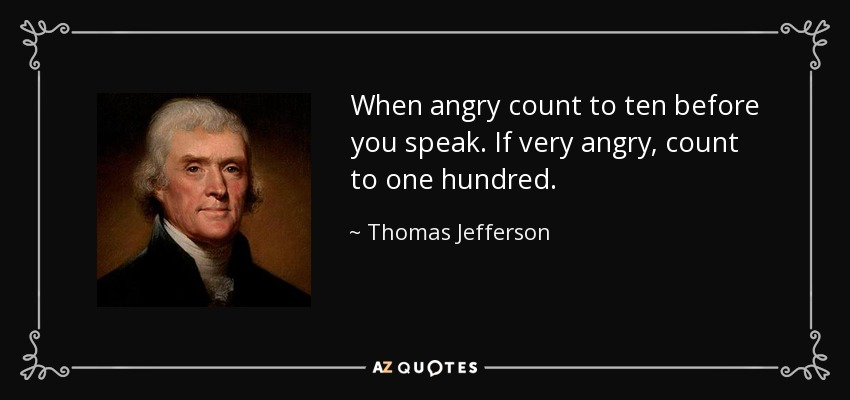
This is great news! We are not at the mercy of our anger! We’re just not going to Hulk out against our will.
Anger does not set the agenda—we do.
In fact, one of the most important choices we can make about how we’re going to manage our anger relates to talking about it—talking it out. Listen to what Carol Tavris has to say about this. She says, “Like most people I know, I have always been a firm believer in the talk-it-out strategy. Talking things over makes you feel better. That’s what friends are for. That’s what therapists are for. That’s what bartenders are for. But that’s not what the research shows. Talking out an emotion doesn’t reduce it, it rehearses it.”
Isn’t that something? It’s true. Research shows that there’s no catharsis effect when you talk about how angry you are but, rather, your anger gets more and more focused! It doesn’t go away; it just becomes more solid and present. Why is that? Perhaps because in raw form, in themselves, emotions are complicated and mixed. What you have originally is something vague and jumbled up together: love and hurt and jealousy; rage and fear; joy and guilt; sadness and fear; and on and on. All sorts of combinations making up the vague but powerful melting pot of our emotions. So when we ventilate only one part of the mix, we are in effect giving it special clarity of shape and form. We dip a spoon into the melting pot of our emotions, and what comes out is something that the spoon of all our words makes very clear and defined.
Anger.
This is why Carol Tavris affirms yet another piece of classic advice: “if you can’t say something nice, don’t say anything at all.” She says to follow this advice “if you want your anger to dissipate and your associations to remain congenial. But if you want to stay angry, if you want to use your anger, keep talking.”

Healing, in other words, involves facing a crossroads.
When rehashing your feelings over and over again only entrenches them even more and prevents you from finding peace, healing means letting go.
On the other hand, when your feelings give you energy to genuinely help our world be better, healing means holding on.
Think about the thousands of tiny things that pop up in our daily lives. So many opportunities for irritation. In our relationships, at church, on the job. If the anger you are feeling is about something truly insignificant, or maybe it’s significant but it’s in the past and life goes on, then let it go. Don’t nurture it by talking about it or by constantly watching it out of the corner of your mental eye. Simply choose to shift your attention away from it, and it will dissipate. Count to 100, to 1000.
But if you have decided, to the best of your judgment, that genuine and significant wrong has been done and you really can do something constructive about it, then stay angry and keep talking.
Sometimes healing is letting go.
Sometimes healing is holding on.
Let me say more about this latter choice of holding on. The Swami said, “I told you not to bite; but I did not tell you not to hiss.” Anger, after all, is a moral emotion. It’s a justice emotion. Anger flares up when something is perceived as wrong, when it seems that a line has been crossed.
How tragic, then, when injustice is countered by even more injustice.
How sad, when the bullied become the one bullying.
When a line has genuinely been crossed, yes, hold on to the anger. Choose to talk the anger out, talk it up, solidify it, clarify it, act on it—even if it leads to conflict which is never pleasant. But conflict does not have to be combat. It doesn’t have to be. Don’t bite. Don’t attack others physically. Don’t be violent with your words, either face-to-face or in behind-the-scenes gossip campaigns. Don’t get all holier-than-thou. But hiss, when it is appropriate and right. Say your piece, honestly and respectfully. Speak it as best you can. Our congregation’s Care Covenant offers a good framework for communicating constructively here as well as elsewhere. It’s right there in your order of service. Take a look.
The psychologist Thomas Moore adds something else important. He sees anger as motivation for personal individuation and wholeness. He says, “To be a person with presence requires the power, heat, and force that come with anger. […] If you can’t get angry, you and those around you don’t know who you are. They don’t know how you feel, nor do they understand the limits of your tolerance. Anger gives you borders and definition.”
You know how some people talk about taking up space?
Anger makes that possible. To take up the space that is rightfully yours to take. To draw boundaries and say no.
You can’t do that without hissing!
Listen to more of what Thomas Moore says: “Anger is only partly an emotion. It has an intellectual component and helps make sense of your life. If you know precisely what and who angers you, you know where you stand, some of what is going on, and how to emotionally deal with it. Anger sorts out a complex life and constantly restructures it. It may take considerable anger to change jobs or decide on a divorce. It’s obvious that social wrongs are only corrected when the abused get angry enough and resist.”
In this light, a truly spiritual life will absolutely make room for anger. Interpreted rightly, anger can be exactly the energy we need to break through blocks to personal and spiritual growth. It can move us to heal our communities and heal our world. There is a reason why the man who said “turn the other cheek” is also portrayed as going into the temple and, in a state of righteous anger, overturning the moneychangers’ tables.
I’m talking about Jesus. Spiritual people can be angry and can use anger to do good things. It’s all in the how.
These days, there’s so much to be angry about.
The President of the United States of America literally tweeted that he hates Taylor Swift. Every day brings a new onslaught of pathetic and immature behavior piled on top of truly egregious acts. Every day. Every day.
Nevertheless, take care. We are in a marathon not a sprint. Don’t allow yourself to be eaten up by anger. Take a break sometimes. Go to a comedy show or 10. Remember all the things to be grateful for. Stop and smell the flowers.
And then, when you’ve got the capacity, discover the thing that makes you angry most of all. Maybe it won’t be at the top of the list for someone else. That’s just fine. People are different. But if it’s at the top of the list for you, then pay attention. Just like Thomas Moore said, your anger is telling you who you are and where you stand.
So now: let it move you. Do the thing you can do. Make the contribution you can make. Create out of it. Organize. Think about that mother from years ago, whose child was murdered by a drunk driver. It hurt her so badly, and nothing took away the memory. But she wouldn’t allow herself to get used to feeling like a victim. She organized Mothers Against Drunk Drivers. Her anger led her to that, and to her healing.

There she is. That’s Candy Lightner, holding the picture of her 13-year-old daughter, Cari, who had been on her way to a church carnival when a drunk driver struck her from behind.
It made Candy really, really, really MADD.
Thank God. The difference she has made.
Let anger make you a difference maker too, in your own way.
Sometimes healing is letting go. Sometimes healing is holding on. May you face the crossroads of your anger with wisdom and discernment.
And, if you choose to hold on, remember the story of the swami and the snake.
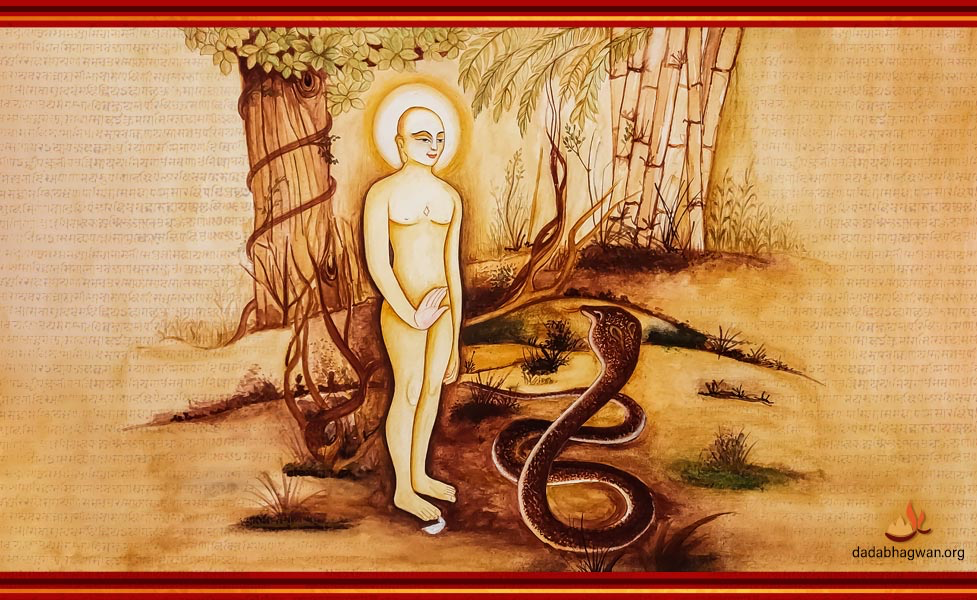
Don’t bite. But hiss.




 Spiritflow
Leave a comment