
Did you know that some of the most important spiritual work we do around here is talk?
Friendship-building talk.
Purpose-clarification talk.
Learning about history to gain wisdom and guidance talk.
Encouragement talk.
Emotional healing talk.
Correction of inaccurate information talk.
Sharing inspiration talk.
Telling your story talk.
Finding your place in the community talk.
Facing scary feelings and not feeling so alone anymore talk.
Organizing so when we’re out there trying to make a difference we’re all on the same page talk.
Meaning-making talk.

Talk talk talk!
The idea of “all talk and no action” makes no sense in this context. Talk IS action, of a special kind.
The problem is never about talking too much. The problem is not talking enough about the right things at the right time.
And so, today, on this Flower Communion Sunday, we’re talking about how we might talk together in ways that create a community bouquet of flowers that is breathtakingly beautiful.
I’ll jump in with some science, as I often like to do.
From the psychology department of the University of Arizona comes a study about happiness and the role that big talk, as opposed to small talk, plays.
Do you get that distinction, by the way? Big talk vs. small talk?
Big talk is when people get existential with each other—when we deep dive into conversations about things that frighten us to death, or perplex us, or things we are enthusiastic about and we are exposing ourselves, and the risk is that someone might denigrate us, shame us, laugh at us, and maybe they don’t, maybe they do, but the point is that we are showing up in our authenticity and our vulnerability about things that matter to us deeply.
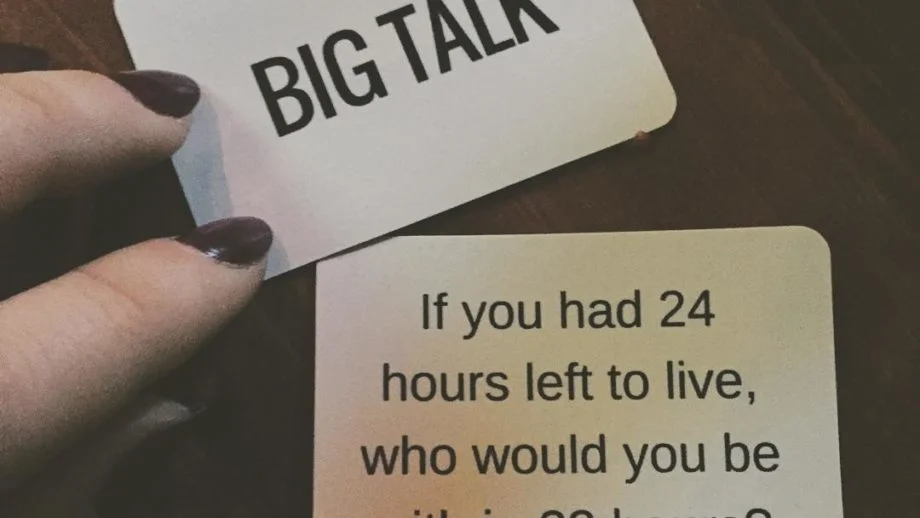
University of Arizona psychologist, Matthias Mehl, says that the risks are well worth it because big talk is the road to happiness in life. People are by nature meaning-makers and we get sick if we don’t find or make meaning. People are by nature social animals and we get sick when we aren’t making the social connections we need.
Big talk satisfies both big needs of our natures.
The scientific study involved participants wearing electronically activated recorders with microphones on their lapels that recorded 30-second snippets of conversation every 12.5 minutes for four days. Turns out that the happiest people engaged in big talk conversations 46% of the time and only 10% in small talk. (There’s another category of talk implied here: a practical one which is neither big nor small, primarily about chores. This explains why 46% plus 10% doesn’t get to 100%).
As for the unhappiest people? They engaged in small talk more than three times as much as the happiest.
All the small talk left no room for big talk.
I’m reminded of a poem from Guante, an American hip hop recording artist and a national slam poet champion,

where he says:
I’ve never been very good at small talk
right
I’m always too busy wondering where
the interesting scars come from
I could give them joyful heart attacks
I could Santa Clause their systems
I could rattle off a string of pop-culture references
or rap really really fast
and we’d all have a good laugh
but
I don’t
Nature in us wants us to go deep. It’s why congregations like this one exist. “Don’t ask what the world needs,” says theologian Howard Thurman. “Ask what makes you come alive, and go do it. Because what the world needs is people who have come alive.”
I know the world can at times feel like it’s coming apart. I know.
But ask what makes you come alive, and go do it.
One of the ways West Shore supports greater aliveness in people is through Connection Circles. A Connection Circle is essentially a group of 6-10 people who agree to meet at least once/month (or more) for at least a year. It’s a bit like a chosen family. At every meeting, there’s time for a personal check in from everyone about what’s going on in their lives. Then there’s mutual exploration of a theme that’s inspiring, or challenging, or fascinating. People are relating in deep ways thoughtfully and respectfully. It’s a big talk sort of time, and let me tell you, it can save lives.
After the service today, I’m offering a sample Connection Circle experience here in the sanctuary starting at noon, for one hour. Maybe you’ve heard about Connection Circles before but aren’t sure–and are curious. Maybe you’re hearing about them for the first time–and are curious. Maybe you’ve been a part of a Connection Circle in the past and would like to experience how we do CCs now.
Come join me and find out more.
Moving on, now. When we talk about big talk, there’s something we must consider. And I have learned this in plenty of ways, including hard ways: the intimacy of big talk cannot be forced. A person can get all existential way too fast, they can overshare, and their conversation partners start to lean out rather than lean in. Their conversation partners start to get fidgety, they start to get that frozen smile on their faces, they start scanning the room for a quick exit.
Know what I mean?
Big talk can’t be forced. I’m not going to expose my deepest enthusiasms to just anyone, because what if they blow my candle out with a mean joke or a dismissive sneer? Prove to me that you can handle my small talk, and maybe I’ll enter into the big talk with you.
Especially as an introvert, I need that proof.

If you small talk about my appearance and say I’ve lost weight and I’ve never looked better, are you saying that I used to be unattractive? And did you know that I’ve been ill and stressed out and that’s why I’ve lost weight?
Not going to big talk with you.
If you small talk about your childhood stamp collection, your pet tarantula, your personal phobias, and you go on and on, and I have no way of joining you in the conversation because I can’t relate to your extremely narrow enthusiasms that you can’t seem to stop talking about—that’s telling me something.
Not going to big talk with you.
If you small talk about all the ways you hate your job and hate your life and your words are a laundry list of grievances and complaints mixed in with gossip:
Not going to big talk with you.
If I am a person of color and you small talk about how you don’t see race, how there’s only one race which is the human race, and you have just denied the singular fact about me that impacts everything and gives me joy and also makes me (unlike you) a target of racism:
Not going to big talk with you.
If I am a woman and I am talking about something and you are a man and you start to talk over me about the same exact thing I was but you go on and on in your mansplaining ways as if I needed a lesson or a lecture from you:
Not going to big talk with you.
If you take a topic like faith and you small talk it—you slam Christianity for example, the whole religion, even though there are many kinds of Christianity and they run the full spectrum and you can’t generalize but that’s what you do, you make small talk out of something that is way too big:
Not going to big talk with you.
And all of this is just so tragic. We exist to get to the big talk. We exist to show each other our interesting scars.
We get sick when we can’t go there.
But we have to go through the small talk first, and in the right way. We need to engage the rituals of small talk skillfully, so we can create that precious feeling of neighborliness.
Remember Mr. Rogers?

It’s a beautiful day in this neighborhood
A beautiful day for a neighbor
Would you be mine? Could you be mine?
Won’t you be my neighbor?
Yes I will, if the small talk is skillful enough to create that neighborly feeling.
Here’s an analogy to think on. A community is like a house. It has a front door and foyer where guests are welcomed–and that’s where the small talk happens. But like all houses, when you enter in completely, you find the living room, where more small talk happens but sometimes it can be a bit bigger. And then there’s the kitchen. There, in the kitchen, at the kitchen table, is where the deepest, I-can’t-sleep-because-I’m-worried conversations (or, I-can’t-sleep-because-I’m-so-excited conversations) happen.
Big talk happens there.
But my main point is that no one goes straight from the front door and foyer to the kitchen table. Kitchen table conversations are possible because they happen within a container of trust and accountability, and all that takes time. There’s no shortcut to that. Strangers need to start the bonding process first, and then let things unfold from there.
First the front door and foyer. Then the living room. Only then, the kitchen.
So, yes,
I’m always too busy wondering where
the interesting scars come from
I am–we are–but first things first.
Here are some things to keep in mind as we engage in small talk.

First, some folks just dread small talk. They worry it will be boring, awkward, or they’ll run out of gas. And it’s the dread and anxiety that become a self-fulfilling prophecy. Anxiety becomes the bottleneck.
So bring awareness to your anxiety, if you can relate to what I’m saying here. Breathe into it. Know that there’s purpose to small talk in this space of Beloved Community, because you want to get to the kitchen table conversation. You want to find the people who are going to sit at that table with you. The investment is worth it. Breathe into the anxiety. Go do the thing that will make you come alive. And then later on, at home, treat yourself to ice cream (or gelato!) and your favorite Netflix movie because you just did something really hard.
Second: know that some topics are just not appropriate for small talk. Even the best-intentioned comments about a person’s body or looks can go so wrong, so take care. Other small talk topics to avoid include: questions about how much money someone makes; or idiosyncratic interests that make it hard for most others to relate; or a steady stream of complaints and gossip.
Or what about offering random bits of advice? Have you ever been in small talk with someone and they don’t know you and suddenly they are giving you all sorts of online dating tips? Or some other advice that is meant to make your life better–but how could they possibly know what you need?
And then there are some small talk patterns that certain folks need to bring awareness to. Some men just have a tendency to dominate conversations and they can go into mansplaining mode so easily. White people can just slip into racially insensitive talk so easily.
If it happens, and if the people around us in the moment are kind enough to call us in on it—to gently say, Hey, that’s doesn’t feel good to hear, and this is why—then let’s say we’re sorry and learn from it. No need to collapse into a heap of shame. As a straight white male, the flip side of all the gifts I can give out of my straight white maleness is an entire world that has schooled me in ignorance about what it is like to be gay, a person of color, and a woman, and I am just going to say stupid, insensitive things sometimes.
But I—we—count on the kindness of strangers and friends to help us learn and grow. We really do. As a very wise congregant once said, If I have a big hunk of spinach in my teeth and I’m walking around and I’m talking up a storm and that big hunk is just hanging out there and grossing everyone one, don’t let me keep on embarrassing myself. Do me a kindness and tell me!

From here, my wise congregant went on to say: It is even more kind if you help me grow as a soul wanting to bring greater compassion and justice and equity to this world. It is even more kind. Let me know if I have given voice unconsciously to some -ism in me: racism, sexism, homophobia, and all the others.
Let me know. It doesn’t have to come from a holier-than-thou place. It can come from a quiet, Hey I care about you place, this is what I heard, is that really how you were wanting to come across?
What, do you think, are the top three topics that are small-talk no-nos?
Religion.
Politics.
Sex.
But at church, how can you possibly avoid such topics? Religion, politics, and sex are among the most spiritually-relevant things there are, and if we’re not talking about such things, we’re not doing our proper work!
I would suggest two things here. When you don’t really know someone—when you don’t really know their story, their joys, their hurts—go gently. (I mean, always go gently, but here go especially gently.) Say, for example, that they tell you paganism is important to them. But you have a knee-jerk reaction to that word. It brings up bad stuff for you, for whatever reason. I highly suggest that you do not use the small talk context as a time to build a wall. Go gently. Maybe you can ask them to say more about what paganism means for them—you may be surprised that you find yourself intrigued and curious and wanting to learn more. Maybe you can respond in another way that’s warm. But don’t go all instantly cold and condemnatory. That’s just not good Unitarian Universalism.
The other thing I would suggest is to remember that the small talk conversation you’ve entered into is just a beginning. Here at West Shore, in our conversations together, we are not like seat mates on a plane and we’re having one of those conversations in which we bare all in 30 minutes or three hours—and then we never see each other again. No. We are in this thing for the long-haul. Our Memorial Garden tells the truth that West Shore supports us in our life and remembers us in our death.
That’s the long haul. That’s who we are. That’s what membership means.
It’s something especially important to remember if you have hurt another person here, or you have felt hurt and feel a grudge. Better to say sorry; better to say, You have hurt me and we need to talk; better to do this sooner rather than later; far better to do this than experience continued pain in this community that is supposed to be Beloved and a space of freedom.
Don’t feel guilty about small talk. If it makes you anxious, hold that feeling lightly and don’t clench around it. We’re not going to stay stuck in the small talk. Small talk puts us on the path to big talk.
So please, talk about the weather. Talk about your favorite movie. Talk about sports, your work, your travel, your hobbies, your hometown.
Good small talk is like asking, “Won’t you be my neighbor?”
And the answer you’ll get is, “Yes.”
Then watch how the small talk starts to grow bigger and bigger and bigger.
From the door and foyer, you wander into the living room.
From the living room, you make your way to the kitchen and its table.
Now the talk is all big.
It’s soul-deepening talk,
It’s justice-seeking talk.
It’s the sort of talk that represents action of its own kind,
action that changes lives,
action that changes the world.
People, let’s talk!



 Spiritflow
Leave a comment