
There aren’t many people about whom it can be said that they transformed the very nature of their profession. That, before they arrived on the scene, it was one way, but when they left, it was something else entirely.
But you can say it about Muhammad Ali.
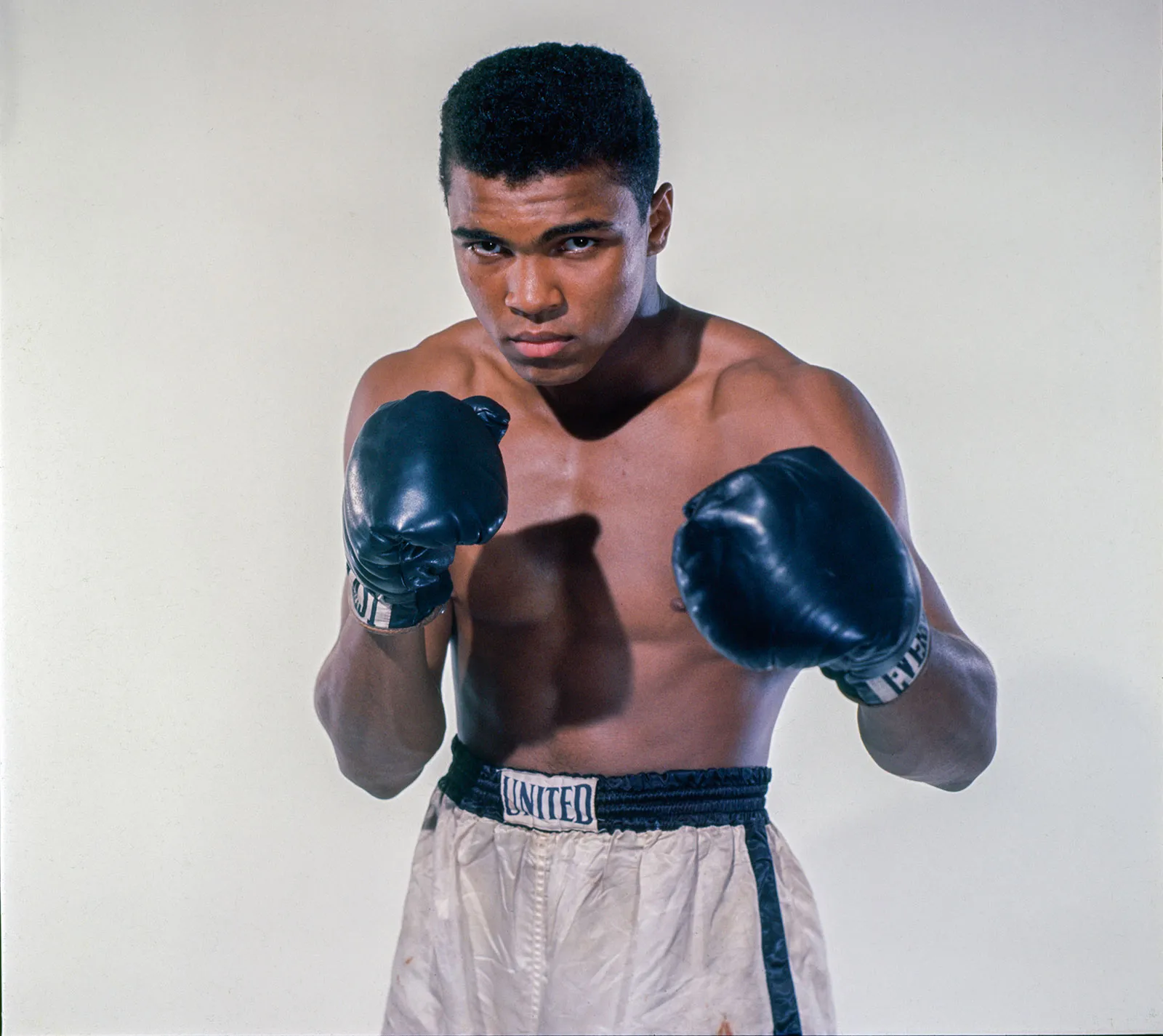
This was a man who, besides being the world heavyweight boxing champion in the 1960s and 1970s, transformed what it meant to be a sports hero.
Before, it meant being the strong and silent type. After: something entirely different.
Listen to the sorts of things Ali used to say:
If you even dream of beating me you’d better wake up and apologize.
I am the greatest, I said that even before I knew I was.
I’m so mean, I make medicine sick.
But now listen to this one, right on target with my topic today about fulfilling our potentials:
Impossible is just a big word thrown around by small men who find it easier to live in the world they’ve been given than to explore the power they have to change it. Impossible is not a fact. It’s an opinion. Impossible is not a declaration. It’s a dare.
And then he says,
If they can make penicillin out of moldy bread, they can sure make something out of you.
Ali loved to go on and on about his greatness, but he never thought that others couldn’t find their own special form of greatness too.
I think our Unitarian Universalist spiritual ancestor Ralph Waldo Emerson might have really liked him, because Emerson was also passionate about the depths of human potential and he, too, expressed his passion in controversial ways. His particular way was to deny godhood to Jesus. If Jesus’ goodness came from his being an actual God, then what hope do mere mortals have for fulfilling their own full potentials? Making Jesus into a God becomes an excuse for human beings to sell themselves short and let themselves off the hook.
It’s tragic, because something else Emerson passionately believed is that Jesus-like potentials exist in all people. Sell ourselves short, though, and what’s in us waiting to be released will stay inside. It’ll go nowhere.
In fact, it will toxify. This last insight comes not from Emerson but from the Gnostic Gospel of Thomas and presumably from the lips of Jesus himself. “If you bring forth what is within you,” said Jesus, “what you bring forth will save you. If you do not bring forth what is within you, what you do not bring forth will destroy you.”
To neglect one’s inner potentials or to suppress them is disastrous.
It is urgent, therefore, for people to be educated out of bad theology and educated into something better. People must take a turn in their thinking. And so Emerson says, “There is a time in every [person’s] education when he arrives at the conviction that envy is ignorance; that imitation is suicide; that he must take himself for better, for worse, as his portion; that though the wide universe is full of good, no kernel of nourishing corn can come to him but through his toil bestowed on that plot of ground which is given to him to till.”

Emerson is saying: Avoid envying and imitating others. Stop resisting your life. Look to it instead as a wellspring of possibilities in the making. Bring forth what is within you. Do the work. Get your hands dirty. The result is sweet.
And it is surprisingly hard to do. You would think that it should be easy to just stand there and shine, be the star that you are, but no. The Unitarian Universalist poet May Sarton speaks to this in her poem entitled “Now I Become Myself.”
Now I become myself. It’s taken
Time, many years and places;
I have been dissolved and shaken,
worn other people’s faces,
Run madly, as if Time were there,
Terribly old, crying a warning,
‘Hurry, you will be dead before [long].”
There’s more to the poem. But stop right there with her insight about death. That is the ultimate context. Death is coming. Life hurts us all, and resentment is easy. But to wallow in that for too long or forever is to waste opportunities to heal and to grow.
Death is coming! Find your resilience and your joy and do it fast!
But, hearing the call of one’s true life—fulfilling it—is a journey that takes as long as it takes. Life is like a labyrinth and sometimes you’ve got to go down a long circuit of grief before the path suddenly turns to peace and gratitude. You can’t short-circuit the process. Everyone learns at their own pace. Many years and many places are indeed required.
And yes, as the poet says, we do wear other people’s faces. Sometimes it’s a matter of developmental necessity, in which infants and children must borrow from their parents and other primary caregivers because there is no other way forward. Then there are the faces we wear that are the stereotypes other people have of us as individuals or as members of some identity group, and they press those faces hard upon us, pressuring us to conform.

We wear other people’s faces. But what’s underneath all those masks? What does YOUR face look like?
At times, it’s really about fear.
Comedian Jim Carrey speaks about fear in connection with his father. He says, “My father could have been a great comedian, but he didn’t believe that was possible for him, and so he made a conservative choice. Instead, he got a safe job as an accountant, and when I was 12 years old, he was let go from that safe job and our family had to do whatever we could to survive.”
Jim Carrey’s dad wore another person’s face.
Fear about showing up to our lives is huge.
A different source of fear comes from being established in the world. You aren’t like Jim Carrey’s dad, just starting out. That was years ago. Now you’re settled. Now you have a comfortable income and a monthly mortgage to pay. Now you are in a relationship that has settled into predictable and stable patterns.
And guess what? You’re not satisfied. It may make no sense to your mind. Your mind knows that you have it made. Your mind knows that you have achieved society’s vision of what is admirable and even enviable. But the heart disagrees. The soul has its own truth to say. It feels in a deep and undeniable way that things are out of whack and that you are out of whack.
When it is clear that “the life I am living is not the life that wants to live in me,” it can shake you to your core. Society defines a success path that goes one way, but you sense that you must go another way and follow the different drumbeat of your own labyrinthine heart.

Or else. Echoing Jesus in the Gospel of Thomas is the poet Langston Hughes, who has a thing to say about dreams deferred. They don’t just go away. Things in your life dry up. You stagnate. Or things get volatile. The denied dream festers and runs, or stinks, or crusts and sugars over, or sags, or explodes—anything but unfold naturally, as is their right.
So it’s out of the frying pan into the fire.
Yet the only way out is through.
We must, with heroic courage, pursue the life that wants to be lived through us.
But then, what is that mysterious life, so in disagreement with the life we are living?
How to discern it?
“I learned many great lessons from my father,” says Jim Carrey, “not the least of which was that you can fail at what you don’t want, so you might as well take a chance on doing what you love.”
“Fear is going to be a player in your life,” he says, “but you get to decide how much. You can spend your whole life imagining ghosts, worrying about your pathway to the future, but all there will ever be is what’s happening here, and the decisions we make in this moment, which are based in either love or fear.”

“Your job,” Jim Carrey says, “is not to figure out how it’s going to happen for you, but to open the door in your head and when the doors open in real life, just walk through it. Don’t worry if you miss your cue. There will always be another door opening. They keep opening.”
This is what having faith means to a Unitarian Universalist. That typical religious word, ”faith,” can bring up so many different things including, for some of us, believing what you know ain’t true. But how can you know, with certainty, that there won’t be other doors opening for you in your future? No one can know that. If there’s something to truly know about pessimism, it’s that your expectations can determine your awareness. Expect doors to be closed (and locked), and you’ll never try opening one.
Better to have faith. Better to trust that there will always be another door opening.
Perhaps some volunteer opportunity here is just one of these doors that Jim Carrey’s talking about. Just walk through. See where it takes you. I can’t tell you how many stories I’ve heard about congregants who opened the volunteerism door, and the result was a changed sense of themselves and what they can do.
One of those stories is my own. One of my volunteer roles in the Unitarian Universalist church, many years ago, was to organize the Brazos Valley Alternative Healing Expo. This was back in College Station, Texas. It was a huge undertaking in which I reached out to dozens of local businesses that offered alternative healing services–my favorite was the chiropractor whose clientele was animals. I persuaded 15 or so business owners to purchase booth space for an all-day event at my church, got the church on board to sponsor this and provide the space, marketed the heck out of the event, and even created the brochure and developed the logo for the event.
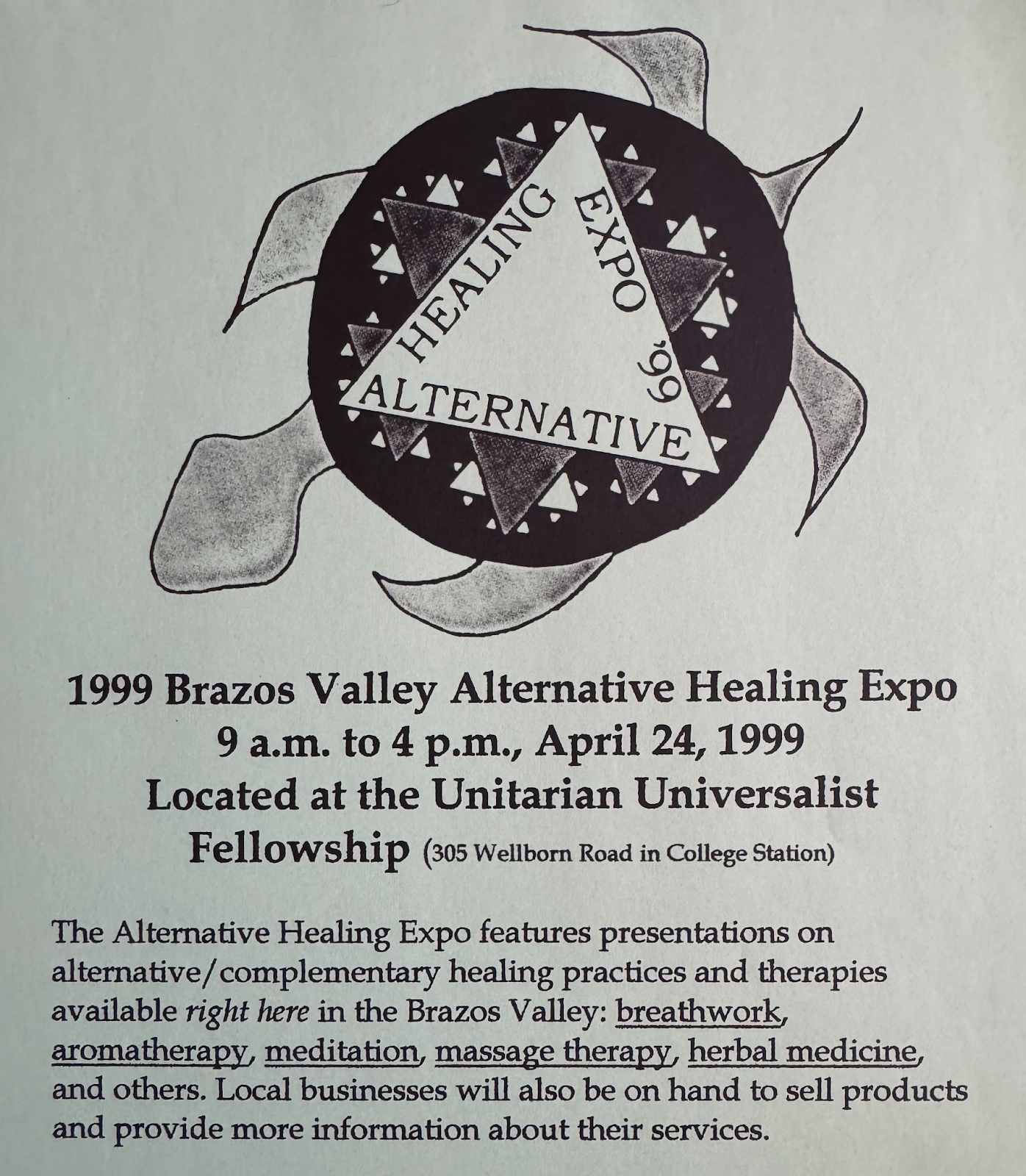
I did this when my paid job at the time (as a college professor of philosophy) felt distressingly unsatisfying to me. I didn’t want it to. I felt restless and did not know why, I felt confined, I felt discouraged. But from my stint as the volunteer creator and coordinator of the Brazos Valley Alternative Healing Expo, and from the way my church believed in me, I gained new life and new understanding about what I liked to do. I like to be a jack-of-all-trades, I like to coordinate, I like to bring people together in service to something worthy.
It turned out to be part of my call to ministry, part of the way I recognized what my vocational step beyond the academy could be.
I stepped through the door. I really believe it was just as Jim Carrey puts it: love over fear. Loving, not fearing, my sense of restlessness. Loving it enough to see what was really there, which was energy for very different kinds of things. Love that gave me courage to go with my gut and do something that, from another perspective, might have seemed weird.
Organizing an Alternative Healing Expo? What? Where did that come from?
The interest I felt in doing this was something that was just there. But it was a choice to love it and to see it through.
It was love over fear.
To quote Emerson again, “Though the wide universe is full of good, no kernel of nourishing corn can come to [a person] but through his toil bestowed on that plot of ground which is given to him to till.”
My church volunteer project was my plot of ground, given to me, and I got my hands dirty.
What is your plot of ground looking like these days?
A Sufi wisdom story, which echoes the same basic idea, shifts up the imagery. Not a plot of ground, but a prayer rug.
The story goes: A man in prison receives a gift. It is a gift of a prayer rug. What he wanted of course was a file, a crowbar or a key. But he began using the rug, doing the five-times prayer at dawn, at noon, mid-afternoon, after sunset and before going to sleep. Bowing, sitting up, bowing again…after many days of prayer he notices an odd pattern in the weave of the rug at the point where his head touches. He studies and meditates on that pattern, gradually discovering that it is a diagram of the lock…a picture of the lock that confines him to his cell and it shows how it works. Studying the diagram, he is able to escape.
I’m wanting to emphasize the plot of ground image, or the prayer rug image, because what life hands us (including the personal interests that bubble up within) might not conform to what the inner critic says is respectable or what the inner finance committee says is marketable and money-making. So what. It’s your door to walk through, your plot of land to till, your prayer rug to pray on.
The Rev. Robert Fulghum, Unitarian Universalist minister and author of All I Really Need to Know I Learned in Kindergarten, gets it. He tells the story of his friend Larry Walters:
Walters is a truck driver, thirty three years old. He is sitting in his lawn chair in his backyard, wishing he could fly. For as long as he could remember, he wanted to go up. To be able to just rise right up in the air and see for a long way.
But the time, money, education, and opportunity to be a pilot were not his. Hang gliding was too dangerous, and any good place for gliding was too far away. So he spent a lot of summer afternoons sitting in his backyard in his ordinary old aluminum lawn chair—the kind with the webbing and rivets. Just like the one you’ve got in your backyard.
The next chapter in this story is carried by the newspapers and television. There’s old Larry Walters up in the air over Los Angeles. Flying at last. Really getting UP there. Still sitting in his aluminum lawn chair, but it’s hooked on to forty-five helium-filled surplus weather balloons. Larry has a parachute on, a CB radio, a six-pack of beer, some peanut butter and jelly sandwiches, and a BB gun to pop some of the balloons to come down. And instead of being just a couple of hundred feet over his neighborhood, he shot up eleven thousand feet, right through the approach corridor to the Los Angeles International Airport.
Walters is a taciturn man. When asked by the press why he did it, he said, “You can’t just sit there.” When asked if he was scared, he answered, “Wonderfully so.” When asked if he would do it again, he said, “Nope.” And asked if he was glad that he did it, he grinned from ear to ear and said, “Oh, yes.”
That’s the story. We all just wish we could fly! But so often, the form that our true freedom takes looks very different from what we (or the world) expects.
So what. It is freedom.
With love, with faith, we care for ourselves. Finally we are living the life that wishes to live through us.
Says Muhummad Ali, “Impossible is not a declaration. It’s a dare.”
I’ll close with another story about Ali. You may know that he was diagnosed with Parkinson’s Disease, a chronic illness that leads to difficulties with movement, mood, and other functions. Chronic means you can’t cure it. It can only be managed, and it progresses over time. But even worse than this is how people can treat folks with Parkinson’s like objects of pity, as victims who need saving, as people who can’t possibly have true quality of life of their own, as souls with dignity untouched by the disease and invaluable life lessons still to learn for which only Parkinson’s can be the teacher.
Like Ali, you and I have life stories with many chapters, and with the turn of a page, the new chapter might be radically different from what went before. A sudden and unexpected turning. Ali’s last chapter was Parkinson’s. But it was still his plot of ground to till and rug to pray on. He embraced it fully–not as a victim but as a fighter–because he had faith.
The story is from Cal Fussman, writer for Esquire magazine:
Muhammad Ali came through the double doors into the living room of his hotel suite on slow, tender steps. I held out my hand. He opened his arms. Ali lowered himself into a wide, soft chair, and I sat on an adjacent sofa. “I’ve come,” I said, “to ask about the wisdom you’ve taken from all you’ve been through.”
Ali seemed preoccupied with his right hand, which was trembling over his right thigh … and he did not speak.
“George Foreman told me that you were the most important man in the world. When I asked him why, he said that when you walked into a room, it didn’t matter who was there—presidents, prime ministers, CEOs, movie stars—everybody turned toward you. He said you were the most important man in the world because you made everybody else’s heart beat faster.”
The shaking in Ali’s right hand seemed to creep above his elbow. Both of his arms were quivering now, and his breaths were short and quick.
I leaned in awkwardly, not knowing quite what to do. Half a minute passed in silence. I wondered if I should call for his wife.
Ali stooped over, and now his whole body was trembling and his breaths were almost gasps.
“Champ! You okay? You okay?”
Ali’s head lifted and slowly turned to me with the smile of an eight-year-old.
“Scared ya, huh?”
That’s the story.
I don’t care what your age is and whether you are formally going to some sort of school. We are all always on a learning journey in the labyrinth that is our life, and there will be twists and turns. The chapter you’re heading into may be a world apart from the chapter you just left. There may be joy, there may be woe. But every chapter is part of the total journey of becoming fully ourselves and whole.
Everyone in here wears a symbolic backpack, to represent this great truth.
So let me put this picture in your backpack, to bless you in your learning journey.
Let Muhammad Ali’s chutzpa be yours!

 Spiritflow
Leave a comment