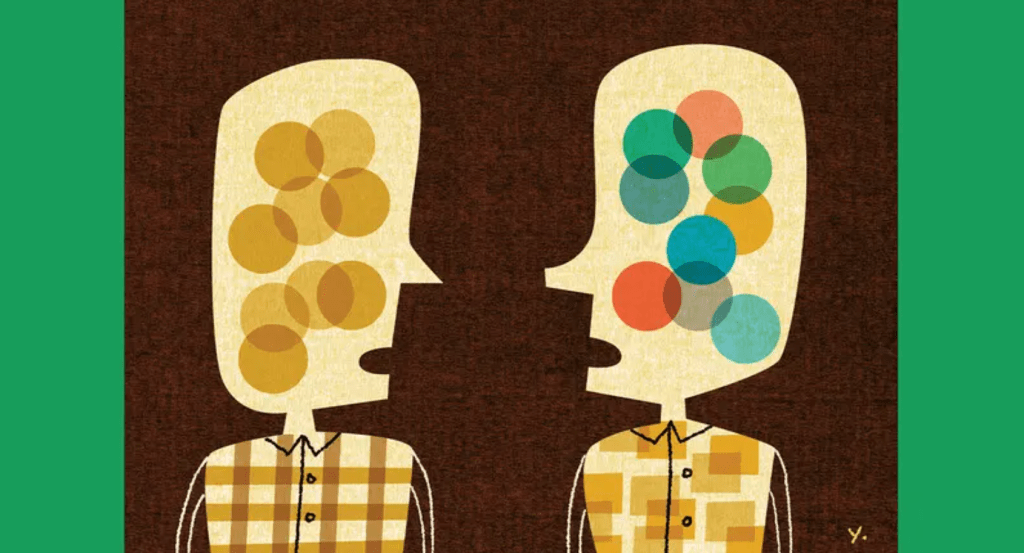
Braver Angels is leading the nation’s largest cross-partisan, volunteer-led movement to bridge the partisan divide and strengthen our democratic republic. See https://braverangels.org/. Today’s message was shared with West Shore congregant Joan Clark, who spoke about this organization and our critical need today to have constructive congregations across our social and political differences and disagreements. The following sermon followed Joan’s message.
Much gratitude to Joan for joining me in creating today’s service and in being one of our Unitarian Universalist champions for liberalism. Liberalism, whether religious or secular, affirms that communities and society as a whole are better off when individuals have wide scope for individual choice and expression. This includes conversations across differences in which people bring their honest convictions and they are free to agree or disagree in the moment.

That freedom feels good, and it opens things up. Seeds of change may very well be planted, which bloom in their own good time.
Among other things, Joan shared some “Braver Angel” communication skills that support liberal spaces of freedom, reason, and tolerance. What I wish to offer here, however, are some thoughts about what might prevent folks from entering into such conversations to begin with.
In doing this, I will draw extensively from the experience of Sarah McBride, the freshman congresswoman from Delaware who’s the first openly trans member of Congress.

“I think,” she says, “that we are in this place where we are in this fierce competition for pain. Where the left says to the right: What do you know about pain, white, straight, cis man? My pain is real as a queer, transgender person. And then the right says to the left: What do you know about pain, college-educated, cosmopolitan elite? My pain is real in a postindustrial community ravaged by the opioid crisis. We are,” Sara McBride says, “in this competition for pain when there is plenty of pain to go around. And every therapist will tell you that the first step to healing is to have your pain seen and validated.”
But the pain is not seen and validated. The pain is minimized or discounted, often because the other side is seen as depraved, disgusting, inhuman. Only pain on our side matters. So, what replaces conversation between people who truly do have a lot in common (namely vulnerability, fear, and suffering) is acrimony and a back and forth cycle of retaliation.
Sarah McBride goes on to acknowledge that one may never automatically equate the social and political Left with liberalism. Plenty of people on the Left have abandoned liberalism and have gone illiberal and authoritarian. She says that. I quote: “We created this ‘all-on’ or ‘all-off’ mentality, that you had to be perfect on trans rights across the board, use exactly the right language, and unless you do that, you are a bigot, you’re an enemy.” She uses the term “maximalism” to describe this. Only the maximal plan is the acceptable plan. Compromise is despicable. People are expected to instantly obey, and if they don’t, they’re written off as horrible human beings.
That’s authoritarianism from the Left.
“So many of the problems that we face,” says Sarah McBride, “are rooted in the fact that hurt people hurt people.” Left-wing maximalism (or illiberalism, or authoritarianism), which shuts down conversation and seeks to force instant change, can reasonably be seen to come from a place of hurt. It comes from a place of real urgency. Trans people are suffering now, trans people are dying now. Sarah McBride knows this personally. “People,” she says, “have one life. And it is completely understandable that a person would feel: I have one life, and when you ask me to wait, you are asking me to watch my one life pass by without the respect and fairness that I deserve. And that is too much to ask of anyone.”
Yes. And yet, look at what happens when an unready public feels forced to change as directed by leaders who come across all holier-than-thou. What happens is resentment. What happens is outright rebellion and escalating backlash that is extreme in exactly the opposite direction. Even reasonable people in or near the middle who might otherwise be open to conversation and change dig in their heels.
Come across all holier-than-thou (which is the exact tone of maximalism or illiberalism or authoritarianism) and people will vote against their best interests because you have offended their sense of dignity. The high price of eggs doesn’t really matter when the far higher price of a diminished sense of self-worth is at stake.
Sarah McBride’s comments, by the way, come from a New York Times article from this past June (https://www.nytimes.com/2025/06/17/opinion/ezra-klein-podcast-sarah-mcbride.html), in which writer Ezra Klein is interviewing her about the current state of trans rights. What is that state? “By every objective metric,” she says, “support for trans rights is worse now than it was six or seven years ago. And that’s not isolated to just trans issues. I think if you look across issues of gender right now, you have seen a regression. Marriage equality support is actually lower now than it was a couple of years ago in a recent poll. We also see a regression around support for whether women should have the same opportunities as men compared to five, 10, 15 years ago.” Sarah McBride’s basic, pragmatic argument is that Democratic Party and progressive group illiberalism isn’t helping. It’s backfiring. It’s making things worse, not better.
The same thing could be said about current Democratic and progressive diversity initiatives. A couple weeks ago I read another New York Times article entitled “Inside the Rise of the Multiracial Right.” (That phrase–“the rise of the multicultural right”–does it summon your attention too, as it instantly did mine?) The article reports the results of a 15 year study by two Yale University political scientists, and these results reveal how communities of color are hurting from problems that aren’t being solved by DEI initiatives, yet Democrats and progressives are only doubling-down on DEI. That’s a big part of what’s behind the rise of the multiracial Right. Listen to one of the folks the Yale University profs interviewed: Orlando Owens, a Black pastor and social activist.

He speaks of attending a meeting of Democrats and the message was: “We have to help the poor Black men and women because the white man is holding them down.” What he heard was (and I quote) “this white savior complex from white liberals.” It was extremely offensive to Pastor Owens. The last thing the Black community needs, he believes, is white paternalism.
As you may know, the Republican party in the Presidential election of 2024 saw significantly increased support by Hispanic and Black voters, especially Black men. Asian American voters who cast ballots for Trump were up 30% compared to 2020. These are among the people who are supposed to benefit directly from DEI initiatives. Yet they jumped ship. They don’t feel truly seen and heard. And the real-world, desperately needed improvements to communities of color aren’t happening.
That’s precisely the problem with echo chambers. By definition, the things that need to be seen and the voices that need to be heard are off script and decidedly not party-approved. People within the party speaking up are branded traitors, not prophets. People outside the party are pre-emptively branded as untrustworthy and 100% wrong.
Illiberalism around trans rights, racial justice, and other challenging social issues is just not working. It’s just not helping to create successful, long-term solutions.
It brings to mind something Joan said earlier: If we saw firemen using flame throwers at a fire we would think they were crazy, but labeling all Conservatives as evil MAGA or avoiding them is supposed to change their minds?
Seeing this unfold in real time is sobering, and may it be a call for people who have adopted illiberal means in pursuit of noble visions to return to the liberal way of freedom, reason, and tolerance.
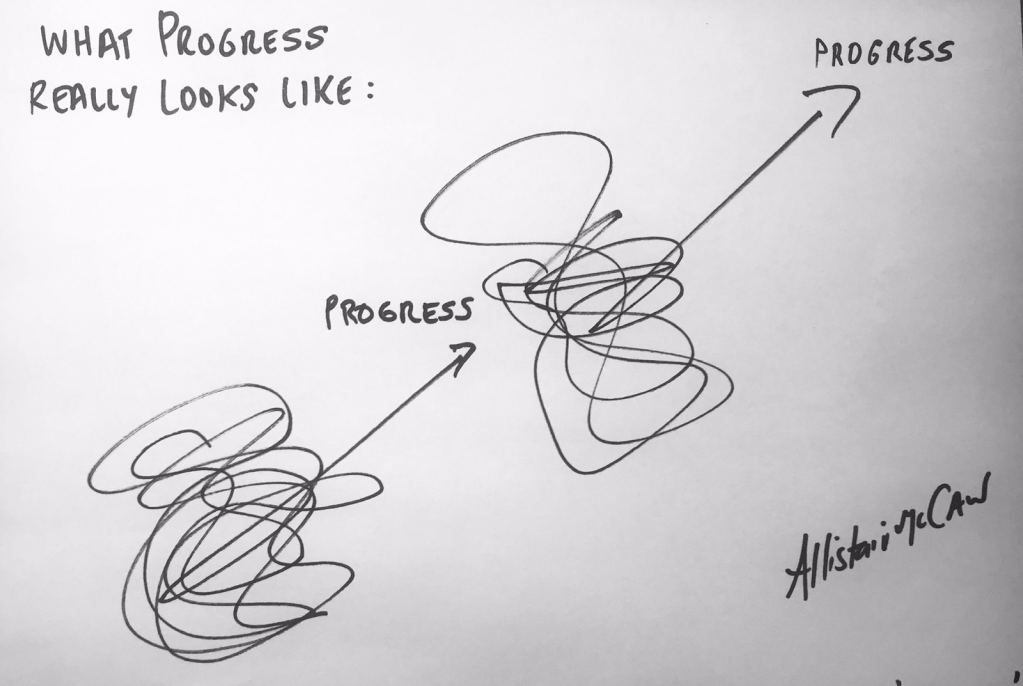
We can improve. Improvement, as Emily Chamlee-Wright, President of the Institute for Humane Studies, says, is a “messy emergent process in which many winding attempts based on competing notions of the good collide, change course, merge, hit dead ends, and start anew. Along the way, we will make mistakes.”
Heaven may never be brought down to earth, and utopia impossible to achieve. But we can improve. Things can get better. Progress is possible.
I want to point out two other mistakes that tend to encourage the huge mistake of authoritarianism whether from the Left or the Right. The first of these smaller mistakes stems from our human frailty. It’s the tendency to be lenient with oneself or one’s own side while being harshly critical of the other side. This is called holding double standards, or, more to the point, hypocrisy. To perceive the other side as hypocritical only strengthens the echo chamber one’s own side is in.
For example, my understanding is that 94% of pro-Black Lives Matter demonstrations back in 2020 were peaceful, while 6% involved violence, clashes with police, vandalism, looting, or other destructive activity. The one I personally witnessed here in Cleveland was a part of that 6%, and I will never forget. Now, I am aware of some on the Left who argue that the 6% that were violent were not really violent. That that violence was somehow righteous nonviolence. Yet these very same people will decry the Jan. 6, 2021 riot at the Capitol as ultraviolence and without any possible righteous justification. So, if you happen to be in a far-right authoritarian echo chamber in which “Stop the Steal” makes perfect sense to you as a true American patriot, and you hear the special pleading about the 6% of BLM demonstrations which were violent (but not really), you will only feel further disgust for the opposition, and you will reach for insulting words like “libtards” or “non-player characters” to describe them. For you perceive the double standard from the Left. You perceive hypocrisy. Why can’t they perceive it? Why can’t they own up to it, own up to the fact that they cast a shadow too?
It only breaks down trust even further.
On the other hand, if you feel you are in the presence of a straight shooter–someone who is impartial, someone who calls out their side for abuses as readily as they call out the other side’s–well, you are more likely to exit your echo chamber and have a real conversation.
All I’m doing here is trying to be a straight-shooter….
Yet another “smaller” mistake I urge us to shine a light on is when people take social media face-value. It too helps explain the leap into authoritarian mode (whether from the Left or the Right) and its imperious, perfectionistic, all-or-nothing, hard power style. To take social media face-value is to fall under the illusion that the public is generally unreasonable and impervious to persuasion. Sarah McBride speaks well to this. “There are two kinds of people on social media,” she says. “The vast majority … scroll their social media. Twenty percent, maybe, are [the ones creating actual social media content]: 10 percent on the far right, 10 percent on the far left — the people who are so, so strident and angry that they’re compelled to post, and that content gets elevated. But what that has resulted in for the 80 percent who are just doomscrollers is this false perception of reality.”
She goes on to say, however, that “One of the best things about being an elected official is that I have to break out of that social media echo chamber — that social media extreme world — and interact with everyday people. And yes, there are real disagreements, but 80 percent of the doomscrollers or the people who aren’t even on social media are actually in a place where we can have a conversation with them.”
Here is this place that Sarah McBride is speaking about:

It’s “the valley of open-mindedness.” And note how big this place really is….
Our politicians might be extremely polarized, but that doesn’t necessarily extend to voters. Not at all.
“People,” Sarah McBride says, “are hungry for an approach that doesn’t treat our fellow citizens as enemies but rather treats our fellow citizens as neighbors, even if we disagree with them — an approach that’s filled with grace. […] And when you go out into the real world — Democrats, independents and Republicans — there is a hunger for some level of grace for us to just not be so angry at one another and miserable. They want to see and know that we actually do have more in common. And therefore it gives you hope that persuasion is not only necessary but can actually still be effective.”
Who here longs for a politics of giving grace?
Who here wants to see and know that Left and Right have more in common than it appears?
Listen especially to the part about persuasion being necessary–persuasion and the required time it takes. Because no one with honest questions and concerns (even if they are ultimately rooted in confusion or ignorance) wants to be forced. Again and again, we are speaking of our inherent worth and dignity, which is a part of you which will send you into grievance when others disrespect you, invalidate you, act all “holier-than-thou” towards you. Nurtured grievance is the reason why people give their unswerving loyalty to a so-called great leader, feel positively empowered through the completeness of their submission to that leader, and feel so completely satisfied when they see their great leader punishing traitors within the party as well as enemies on the outside.
To feel forced offends the libertarian heart of every American. It offends everyone’s instinctive sense that they have a right to take the time needed to make sense of things for themselves. Short-term obedience only breeds long-term resentment and the ultimate failure of ideological regimes. For trans people like Sarah McBride who are suffering, she says, “It is our job to demand ‘Now!’ in the face of people who say ‘Never!’ But it’s also our job to then not reject the possibility for a better tomorrow through compromise. I truly believe,” she goes on, “that … our ability to have conversations across disagreement [must be protected]. In a pluralistic, diverse democracy, there will inevitably be people and positions that hurt us. But when you’re siloed and when you suppress [the opposition] … it breeds radicalization. Liberalism is not only the best mechanism to move forward but it is also the best mechanism to rein in the worst excesses of your opposition.”
Every day seems to bring news of yet another worst excess of the opposition. It’s a perfect storm of radicalization right now, but it’s been years in the making. Now more than ever is the time to be Braver Angels, to reign in the even worse excesses that could come.
Liberalism is the promise that we can work together as people with differing backgrounds, values, and aspirations to find common solutions, and even if the way there won’t be a straight line–even if the way there involves many winding attempts, course changes, dead ends, and efforts to start over–at least we won’t lose our souls.
At least we won’t forget that, however we disagree, we are still all in this thing together. America is like a single house that opposing sides equally love and won’t let go of. But with worsening polarization and escalating extremes of retaliation, the beloved house itself takes structural damage. Each side is so caught up in their resentments towards the other–each side is so all-consumed by their thirst for revenge–that the result may be that the only home they know comes crashing down, and everyone loses.
We must step back from that potential disaster.
There is only one house, and we need to learn how to live in it together.
It is a time for the braver angels of our natures to come forth.
 Spiritflow
Leave a comment