
The title of my homily is “The Gospel of Finding Nemo.” I’m using that big theological word, “gospel,” intentionally because a “gospel” is a message that may tell a story about a particular person at a particular place and time, but there’s a story within that story, a deeper story which speaks universally and which resounds throughout history with wisdom that awakens those who slumber, heals those who suffer, and fulfills those who seek.
Plus, to link “gospel” with something pop culture like a Disney movie can be startling. Surprising. Yet for Unitarian Universalists who don’t believe that Wisdom is scarce and comes only from a single book or a single tradition, maybe it’s not so surprising after all. The alternative to scarcity is abundance. Wisdom is abundant in the world. You can find it in all sorts of unsuspecting places–including a Disney movie.
The scarcity of Wisdom, I believe, has never been the problem for people. The problem is and has always been attention spans. The problem is people slowing down long enough to allow Wisdom to find them. Allowing the agitation to be soothed. Pushing away the tempting distractions.
It can be just as hard for Wisdom to find overwhelmed and perpetually busy you and me as it is for Marlin to find Nemo.
But here we are. Thank you for giving yourself this gift of spaciousness today. You could have just stayed home. But you are here, and that means you’re making room for Wisdom to find you.
It certainly found me, when I finally sat down and watched the movie. Finding Nemo came out in 2003 but for some reason I’d never seen it. What an oversight, I soon came to see.
It really spoke to me, gospel style. Story within the story. From my earlier comments, you might anticipate one of the directions I’m headed: that in the animated fish characters of Finding Nemo, we human beings find key aspects of ourselves reflected back to us.
Nemo, first of all, reflects the part of us which is all about aspiration.

Nemo bursts with life energy, curiosity, thirst for adventure, and yearning for challenge. He desires to expand outwards into a world that is endlessly interesting and full of beauty.
Think of a six-year-old asking endless questions or never sitting still. You might be in a place in your life where having this kind of energy is unimaginable. But we were all six-years-old once. And the six-year-old is still inside you, no matter how old you are on the outside.
That’s what Nemo represents. Aliveness. Vitality bursting forth. Dory, on the other hand, represents our essential human incompleteness.
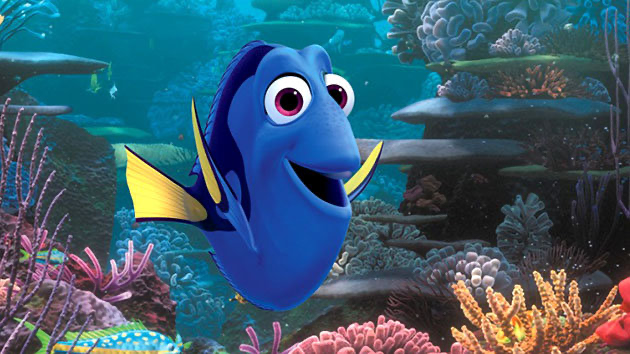
In the movie, unless she had collided with Marlin and taken up his noble cause to find his lost son, she could still be zipping along in that stream of fish, moving fast but not really going anywhere. The movie explains it as a memory condition, but I see it as symbolic of the absence of things people need in order to become more complete–things that the person themselves cannot supply. As infants we needed the protection and nurture of our parents; we could not have survived otherwise. No matter how old we are, we need the kindness of others. We are essentially relational beings. Our being comes into focus when others join us in friendship, community, love, and a shared sense of larger meaning and purpose.
Did you know that this even extends to our need for nature? Without experiences in the natural world–being among the trees, getting our hands dirty gardening, being among animals–something shrivels within. It’s called “nature-deficit disorder.”
We are dependent on things beyond us for our being to come into focus, and when these things are absent from our lives, we are unfocused. We are fuzzy, unformed. We are like Dory before she collides into Marlin, going through the motions, living on autopilot, killing time instead of living it, alive yet not awake.
But now, what about Marlin? You’ve already heard his name dropped a bunch of times. Let’s be introduced.

On the outside, the only differences between Nemo and Marlin is that Marlin is bigger in physical size and both his fins are fully developed. Nemo’s left fin is underdeveloped.
To find the more significant differences, we have to look inside.
Go back to the movie’s beginning. There, we are introduced to Marlin, his wife Coral, and hundreds of their lovely babies, still in their eggs, soon to hatch. Marlin has moved his family to a location which he believes will be perfect for a new family. Better opportunities are ahead, he is convinced. Coral says that where they had been was just fine. But Marlin is confident in the risk he’s taking. It’ll be good for them.
Horribly, tragically, Marlin’s optimism is shattered. His risk-taking is punished. A barracuda swoops in, kills Coral, and eats all the eggs except one. This remaining egg hatches to become Nemo. When the movie fast-forwards to the time when Nemo is old enough to start school, it soon becomes clear how deeply Marlin has been traumatized. Marlin is now always afraid. Marlin is now always hypervigilant. He’s also overprotective of Nemo and spends way more time telling him about all the things he can’t do and all the things he ought to be careful about rather than supporting his budding sense of self and encouraging him to look for the helpers in his midst.
You’d think a Disney movie would be all fluff and sparkles. Not this movie.
Just like anyone who’s experienced trauma, the terror of Marlin’s encounter with the barracuda descends into his very cells. He can’t escape. It always feels like a barracuda is about to swoop in though he might not be consciously thinking about barracudas. It’s his very cells crying out. The result is that Marlin’s present and future are determined to bend in conformity to the inexorable gravity of this emotional black hole.
Marlin is emotionally unfree. Unavailable to anything new.
Meanwhile, as you know, Nemo is all about freedom. He’s all about being available to what’s new. He’s young and curious and has all this expansive energy. Marlin is constantly undermining him, talking him into helplessness (you can’t do this, you can’t do that); and Nemo’s underdeveloped, tiny left fin is the overt excuse.
But you know that Marlin would seek to bubble wrap his kid even if Nemo’s body was perfect.
Ironically, throughout the entire movie, in no way is Nemo’s movement through water compromised by this imbalance in his fins. His swimming ability is undiminished. Yet it’s all his dad can talk about. The hypervigilant parent who seeks to overprotect will find something–however innocent–as the excuse to enlist their kid in their hypervigilance agenda.
The painful truth about the first 15 minutes of Finding Nemo is that the most dangerous thing in Nemo’s young life is his dad. Nemo’s curiosity, energy, and identity are being slowly gobbled up by Marlin’s barracuda-like fear.
So–what does Marlin reflect back to you and me? Certainly any baggage we carry into the present from the past. Certainly our traumas. But this, above all: our ever present awareness that we are living in a world that is dangerous and we know with excruciating sensitivity that we are vulnerable to these dangers. It’s both personal and political. 9/11 was just three days ago. The day before, September 10th, witnessed a school shooting in Denver and the political assassination of right wing activist Charlie Kirk. Things feel like they’re spinning out of control. People on the extreme right and people on the extreme left are escalating the rhetoric of us vs. them while the 80% want to find a politics of grace and want to transcend meanness. They want–we want–a return to sanity.
But no matter how intense the times are, the Marlin in you and me will always be on the lookout for trouble. Evolution guarantees this. Within the structure of our brains is what psychologists call a “negativity bias.” That same brain comes with an automatic alarm system which scans the environment for anything that looks like a barracuda coming at us. Do we fight, do we swim away fast, do we freeze and play dead, do we fawn and play at being friends with the barracuda so they don’t eat us? The menu of options is encoded in our nervous systems, and we choose which one to go within milliseconds.
Can you relate to this part of you, the Marlin part?
If you go to bed every evening feeling like the world is burning down around you, I dare say you can relate. Whether the problems are personal, or social-political, or both.
But the key additional things I need you to recognize about your Marlin part–which the gospel of Finding Nemo is so clear about–is how its fear-based mindset is a danger to the Nemo part in you which wants to open up, seek, learn, enjoy, dare, face challenges, take risks.
The Nemo part in you is squelched by the Marlin part in you.
It’s just not tenable to live that way. Life with a muffled inner Nemo is not worth living! Sure the world needs saving, but what about all the things that deserve savoring? So much is beautiful, so much is interesting, so much deserves our enthusiasm. So much is also boring, and thankfully so, since the steady drum-beat of the mundane is a comfort in the face of headlines screaming the news of this or that.
Can you relate to what I’m saying? Have you ever felt the Nemo part in you pushed down by the Marlin part?
To live exclusively in a fight-or-flight state is to miss out on the delight which our inner Nemos want to bring us. It also isn’t effective. It’s a straight ticket to burn-out.
Another thing to recognize about Marlin’s suffering-based self is its conviction that he’s all alone with his problems. “No fish in this entire ocean is going to help me,” he literally says in the movie. But what’s worse is he says it even after Dory’s been helping him plenty. “No fish in this entire ocean is going to help me,” he says, and Dory is right there hearing this. Dory replies, “But I’m helping you.” And she is. She’s been helping with her superpowers. Her impossible ability to read human language. Her astounding ability to communicate with whales.
To what degree is your inner Marlin convinced that you are all alone in life and no one will help?
I want to say this to your inner Marlin right now: this year, as you keep swimming into every new day, who will you accidentally bump into and they will turn out to be your Dory? Look at the people around you. Any one of them could be your Dory.
Will you recognize it? Will you allow it?
Something else I want to say to your inner Marlin. I’m so sorry for the pain. I’m so sorry you’ve been hurt, for whatever barracudas have hurt you, for the shadows they cast over your present and future. I speak as a fellow traveller who is very aware of how this plays out in his own life.
And I want you to know that, rather than bubble wrapping yourself and anyone you love so that there’s no more danger (which is impossible and never succeeds), the only way forward is to put aside the bubble wrap and lean into the grief. The only way forward is into and through what you most fear.
In the wake of the events of this past week, your inner Marlin might be reeling. You may be feeling confused, sad, angry, hopeless, or something else. Your grief is full. I know we’ve got a lot planned after services, but here’s yet something else. I’ll be back here in the Sanctuary at 12:30pm, and I invite you to join me if you are needing a space of grieving and healing and just to be with your fellow UUs for a time. 12:30pm back here in the Sanctuary. You aren’t alone. Join us.
It’s just not an easy time. It’s a crisis time. So it is imperative we recognize something about what it means to be human. There’s a reason why every culture on this planet—all places, all times—tells stories of epic quests, where a person finds themselves plunged into dangers and challenges of all sorts, in pursuit of some good. It’s the Hero’s Journey I’m talking about.

The Hero goes forth, encounters dangers and strangers, makes new friends, and fights monsters. Eventually they find what they were seeking: a knowledge, a treasure, a changed state of being. Ultimately the Hero returns home and nothing is ever the same again.
Crisis is in our bones. Our mythology proves it:
Odysseus and his Odyssey
Demeter in search of her daughter Persephone
Arjuna in the chariot with Krishna
Buddha under the Bo tree
The life, death and resurrection of Jesus Christ
So do our favorite books and films:
Frodo on his way to Mordor, ring of power in hand
Celie in The Color Purple, and all she endures
Luke Skywalker against The Empire and Darth Vader
Harry Potter, Hermoine Granger, and Ron Weasley in the fight against Voldemort
Katniss Everdeen and the Hunger Games
And, of course, there is Marlin with Dory, in search of Nemo.
Yesterday and today and forever the human race will be telling these stories because we love them, we thrill to them, they feel realer than real. Between the lines is the gospel truth: the human species was born out of crisis. Crisis shows us what we’re made of, what we’re for. It’s the lesson of the humble coffee bean: there is no way to know how good coffee is until you roast the beans, grind them up, then brew them in boiling water. Only then can you know.
Only then are we able to sing:
Coffee, Coffee, Coffee, Praise the strength of coffee.
Early in the mo-orn we rise with thoughts of thee.
Served fresh or reheated, Dark by thee defeated,
Brewed black by perk or drip or instantly.
Therefore: be not afraid of crisis! You can step towards crisis, rather than away.
You are stronger and braver than you know.
From the quest–into, through it, and beyond it–comes the healing.
Just like Dory says, “Keep swimming.”
When you go to bed after a long day of enduring exhausting things, say to yourself “Keep swimming.”
When a loved one comes to you sharing their burdens, say to them “Keep swimming.”
When the latest insanity happens in the social and political sphere, and you’re not sure what to do, tell yourself, “Keep swimming.”
All quests come to an end. While you’re on one, it can feel endless. But all come to an end.
As David in the Hebrew Bible says, “Weeping may endure for a night, but joy comes in the morning.”
Let me tell you something about the end of Finding Nemo. All throughout the movie, there’s been a running joke. It’s that Marlin, a clownfish, can’t tell a joke to save his life. At different times in the movie, when other fish realize he’s a clownfish, they put him on the spot. Tell us a joke. And what Marlin comes up with is like fingernails on a chalkboard.
But at the end of the movie, after he’s shown up to every challenge thrown his way on his Hero Journey quest to find Nemo, and Nemo is found, and they’re back home again, there he is, telling a joke, and he’s hilarious. His groove is back. The clown is back in the clownfish. Nothing will ever take away the sadness of his loss of his wife and all their babies to the barracuda. But his life has grown larger than all that. Now there is more room for gratitude amidst all the grief. And now that the quest has tested his mettle, he knows first hand that, though the world is indeed dangerous, and he is vulnerable in it, he’s no pushover. He can meet challenges with strength. He is indeed stronger than he knows.
May you know that as well, as you face the new year and whatever it may bring.
Keep swimming!

 Spiritflow
Leave a comment