
This is not an S. On my birth planet of Krypton, it’s a symbol of hope.
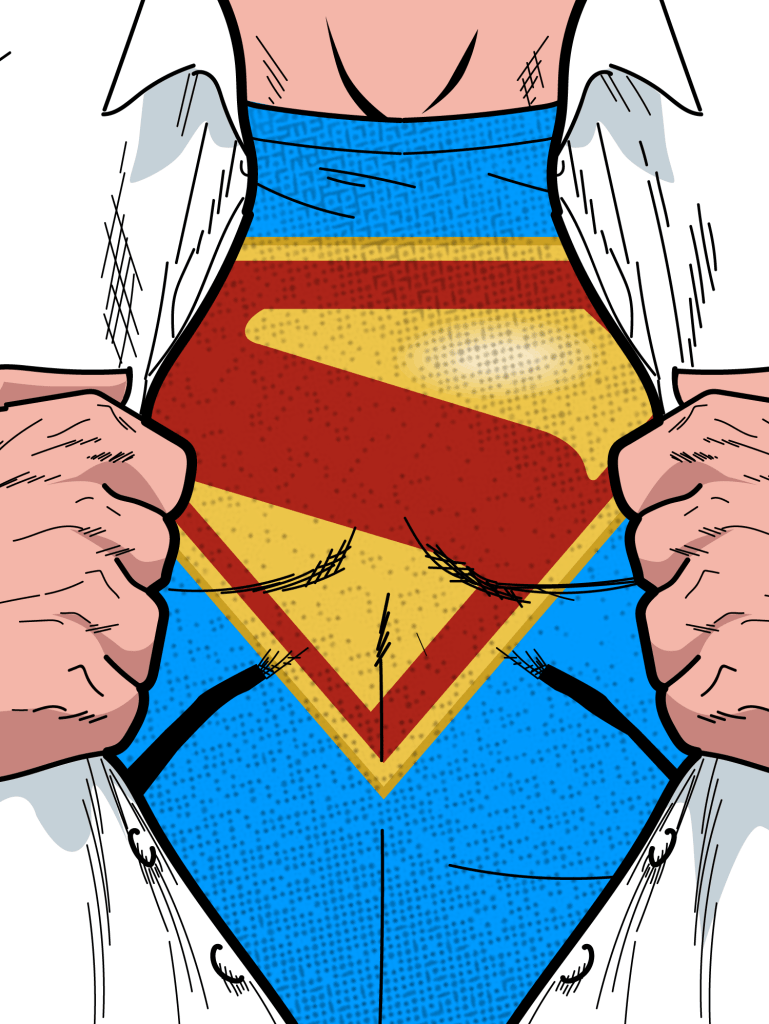
It’s what I put my superpowers in service to. The finish line to my race.
Faster than a speeding bullet! More powerful than a locomotive! Able to leap tall buildings in a single bound! Look! Up in the sky! It’s a bird! It’s a plane! No! It’s … me.
Might does not itself make right. But might certainly got me noticed. In 1938, I appeared for the very first time in Action Comics #1. The cover featured me lifting a car above my head. Inside the covers I was described as “Champion of the oppressed. The physical marvel who had sworn to devote his physical existence to helping those in need.”
Action Comics #1 flew off the shelves, and this was a kind of marvel as well.
Looking back, I’m credited as the starting point of the whole superhero genre. Batman, Wonder Woman, Incredible Hulk, Iron Man, Doctor Strange, and a whole legion of other bona-fide superheroes came forth because of my success. Billions of dollars are now spent on superhero major motion pictures. Maybe they should add to my catchphrase Faster than a speeding bullet and more powerful than a locomotive this: More profitable than a pumpkin spice-menu in October!
That was supposed to be funny.
Maybe funny isn’t one of my superpowers.
What’s for sure is that powerful feats and the clash of powers make great stories. Everyone knows powerlessness. Most everyone knows what it’s like to be the little guy in the fight for dignity and respect if not for life.
While historians do consider me the superhero genre beginning point, the way to me was prepared by any number of popular cartoonstrip, radio, and movie heroes who were justice vigilantes. One was 1930’s The Shadow. It’s said that, while traveling in the Orient, he gained “the mysterious power to cloud men’s minds, so they could not see him.” At the end of each episode, he’d remind listeners, “The weed of crime bears bitter fruit! Crime does not pay…The Shadow knows!”
Gotta admit, that’s pretty good.
Then there’s Doc Savage, who debuted in 1933. According to his story, he was raised from birth by his father and other scientists to become one of the most perfect human beings of all time in terms of strength, intelligence, and physical ability. He was all about “righting wrongs and punishing evildoers,” earning bragging rights as “the Man of Bronze.”
I could go on and on. Flash Gordon, appearing in 1934. The Phantom, in 1936. These justice vigilantes were all huge hits. But they were also only human, albeit with highly developed human powers. I, on the other hand, am a bona fide extraterrestrial. I was born on the planet Krypton and received my name of Kal-El just before I was tucked into a small spacecraft and sent hurtling away from my doomed world towards safety on another planet called Earth. I landed near a small town in the heartland of Kansas, and Earth’s sun flooded my cells with unimaginable power. I was raised by Martha and Jonathan Kent, on a farm, and grew up as nice guy Clark Kent. On reaching adulthood, I moved to the city of Metropolis and found work as a reporter at the city’s newspaper, the Daily Planet. As a reporter with access to breaking news stories, I was perfectly positioned to be in the know about dastardly deeds and injustices and to do something about them–as Superman.
My point being: Nobody had ever seen the likes of me before.
Compared to The Man of Bronze, I was and am The Man of Steel!
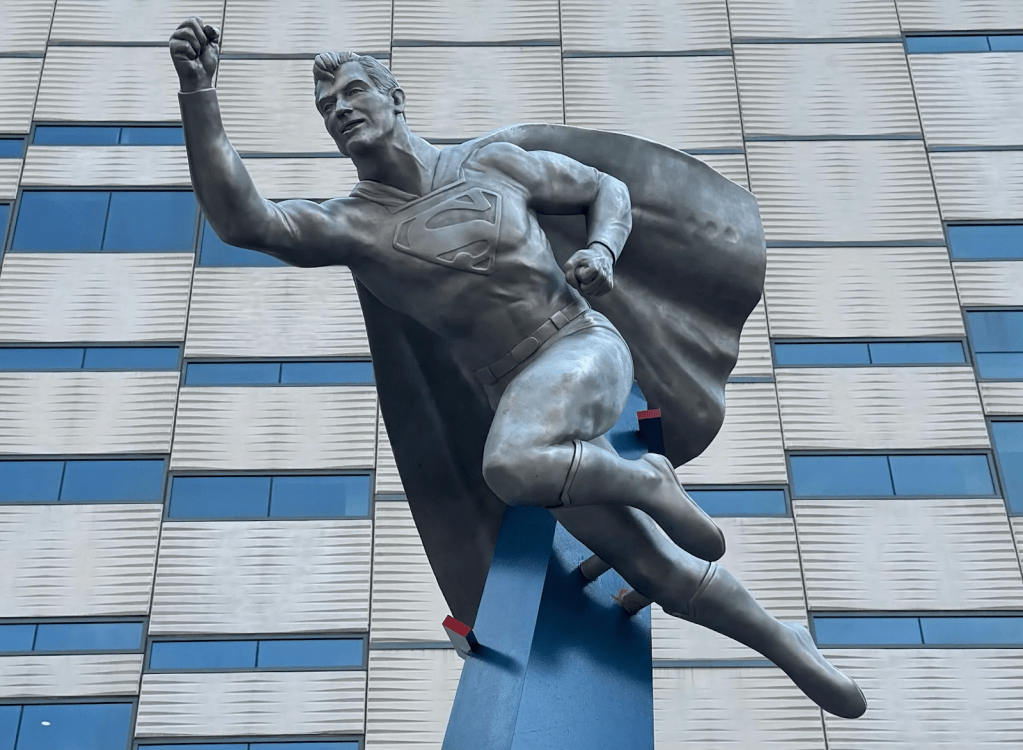
They also call me The Man of Tomorrow.
Boasting doesn’t make it true, though. Glorious titles are just words. And, with all the justice vigilantes already in place, why add one more? What was the particular need for me?
Go back to 1932. Jerry Siegel, one of my creators (the other being artist Joe Shuster), was a teenager living here in Cleveland. Jerry’s father, Michael, was a Jewish immigrant from Lithuania who owned a modest secondhand clothing store. On June 2 of that year, his shop was robbed at gunpoint. Cleveland violence. A robber struck him in the face. The situation got too intense and he collapsed, dying on the spot from a heart attack.
The thieves were never caught.
That very night of June 2, 1932, Michael’s son Jerry locked himself in his room. He felt utterly helpless. His grief was overwhelming. So he turned to the only superpower he knew, which was his imagination expressed through words. He started writing a story. A story about an indestructible hero who could protect the innocent and do what no one else had done for his father.
In some of my first sketches, I’m shown saving a man at gunpoint.
That man looked a lot like Jerry Siegel’s father.
That’s really how I was born. Out of helplessness and deepest loss, hope.
Remember Jerry and his father when you see the S on my chest.

The murder of Jerry’s father was bad enough. But even if that had never happened, put yourself in the shoes of a Jewish immigrant living in America. Every day, facing antisemitism. Every day, dealing with disrespect and suspicion towards immigrants.
Now you understand better where the line from Action Comics #1 comes from, where it describes me as “Champion of the oppressed. The physical marvel who had sworn to devote his physical existence to helping those in need.”
Hope, despite all.
Would you agree that hope is still relevant today?
Some things do change, however, and this includes how I’ve used my power. Over 87 years of existence, as of 2025, different times have called forth different things from me.
Honestly, all my life, it’s felt like I live in a world made of cardboard. So I’m always taking constant care not to break something, to break someone. Never allowing myself to totally lose control even for a moment, or the worst could happen.
But in my first few years, I came close to it. Those were the terrible years of the Great Depression. Millions were left poor and disadvantaged. Millions had lost faith in the government. I certainly had. I, Superman, did not trust established authority, and I worked outside the system. I’d bash heads, lay down the law with fists, show no mercy.
The only difference between me and Batman was that I’d crack jokes while at it.
Now, I’m better known for fighting glamorous supervillains like my archenemy Lex Luthor, my fellow Kryptonian General Zod, the intergalactic conqueror Brainiac, the powerful Darkseid, the chaotic Bizarro, and the technologically advanced Metallo. But in those Great Depression years, I fought against real life forces of cruelty which ordinary Clevelanders knew only too well: reckless drivers, domestic abusers, the owner of a factory where faulty cars are assembled, an orphanage superintendent who is cruel to children, or a mine owner who skimps on safety measures.
This last case was featured in Action Comics #3, published in August of 1938. The story opens with a mine collapse and a miner who’s trapped. I rescue him, but it turns out he’s crippled for life. Later, as Clark Kent, when I interview him for a Daily Planet article, I learn that the miners have been working in unsafe conditions for months. They complained repeatedly to the mining company boss, but he ignored them. Next, I interview the boss and he actually says this: “there are no safety hazards in my mine…But if there were, what of it? I’m a businessman, not a humanitarian.” Disgusting. So I show him. The night the boss threw a party for all his rich friends–in the mine!–I make it collapse on top of all of them. They get to find out for themselves what it’s like to fear for their lives. They get to walk for a while in the shoes of those poor miners. I know I’ve done well when I overhear the mine boss break down and admit that he had no idea that this was what it was actually like for his workers. That’s when I step in and save them. I’m giving them the tough love treatment. The end of the story is the mine boss, with a changed heart, treats his workers like they’re human beings, and the unsafe mine is now the safest one in all the land.
Show some love for the Man of Steel!
I was a working-class hero for the working class, because no one else was.
My stories of this sizzled–so much so that I became a victim to an archenemy that even I with all my powers could not defend against: success. In 1940, Macy’s added me to its annual Thanksgiving parade. This outsider was being brought inside.
I was becoming respectable.
When the Japanese attacked Pearl Harbor, on December 7th 1941, and America was united in joining World War II on the side of the Allies, the chip on my shoulder was completely knocked off. There was no going back to anti-establishment me. I became a superpatriot. Patriotism meant the difference between life and death. I encouraged my readers to be proud to be an American; to be loyal to their schools, communities, and religious teachings; and to do their part so America is victorious. Enlist! Buy war bonds! Volunteer for the Red Cross! I also made it clear that there was no excuse for doubts about America’s place in the war. No negative nellies!
Head-to-head, I brought the fight to America’s enemies, from Hitler and his Nazis to the Japanese, and even to Joseph Stalin.

It was “Truth, justice, and the American Way”–all the way!
Thankfully, the Allies prevailed. Post-war, life could return to normal–or as normal as possible in the shadow of the Cold War, the Red Scare, and fears of nuclear war. Action Comics #143, released in April of 1950, illustrates how some of these themes came together. Lois Lane is a key part of the story. I’d met her back in 1938, and boy, she was one tough, beautiful dame. It was complicated from the beginning. She was smitten by Superman, but how could I let her know who Clark Kent really was without blowing my cover? The romance was, as I said, complicated.
Fast-forward twelve years to 1950 and the story. News goes out that I am engaged to a mysterious woman in a veiled hat named Nikki Larue. In a fit of jealousy, Lois tries to get me to deny the engagement and proclaim that I love her instead–even going so far as to deliberately get
herself kidnapped and held hostage. She’s no longer the woman I used to know and respect for her independence. Now, she’s almost borderline obsessive with me. Whiny. Demanding. And what she doesn’t know is that Nikki is actually a world-famous scientist hired by the American government to perform atomic experiments. Claiming she’s my girlfriend gives me cover to collaborate with her work on a nuclear device called a cyclotron, and to protect her from spies.
Lois’ jealousy almost ruins everything. Lois is given a tip from two “foreigners” and it leads her to discover the whereabouts of the secret laboratory and its cyclotron, but guess what? The foreigners were actually spies, and Lois leads them right to us. I save the day, of course. But Lois’ efforts to scheme me into marriage are so frustrating.

That was the 1950s for you, though. Everyone needed to settle down, get married, have babies.
1950s Lois Lane was just behaving according to what society wanted from its 1950s women.
Every age has brought changes. The 60s. The 70s. The 80s. I could go on and on. There’s been so many stories.
Did you know that, in 2016, I actually died? It was in the film Batman vs. Superman: Dawn of Justice. One subplot to the movie is Batman’s distrust of me. At one point he says, “[Superman] has the power to wipe out the entire human race and if we think there’s even a 1% chance of that we have to take it as an absolute certainty.” Batman just doesn’t trust me. He doesn’t trust that I will never betray the symbol I wear on my chest. It’s only when I sacrifice my life in order to kill the monstrous Doomsday and save the world that he believes. In a later movie, it’s actually thanks to Batman that I am resurrected.
I admit, I faced real temptation to do harm in this year’s Superman movie–much of it filmed here in Cleveland, by the way! For years I comforted myself by watching a transmitted message from my birth parents, saying I should help the people of Earth. The message was corrupted in transmission, however, so I could only see the first part. But it’s when evil Lex Luthor and his minions break into my Fortress of Solitude and my computer system, discover the transmission, and correct it, that the whole truth comes out: what my birth parents really wanted was for me to conquer Earth, take many wives, and have many children–all to restore the Kryptonian race.
If you want to successfully gut punch Superman, this is how.
In the end, it’s my human dad who saves me, by reminding me it’s my choices and actions that determine who I am, not what my birth parents want.
Again and again, I’m learning that wisdom is a superpower too.
87 years later, I’m still learning. I’m still learning how to use my power in service to hope.
I have fought so many things over the years. Robots, aliens, bizarre creatures from other dimensions. But, honestly, I’ll take these any day over the challenge of battling attitudes and mindsets. You can’t punch an attitude to make it go away. You can’t unleash heat vision on a mindset to change it.
You just can’t.
Let me tell you a secret. You may already know that Lois and I were married (finally!) in 1996. Our son, John, was born in 2015. The secret is that we were this close to divorce. It was our consultation with Dr. John Gottman, a marriage counselor–the power of his wisdom–that saved our relationship.

Lois and I were in the grip of “negative sentiment override”–I’m using Dr. Gottman’s language now. There were times when Lois reached out to me with honestly positive intentions and I was so caught up in negativity that I would interpret it as a hostile act. We went back and forth like this. Criticism filled our “conversations.”
“You never clean up around here!”
“You don’t care!”
Criticism led to defensiveness. “I’m so stressed at work trying to support our family.” “You don’t appreciate how hard I work.” Each of us was playing the victim. Each of us was loudly protesting our innocence and refusing to own up to our part in helping create the problem.
From defensiveness, we went to stonewalling each other. Silence, lack of eye contact, and disinterested gestures such as eye-rolling or shrugs. Lois withdrew from me and I withdrew from her. We sort of threw each other away. This was around the time when Hilary Clinton famously described supporters of Donald Trump as a “basket of deplorables.” She was throwing those people away too.
But it was when Lois and I started treating each other with contempt, that we knew something had to change. We were mocking and belittling each other. Namecalling. Lois would stab me in the S with her finger and tell me I was some superhero. I was made to feel worthless.
Don’t pity me. I gave back as good as I got.
Dr. Gottman helped turn things around. Hurt people hurt people! Criticism, he says, comes from unmet needs–so what were the unmet needs we were each feeling? Defensiveness, furthermore, comes from not feeling heard. What if we could validate what the other was saying without equating that to a full admission of guilt. And maybe there was some guilt to own up to. No one is perfectly innocent.
Stonewalling, we learned, can happen because we’re emotionally flooded. We need time to calm down, and that’s when we can get back to solving things.
As for contempt, one thing that helps is making sure to notice what your partner is doing right and expressing that to them whenever you see it. You can do that in many different ways. Focus on your partner’s positive qualities. Express gratitude for their positive actions. Thank them for the little things. No one is all bad.
When a relationship is in a death-spiral, I’ve learned, hope requires something different from being faster than a speeding bullet, more powerful than a locomotive, and able to leap tall buildings in a single bound. Hope requires the superpower of compassion and love expressed skillfully. You don’t have to have been born on Krypton to do that. Everyone can wear the cape, if they make the effort to learn how.
And that’s the last thing I’ll say to you. I’ve never stopped loving America. Maybe I’m not the gung-ho superpatriot of the World War II years, but I still love America, and America right now is like a single house that opposing sides equally value and won’t let go of. But with worsening polarization and escalating extremes of retaliation, the beloved house itself takes structural damage. Each side is so caught up in their resentments towards the other–each side is so all-consumed by their thirst for revenge–that the result may be that the only home they know comes crashing down, and everyone loses.
Do you know what Dr. Gottman calls criticism, defensiveness, stonewalling, and contempt? The “four horsemen of the apocalypse.”

That’s a biblical metaphor for the endtime! Gottman uses it to emphasize just how destructive criticism, defensiveness, stonewalling, and contempt are to relationships.
America is literally swirling in this poison!
My God, we need to walk back from the brink.
There is only one house, and we need to learn how to live in it together.
The negative sentiment override that has come to possess our collective American mind must be healed!
And I can’t do that for you. I simply can’t.
But we, acting together, can. Hope still remains.
Time for all of us to be Superman.
The S on my chest I wear, I now give to you.

 Spiritflow
Leave a comment