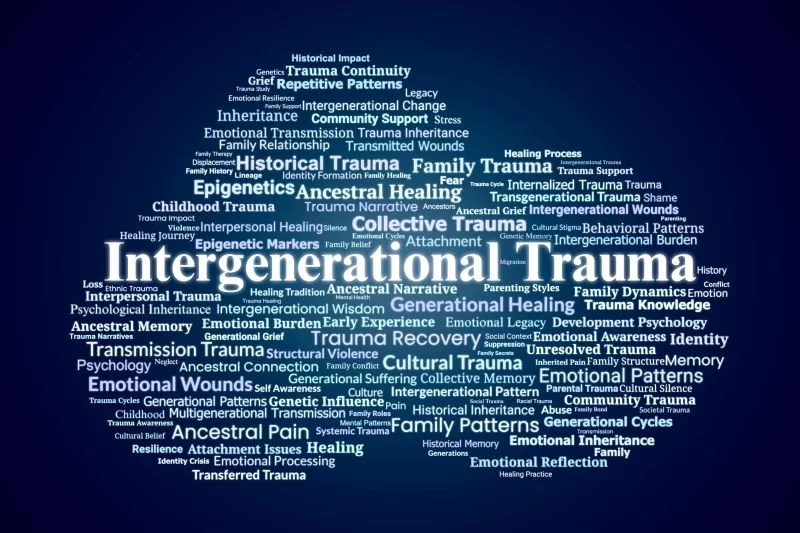
Beloveds, today we turn toward a tender mystery: Why do we sometimes carry fears, reactions, and emotional patterns that we cannot fully explain? Why do some of us startle at joy, as if joy were something dangerous? Why do some of us feel the need to stay vigilant even when life is going well? Why do some of us carry sorrow that seems older than our own story?
Generational trauma theory offers us a powerful insight: What is unhealed in one generation can echo through the next.
Sometimes the trauma is well-documented:
The horrors of enslavement in America.
The starvation and displacement of the Irish potato famine.
The boarding schools that tore Indigenous children from their families.
The Great Depression.
The violence of Jim Crow.
The devastation of forced famine in Ukraine.
The genocide of the Holocaust.
But for many–perhaps for most–the trauma is unknown. Truly unknown, or pushed down so hard that it’s been silenced and never spoken of again. Maybe you grew up in a family that said, “We don’t talk about that.”
Doesn’t matter. It lives on in the body. It creeps in the nervous system. It tangles up our ways of loving and hoping and fearing.
You may not know the story but you sense the wound.
Now, as I say all this–as I speak of generational trauma theory–this might land awkwardly with you. After all, it’s common sense to think of trauma as something personal. It’s common to conceptualize it as the scar coming from a specific event that happened to a specific person in their specific lifetime. But it really can be a wound passed on, generation to generation. Children learn emotional survival from their caregivers, and their caregivers learned from theirs, in a chain that stretches far beyond what we can trace.
So you have a grandmother who learned not to cry–and passes on a quiet that isn’t peace.
You have a grandfather who learned not to trust–who passes on a cautiousness that isn’t prudence.
Then there’s the great-grandparent who learned that joy can suddenly be ripped away–who passes on a pessimism that isn’t discernment.
The result is the grandchild or the great-grandchild who, now an adult, sits in a therapist’s office, or in a pew, or they dwell in the quiet of their own heart, and they say: “I don’t understand why I feel this way. Nothing bad happened to me. But something lives in me anyway.”
The truth is: Sometimes the story is older than you.
For many African American families, the trauma is not hidden but historic. The trauma of almost 250 years of enslavement, from 1619-1865. Then it was Jim Crow segregation and racial terror with its legal apartheid, disenfranchisement, lynching, housing discrimination, and the like. Since 1968 the racial control has shifted into policing, prisons, economic inequality, and other forms of wounding.
It’s been a long, unfinished struggle for dignity and safety….
And it is not utterly unique to the Black experience. To say this is not to flatten different histories into sameness. The African American experience is not simply one trauma among others—it is a foundational trauma of this nation itself. Others may find echoes in their own histories, but we must not pretend these histories are interchangeable. They are not.
It is only to acknowledge the terrible reality that historic trauma has visited others as well, and how people of different lineages can learn from one another. Our different wounds need not divide us, and can unite us instead in empathy.
And so, for Indigenous families, it’s been a sad history of displacement, dispossession, forced assimilation.
For Jewish families, it’s been attempts at erasure across centuries.
For Ukrainian families, it was Joseph Stalin’s rule in the 1930s which led to the deaths of approximately 3 to 4 million Ukrainians, through starvation and terror. This, and so much more. My grandfather’s father died from a bullet to the brain, in 1946, because the Communists demanded he give up his land and allow himself to be displaced, and he refused. I will never forget my Dido trying to tell me the story, haltingly, through his tears.
It also helped me wrap my head around how this beloved man of my childhood could be so ruthlessly perfectionistic in a way that did lasting harm to my father and all his siblings.
It’s all too much. The wars, dictatorships, forced migrations, famine, poverty, which haunt family lineages of many nations and ethnicities.
These histories leave deep imprints. Grief stored in the muscles. Hypervigilance. Unhealthy habits. Hyperresponsibility. Ruthless perfectionism. Fear of abandonment. Guardedness around trust. A tendency to brace for loss even in moments of joy.
But here is the astonishing part: Not only wounds were passed on. Wisdom was passed on too.
People who survived the unsurvivable learned how to hold dignity under pressure. They learned how to read danger early and accurately. They learned how to make beauty out of sorrow and find joy when joy made no sense.
Scholar Resmaa Menakem describes this as “intelligence stored in the body.” Not theoretical. Real. Lived.
As one example: under enslavement, when Black families were torn apart by sale and state power, people innovated new forms of kinship. Aunties who mothered without being mothers. “Play cousins” who became siblings in every way that mattered. Elders who held historical memory when keeping a written record was forbidden.
This is ancestral genius.
Community became the method of survival when the state tried to make survival impossible. In generational trauma theory, this is known as post-traumatic growth embedded in community practice. It’s the pushing back against the worst that historical violence accomplishes, which is the breakage of continuity–of tradition, language, land, and ancestry.
Here again we turn to the Black experience, for its guidance. The Black experience in America shows that identity can be reconstructed even when the past has been violently interrupted. Culture is not only a thing inherited; it can be created forward.
For diasporic Irish, Ukrainian, Vietnamese, Jewish, Cherokee, Palestinian, Sudanese, and many others: Community must be chosen and continually re-made in the face of dispersal and dislocation. One need not be condemned to identitylessness. Cultural memory can be rebuilt through intentional practice, even when the original form is damaged.
I say “intentional practice.” But what this looks like can include:
Spirituals sung in secret.
Laughter in kitchens.
Stories told around tables.
Hands held at gravesides.
Rituals observed around campfires, in the depths of night.
Dances, recipes, lullabies, prayers.
While generational trauma often teaches, “be on guard,” “don’t relax,” “joy is risky,” African American wisdom replies with joy as resistance. Joy is what saves your sanity. Gospel, blues, dance, hip-hop, carnival traditions all teach: Joy is not denial of suffering. Joy is how people refuse to let suffering have the last word.
Everyone can learn from this. No matter how you’ve been hurt, to insist on joy anyway is resistance and resilience. Audre Lorde puts it this way: “Caring for myself is not self-indulgence, it is self-preservation, and that is an act of political warfare.”
Think on that: suffering metabolized into meaning becomes spirituals holding encrypted messages of escape, blues as the art of turning pain into beauty, gospel as the insistence that joy can exist without permission, jazz and hip-hop as reassertions of creative sovereignty.
This is trauma transmuted into cultural brilliance. Not avoidance but alchemy.
So when we say “generational trauma,” we must say something else alongside it: There is also generational strength. There is generational creativity. Generational brilliance. Generational love.
I want to pause right now to acknowledge: there may be some of you who feel like you are on the outside, listening in on a sermon that doesn’t seem to be speaking to you.
I assure you, this is a sermon for everyone. This is a sermon for anyone who flinches at tenderness or braces for loss even when love is present. It’s a sermon for those who feel joy and also fear it; those who struggle to rest; those who don’t know how to receive help; those who carry a sadness that does not have a name.
If this is you: It’s not because you were born broken. It’s because something happened, even if you don’t know what. Even if the story was never told. Your body is not confused. It remembers. And healing begins when we listen.
Let’s turn to that now: the healing. The work of healing generational trauma is not about erasing the past. It is about making space for the past to be acknowledged, named, and held with tenderness.
Recently I purchased a piece of art for this congregation, and our Aesthetics Team very kindly agreed to accept the piece. Here it is:

“Amazing Grace” is a portrait of a Black woman, with a backdrop of apparent arches or wings which on closer examination are actually cutaway images of the slave ships that brought her ancestors to the Americas. Through her shawl, we can see traumatic ancestral pressures that affect Black people’s vision of their lives in America. Burning crosses. Lynchings. Yet, like the slave ship captain turned abolitionist who wrote the hymn “Amazing Grace,” the descendants of those enslaved people try to make this a better world. They wear angels’ wings.
West Shore congregants first experienced this piece back in March 2024. Led by April Stoltz, around 15-20 members went to Cleveland City Hall for a Black history art exhibition which included “Amazing Grace.” Rev. Shirley Nelson was part of this group, and she tells me that this painting was their unanimous choice as the very best one.
Later in 2024, on July 7 (when I was away on break), Rev. Shirley preached a sermon entitled “Exploring the Many Layers of Grief.” During this service, “Amazing Grace” was shown as a slide during the service, and it was also available in physical form on the chancel.
Back from my break, this is when Rev. Shirley and Judy Montgomery introduced the piece to me, and I fell in love. My heart broke wide open. I heard myself say out loud, “This is about wounds turning into wisdom.” This is how the artist, Gary Williams, is doing the work of processing the generational trauma passed down to him from his ancestors.
Even as I saw all of that so very clearly and with such appreciation, it also took me to the pain of my grandfather, whose own father was murdered by political violence, and it was helping me in processing my own generational trauma. It was helping this non-Black, Ukrainian too!
It shows the way. A portrayal of woundedness and wisdom. Terror and the unyielding strength that answers back. Black dignity in the face of the undignified. The inherent worth and dignity of us all, untouched by the worst that damaged and cruel people can do.
You can see “Amazing Grace” for yourself. It’s hung on the wall on the way to Baker Hall, opposite the Chapel. It’s there because this is a church that chooses to look at history rather than turn away.
This is a church that believes art is part of spiritual healing. Go see it up close. God bless Gary Williams for showing the way forward for all of us. It’s a great example of the healing work of “re-membering”: reassembling belonging, identity, and community in the aftermath of being shattered.
Resistance as joy.
But what if, for the sake of your healing, you can’t paint a picture of your ancestral history–or in some other way name it and honor it–because you’re not sure what happened? You sense the wound but don’t know the history behind it.
Remember, this is a sermon for everyone. It’s for anyone who carries a sadness that does not have a name.
I want to say a little, now, about how I’ve experienced this in my own life.
I can say it simply, though this completely betrays the depth and complexity of the pain. From my earliest years, I can remember my mother telling me that I was bad because I was male. Before I could actually do anything actually toxic, I was condemned as a toxic male. The things she screamed my way. The things she would say.
I grew up burdened with the shame of being a man. And I didn’t know why. What provoked her to say such things to me?
My healing journey around this has been rather extensive. And I suppose I can say that, at some point, I painted a picture of what might have happened to my mother that would lead her to damage me–to do to me what she would never have done if she had been sane and whole.
I painted a picture of her being sexually molested when very young.
I painted a picture of her experiencing the terror of sexual violation, with no one to take that to, no one who would believe her. People she loved and trusted telling her it never happened, you’re imagining it, forget it, never speak of it again.
I don’t know the truth of what happened. I only know that my mother, who loved me, couldn’t help react out of her trauma and ended up damaging me terribly.
So I tell the story–I paint the picture–to help me in my healing, and to bring compassion to her.
First and foremost, this is a sermon for everyone because you will become the Ancestor of another, and whatever the origin of your trauma–hundreds of years ago, or in your own lifetime–you will pass it on to the next generation unless and until you face it, name it, grieve it, learn from it, grow larger than it, and alchemize the wound into wisdom.
This is slow work. Gentle work. Sacred work.
Beloveds, hear this: You are not the beginning of your story. You are not the end of it. You carry both injury and insight. Both ache and brilliance. Both scar and song. Your ancestors—whether you know them or not—endured more than you can imagine. And yet, somehow, you are here.
And, you are yourself becoming the Ancestor to countless future generations.
The work before us now is not to bury the past, but to tend it. Not to suppress the wound, but to help it become wisdom. To let joy come back into the room—not as something to fear but as something to practice. This is not a romanticizing of suffering. It is the honoring of what the ancestors made out of what was done to them, and what you yourself can do as an ancestor-in-the making. Not the wound alone, but the way the wound was survived, and the precious wisdom learned along the way.
May we be the generation that listens deeply.
May we be the generation that heals gently.
May we be the generation that transforms memory into compassion and survival into Amazing Grace.
 Spiritflow
Leave a comment