There are moments when life feels washed out—like a hallway lit by fluorescent bulbs.
Everything is surface. Everything is only what appears.
And then there are other moments.
They look ordinary enough: a crossing of paths, a matter of timing.
And yet they do not feel ordinary.
They feel charged.
They feel as if something in the outer world has answered something in your inner life.
Surface and depth have rhymed.
Have you ever had a moment like that?
A phone call arriving at the exact moment you were falling apart.
A line in a book finding you when you did not know how to name what was happening.
A person appearing just when you were about to give up.
A door opening at the very moment you had decided there were no doors left.
And then you wonder:
Was that just dumb luck?
Or something deeper?
That is the question I want to sit with this morning.
And it is an especially fitting question for us, here, today. Because after this sermon, we will mark the public launch of West Shore’s major capital campaign. We will celebrate what has already begun. We will reveal, joyfully, what has been raised so far. On one level, of course, that is practical. It is about dollars and planning and buildings and the future we are trying to make possible.
But on another level, this moment asks a deeper question.
When does something become more than logistics?
When does timing itself begin to speak?
When does a moment feel like more than chance?
Now before we go further, let me be clear about the kind of sermon this is.
I am not asking you to leave your mind at the door.
And I am not asking you to leave wonder in the parking lot.
Because one of the deepest spiritual tensions many of us face—especially modern, educated people—is the tension between discernment and enchantment.
We do not want to be gullible.
We also do not want to live in a universe shorn of mystery.
So let us begin with two honest ways of understanding these moments.
One way is psychological. Michael Shermer uses the term “patternicity” to name the human tendency to find meaningful patterns in the swirl of experience. Sometimes those patterns are real. Sometimes they are not. Our minds are meaning-making machines. We connect dots. We see shapes. We notice timing. We infer significance.
And that capacity is not foolish. It is one of the ways human beings survive. Better, from an evolutionary standpoint, to see a pattern that is not there than to miss one that is.
So one explanation for meaningful coincidence is simply this: you were primed.
You were paying attention in a particular way.
Your mind connected the dots.
And sometimes that is exactly what is happening.
But there is another way to speak of these moments.
Carl Jung gave it the name “synchronicity”: a coincidence infused with meaning—an event in which inner life and outer life seem to meet, not through a straightforward chain of cause and effect, but through significance.
This is not a claim that the universe is a vending machine for signs.
Not a claim that every odd moment contains a coded message.
Only this more modest and more mysterious possibility: that now and then, life meets us in a way that feels answering. A moment arrives and lands with such uncanny precision that we feel not merely that something happened, but that something spoke directly to us.
I know that territory.
I remember a time in my own life when I wanted something so badly it felt tied to everything—not just a preference, not just a wish, but one of those wants that reaches down into your sense of basic identity and future.
During that time, I found myself repeating an old saying. Not because it was scientifically rigorous, but because it was spiritually useful: “Aerodynamically, the bumblebee shouldn’t be able to fly … but the bumblebee doesn’t know this, so it goes on flying anyway.”

I repeated that line to myself again and again. Quietly. Stubbornly. Like a little candle in the wind.
One day, while I was in that season, I walked out of a store with that line running through my mind—and at that exact moment, two bumblebees darted right in front of me. They buzzed around each other in what looked almost like a dance, hovered just long enough to be unmistakable, and then flew off.
That is the whole story.
No heavenly soundtrack. Just two bees.
And yet, if you have ever had a moment like that, you know why it lands.
Because it did not feel like I merely noticed bees.
It felt as if something in the world leaned toward something in me.
Like a wink from the universe.
Now can I prove the bees were personally sent? No.
Can I prove it was anything more than timing plus a primed mind? No.
But I can tell you what happened in me.
Something in me that wanted to quit did not quit.
Something in me that felt impossible became “not yet.”
Something in me kept flying.
And I think that matters.
Which brings me to one of the foundational stories of our religious tradition: the story of John Murray.
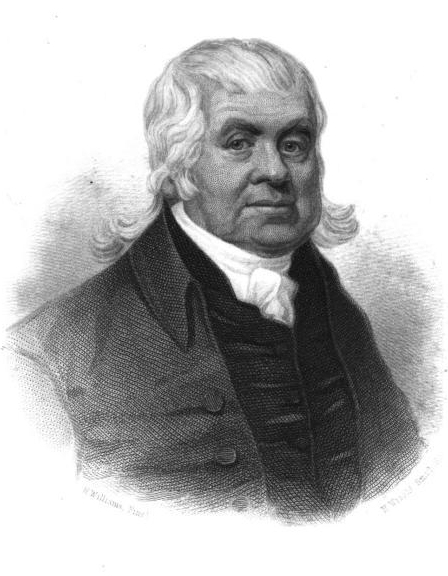
If you know the phrase “Father of American Universalism,” things can sound polished and inevitable. But Murray’s life did not feel like that from the inside. It felt broken. It felt despairing. It felt like the kind of life that makes a person wonder whether there is any future at all.
His early life was marked by waves of grief and hardship: the deaths of his wife and children, devastating illness, time in debtor’s prison, and the loss of family and community because they detested his conversion to Universalism. This is the kind of unraveling that can hollow a person out.
Universalism is the daring and beautiful claim that divine love is larger than fear, larger than damnation, larger than our worst ideas about who is in and who is out—but that vision did not spare him from suffering.
Eventually he left England and sailed for America—a weary man trying to begin again. And the new start he wanted had no room for religious leadership. He wanted to leave preaching behind. He was done.
That is the setting for one of the strangest and most beloved stories in our history.
The ship Murray was traveling on became stranded on a sandbar off the New Jersey coast.
And the place where the ship got stuck was called Good Luck.
You cannot make that up.
So there he is: exhausted, uncertain, trying to get somewhere else entirely—and he is stuck at a place called Good Luck.
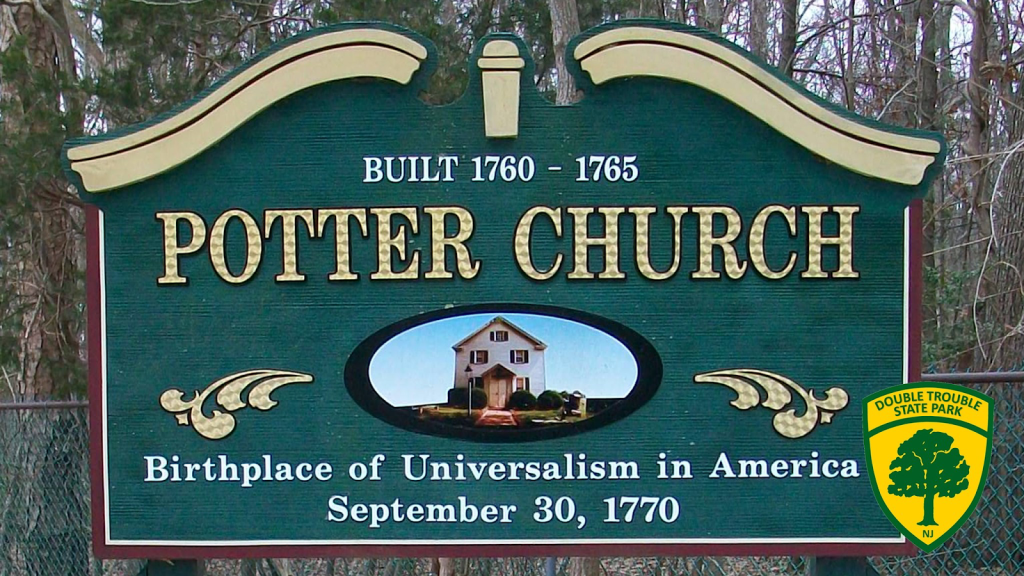
He goes ashore for provisions and meets a local farmer named Thomas Potter. Potter had heard of Universalism and become convinced that this message of wider love, larger grace, and deeper hope needed to be preached. So convinced, in fact, that he had built a chapel on his land in anticipation that one day the right preacher would come.
Think about that for a moment.
He built the space before the preacher appeared.
He prepared the room before the answer arrived.
He made ready for a future he could not yet prove.
And then, of all people, onto his shore comes John Murray, a preacher who has sworn he will never preach again.
Potter invites him to preach that Sunday.
Murray refuses.
Potter keeps asking.
And Murray begins to have that strange feeling many of us know: the feeling that life keeps putting the same question in front of us until we are willing to answer it.
So Murray makes a bargain. If the wind changes before Sunday and the ship is freed, he will not preach. But if the wind does not change—if they remain stuck—then he will preach.
The wind does not change.
The ship remains grounded at Good Luck.
And so on Sunday, Murray enters Potter’s chapel and preaches.
And according to the tradition, something opens. Not because all mystery is explained. Not because hardship vanishes. But because a man who thought he was finished discovers that life is not finished with him.
He finds words again.
He finds vocation again.
He finds himself, not by escaping interruption, but by being held still long enough to hear what was being asked of him.
And when the sermon is over, the wind changes.
The ship is freed.
And not only that. Not merely that.
Universalism is literally born in America!
Now, what do we do with a story like that?
We do not have to make it prove too much.
But neither do we have to explain it away.
What if there really are moments when life gathers itself around meaning?
What if there really are times when inner readiness and outer circumstance meet?
So how do we honor such moments without becoming foolish?
How do we remain open without becoming superstitious?
How do we receive mystery without surrendering responsibility?
I think the answer is not to choose between skepticism and wonder, but to let each discipline the other.
Patternicity protects us from fantasy.
Synchronicity protects us from a flat and disenchanted world.
We need both.
Because yes, human beings can find patterns that are not there. We can turn coincidence into certainty. We can turn wonder into ego. We can make ourselves the center of some private cosmic drama.
But we can also become so anxious about being duped that we refuse to be moved. We can become so suspicious of mystery that we dismiss every moment of awe before it has a chance to ask anything of us. And that can become its own kind of superstition: the superstition that only what fits within normal calculation can be significant.
So here is a simple spiritual practice for moments like these. When something happens that feels meaningful—an uncanny convergence, a strange rhyme between your inner life and outer life—ask three questions.
First: does it enlarge you?
Does it make you more courageous, more honest, more compassionate?
Or does it shrink you into fear or fixation?
Second: does it ground you?
Does it return you to responsibility, agency, and the next faithful step?
Or does it tempt you to sit back passively and wait for more signs?
Third: does it soften you?
Does it make you kinder, humbler, more connected?
Or does it make you feel superior, chosen, special in a way that separates you from others?
If an experience enlarges you, grounds you, and softens you, receive it.
Hold it lightly, but receive it.
If it makes you rigid, superior, paranoid, or passive, be cautious.
That is not wisdom. That is ego wearing a spiritual costume.
And now let me come back to us.
Because sometimes synchronicity is private.
Two bumblebees in a vulnerable season.
A ship stuck at a place called Good Luck.
And sometimes synchronicity is communal.
An entire people arriving at a moment that feels charged—prepared over time, carried by many hands, shaped by long labor, and alive with more than mere efficiency.
That’s how Universalism was born on American soil.
And we here at West Shore are witnessing another birth.
We are undertaking, as you know, a major capital campaign. On one level, of course, this is practical work: planning, generosity, vision, repair, stewardship, decision-making. It is asking what kind of congregation we mean to be and what kind of future we are willing to build.
Every gift, at every level, is a step toward our goal and an act of faith in this congregation’s future.
This is not magic. It is not wishful thinking. It is not a substitute for spreadsheets, commitments, leadership, and hard work.
And yet I do not believe it is merely that.
Because the fact that this is happening now—among us, in this season of our life together—does not feel to me like just dumb luck.
I do not mean that every detail has been scripted from above.
I do not mean that fundraising totals are divine proof.
I mean something steadier and, to me, more profound.
I mean that there are moments when the readiness of a community and the needs of a moment meet each other.
Moments when inherited faith and present courage meet.
Moments when the hopes of those who came before us meet the willingness of those who are here now.
Moments when inner call and outer opportunity begin to rhyme.
That is what I hear in this moment.
What is being revealed today is not only an amount.
What is being revealed is that people have been listening,
people have been trusting,
people have been saying yes.
People have been deciding, quietly and concretely, that West Shore matters, that its ministry matters, that the future matters, that what we hand on matters.
Just as Thomas Potter built a chapel before the preacher arrived, generations before us built and gave and served and hoped without knowing exactly how their faithfulness would ripen in our time.
And now it is our turn.
Our turn to prepare a space for a future we cannot fully see yet.
Our turn to trust that what we build in faith may bless people we will never meet.
Our turn to decide whether love will merely be admired here, or embodied.
In a little while, we will celebrate what has already begun to emerge.
We will do it with delight.
We are going to sing a song most of us know, but with adjusted lyrics:
Come, come, generations of care
Voices of old calling us to the future
Hearts and hands in today’s work of hope
Come, yet again come
But beneath this joy is something I hope we do not miss.
This moment is not only an announcement. It is itself a sermon illustration
John Murray got stuck at Good Luck until he was ready to say yes to what was being asked of him.
Maybe congregations have their Good Luck moments too.
Moments when we are held in one place long enough to hear the deeper call.
Moments when what seemed merely practical becomes quietly luminous.
Moments when we realize that the real question is not “How did this happen?” but “Who are we being invited to become?”
So yes—let the skeptic in you ask honest questions.
Yes—keep your discernment.
Yes—do not hand your life over to superstition.
But also do not miss the holy convergences.
Do not miss the moments when a community becomes ready.
Do not miss the times when hope and labor and courage and timing suddenly come into alignment.
Maybe those moments don’t come as mathematical proofs.
Maybe they are simply invitations
to trust more deeply,
give more bravely.
and step into the future with more openness than certainty.
So when life offers you a rhyme, do not cling to it.
And do not dismiss it.
Pause.
Ask what it enlarges in you.
Ask what it grounds in you.
Ask what love might be leading you to next.
And as for us, here, today—on this day when we launch the public campaign,
reveal what has already been raised,
glimpse what becomes possible when many hearts lean in the same direction—
may we receive this moment with gratitude.
Test it with discernment.
Meet it with courage.
And may we be ready to recognize not only what has been raised—but what is rising among us.
 Spiritflow
Leave a comment