As part of this year-long sermon series on Transcendentalism, this morning we spend time with one of its most brilliant and eccentric figures: Henry David Thoreau, the younger protégé of Ralph Waldo Emerson and companion to that remarkable circle of 19th-century restless spiritual experimenters we call the Transcendentalists.
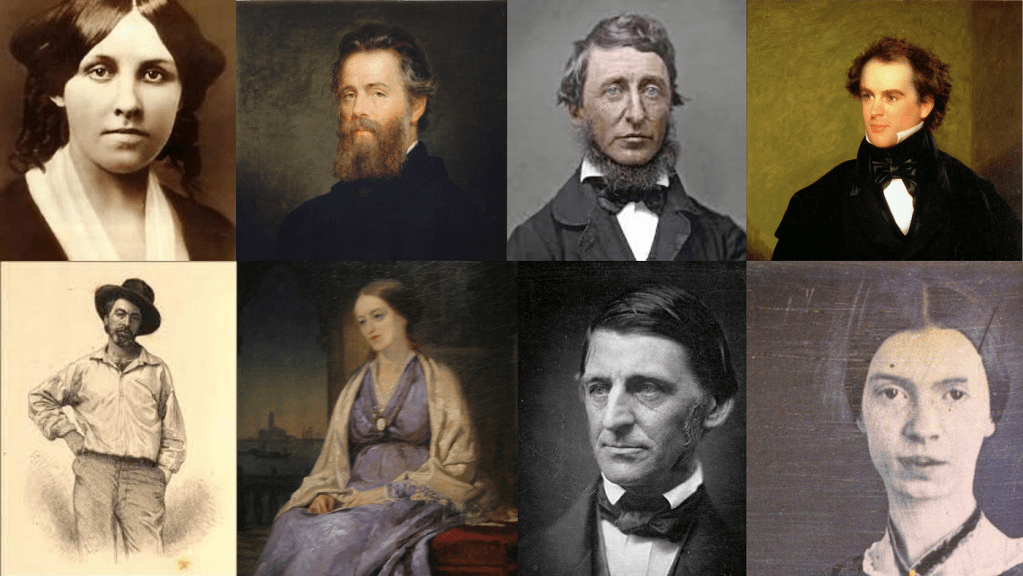
Thoreau was never merely Emerson’s disciple. He was too original, too sharp-edged, too funny, too stubborn for that. But he belonged to that world and gave some of its clearest expression. If Emerson gave Transcendentalism much of its philosophical voice, Thoreau gave it boots, a walking stick, a pond, and a test case.
Many of you may know the famous passage from Walden inscribed on the sign at Walden Pond itself. Thoreau writes: “I went to the woods because I wished to live deliberately, to front only the essential facts of life, and see if I could not learn what it had to teach, and not, when I came to die, discover that I had not lived.”
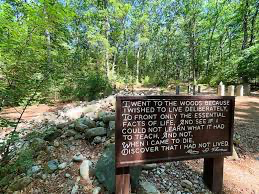
That is one of the great spiritual questions, isn’t it? How shall we live so that when we come to die, we do not discover that we have not lived?
“Near the end of March, 1845,” says Henry David Thoreau in Walden, “I borrowed an axe and went down to the woods by Walden Pond … and began to cut down some tall arrowy white pines, still in their youth, for timber. It is difficult to begin without borrowing….”
Ever afterwards, the question of whose axe Thoreau borrowed has remained an open one. Was it Emerson’s? Bronson Alcott’s? Ellery Channing’s? What we can know is that, this morning, as we contemplate our own experiment in living more simply and wisely, we borrow something from Thoreau too.
Not an axe, but an angle of vision.
We borrow the bent of his genius, which, as Thoreau himself wryly admits, is “a very crooked one.” We do what he did: “see our native village as if we were a traveler passing through,” think new thoughts, and have new imaginings. We borrow from him a way of making the familiar strange, a habit of questioning, a refusal to accept the ordinary terms of life as final.
And as for where each of us ends up, Thoreau is clear: this is not about imitation. Once, he tells us, “a young man of my acquaintance … told me that he thought he should live as I did, if he had the means. [But] I would not have anyone adopt my mode of living on any account. … I would have each one be very careful to find out and pursue his own way, and not his father’s or his mother’s or his neighbor’s instead.”
That is what we borrow as we begin: not a blueprint, but a way of seeing.
The first chapter of Walden is entitled “Economy,” but characteristically Thoreau means something larger by that word than fiscal prudence. He means the whole art of maintaining oneself upon the earth. Economy, in this deeper sense, concerns how we steward our life resources: labor, time, desire, strength, and selfhood.
“I am convinced,” he says, “both by faith and experience, that to maintain one’s self on this earth is not a hardship but a pastime, if we will live simply and wisely.”
That is a wonderful sentence.
To maintain oneself on this earth could be not a hardship, but a pastime.
Could be.
But what Thoreau discovers as he travels through his own native village of Concord is people experiencing something very different. He sees lives pinched and distorted by false necessity, frantic activity, unexamined assumptions, and the heavy cost of trying to keep up with what does not truly matter.
Listen to him:
“Most men … through mere ignorance and mistake, are so occupied with the factitious cares and superfluously coarse labors of life that its finer fruits cannot be plucked by them.”
Or this:
“Our inventions are wont to be pretty toys, which distract our attention from serious things. They are but improved means to an unimproved end.”

Or this piercing line:
“There are a thousand hacking at the branches of evil to one who is striking at the root.”
One after another, these are observations about hardship in the economy of life. And perhaps they echo things we ourselves have seen.
The rush and gush of our days. The time crunch in an age of so-called time-saving devices. A culture that does not merely meet needs, but continually manufactures wants. Communication technologies more powerful than ever, yet so much of what passes through them is noise, speed, heat, and distraction that does not enlighten so much as confuse. Effort everywhere. Motion everywhere. And beneath it all, not peace, but strain.
No wonder Thoreau cries out, “The mass of men lead lives of quiet desperation.”
That sentence has lasted because it still finds us.
And yet the sermon cannot stop there, because Thoreau does not stop there. His critique is sharp, but not nihilistic. He is not merely exposing false life. He is trying to clear ground for a truer one.
People imagine there is no choice left. They assume the way things are is simply the way things must be. But Thoreau says otherwise: “It is never too late to give up our prejudices.” And again: “Man’s capacities have never been measured; nor are we to judge of what he can do by any precedents, so little has been tried.”
That is hope.
Not sentimental hope. Experimental hope.
Hope that says alternatives exist, though they may require a willingness to stand a little apart from the crowd in order to hear what life is actually asking of us.
This takes courage.
It also implies strangeness.
This is what led Thoreau to borrow an axe and begin his social experiment of one at Walden Pond. He goes there, as he famously says, to live deliberately; to front the essential facts of life; to test his beliefs against actual experience; to peel away artificial wants and discover what is truly necessary; to distinguish roots from branches; and to see whether a human being might “get one’s living honestly, with freedom left to pursue one’s proper pursuits.”
“It would be of some advantage,” he says, “to live a primitive and frontier life, though in the midst of an outward civilization, if only to learn what are the gross necessaries of life and what methods are used to obtain them.”
That is what Walden is: not escapism, but investigation. A disciplined inquiry into what is actually necessary for a good human life.
Now I will tell you plainly that the first time I picked up Walden, I had no idea what this guy was talking about.
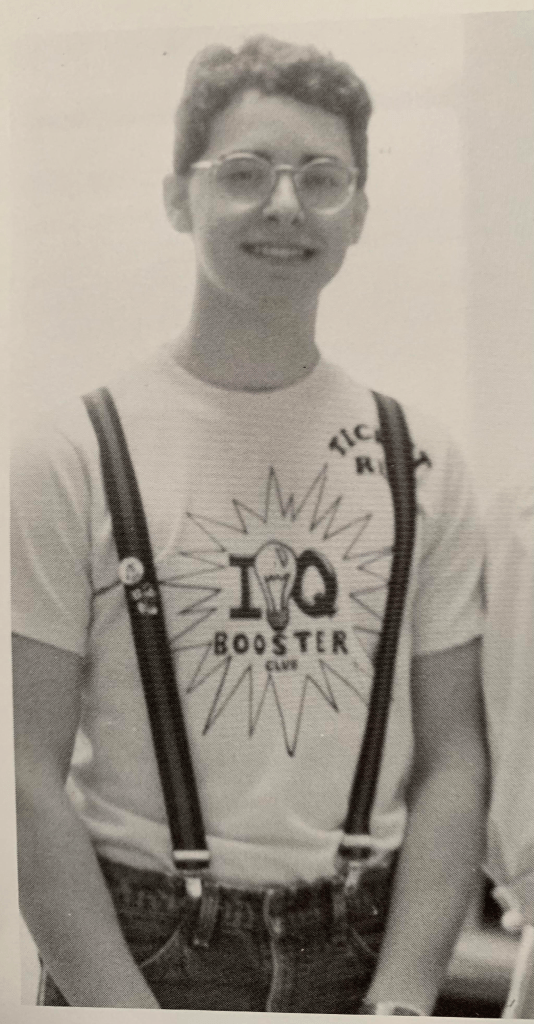
I was in the eighth grade, and I had heard that the book was a classic. Being a student in the gifted and talented program at my school—being a future member of my high school’s I.Q. Booster Club—how could I not want to check it out?
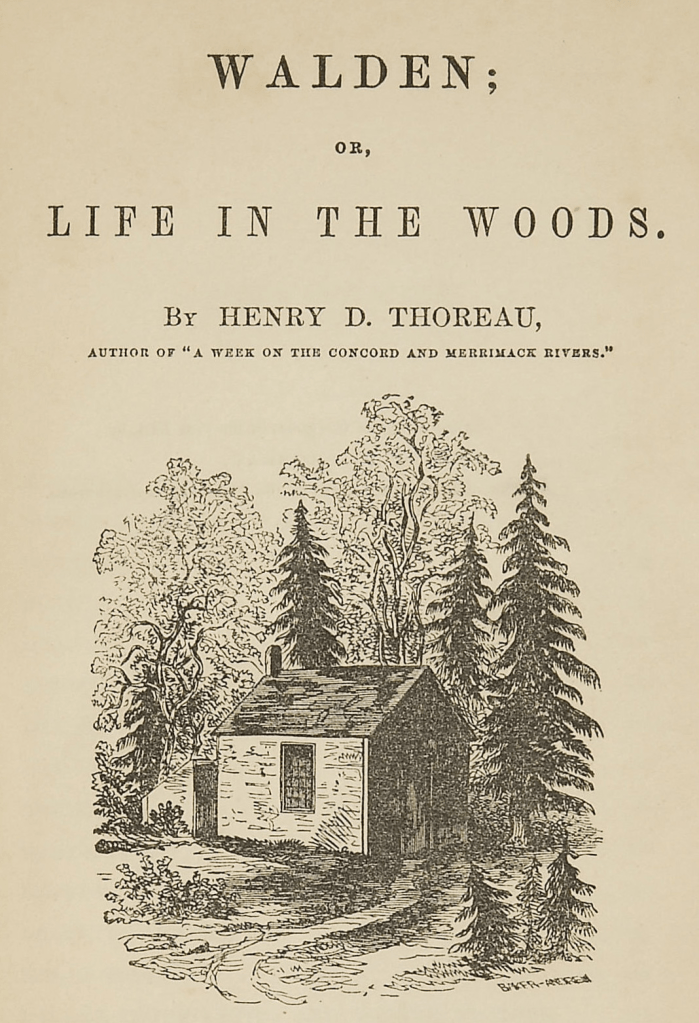
I found it in paperback, there on a dark dusty wooden shelf, wedged tightly among other classics. The cover was not promising. It had a weird-looking guy on it with a neck beard.
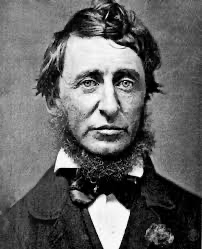
Did he just forget to shave his neck? What’s up with that?
I flipped through the pages: tiny print, no pictures. Uuugh.
Then I started to read. Sentences with way too many phrases and commas in them. References to mythology, religion, science—things I could only vaguely sense. Now I know that Thoreau loved puns and paradox and wordplay, enough to drive Emerson crazy. Now I know he believed that “in writing, conversation should be folded many times thick.” Now I know.
But then? Not at all.
Walden was indigestible. I struggled with it for a time, and then gave up.
Now I am in a different place in my life. Perhaps more mature. Definitely more hungry for an alternative to the quiet desperation of contemporary life. And voluntary simplicity as a spiritual discipline sounds very good to me.
To what degree does our genuine happiness depend on the clothing we wear, the shelter we possess, the food we eat, the work we do? What do we actually need? What owns us? What have we mistaken for necessity?
“The more you have,” says Thoreau, “the poorer you are.”
That is not literally true in every sense, but spiritually it contains a hard wisdom. We imagine we own our things, but often our things own us. Simplicity preserves room to move. Excess weighs us down.
And it is remarkable how easily and insensibly we fall into a particular route, and make a beaten track for ourselves. Thoreau says that the surface of the earth is soft and impressible by the feet of human beings, and so too with the paths which the mind travels. How worn and dusty, then, must be the highways of the world—how deep the ruts of tradition and conformity. What begins as habit hardens into routine. What hardens into routine begins to feel inevitable. And before long, we have mistaken a well-worn track for the only road there is.
And Thoreau can be very funny about this.
“I had three pieces of limestone on my desk,” he says, “but I was terrified to find that they required to be dusted daily, when the furniture of my mind was all undusted still, and I threw them out the window in disgust.”
Or this:
“A lady once offered me a mat, but as I had no room to spare within the house, nor time to spare within or without to shake it, I declined it, preferring to wipe my feet on the sod before my door. It is best … to avoid the beginnings of evil.”
That is classic Thoreau: severe, absurd, and somehow liberating.
And then he asks a question beneath the joke. Are we so enslaved to keeping up appearances that we cannot bear even the smallest break in convention? Are we so burdened by possessions, habits, expectations, and status that we no longer know what ease feels like?
Applying a principle of voluntary poverty in a culture like ours may seem almost impossible. I am not suggesting that we all go build cabins by ponds. Thoreau himself would not want imitation. But I do wonder about the effects of even trying, in modest and honest ways, to live more deliberately.
To buy less impulsively.
To want less reflexively.
To create a little margin.
To question what our culture tells us is necessary.
To recover the difference between comfort and captivity.
To make room again for thought, presence, and soul.
Because what Thoreau finally wants is not deprivation for its own sake. He wants awakening.
He tells a small story about his axe. One day, he says, after repairing it, he saw a striped snake run into the water and lie there on the bottom, “apparently without inconvenience,” as if not yet fully emerged from its sluggish state. And then he adds: “It appeared to me that for a like reason men remain in their present low and primitive condition; but if they should feel the influence of the spring of springs arousing them, they would of necessity rise to a higher and more ethereal life.”
That image stays with me.
We too can live sluggishly. Half-awake. Buried under habit, anxiety, and noise. And yet, he says, there is a spring of springs that can arouse us.
A higher life, for Thoreau, is not one of glamour or accumulation. It is a life of sanity, honesty, steadiness, and trust.
Above all, trust.
“I think we may safely trust a good deal more than we do,” he says. “Nature is well adapted to our weakness as to our strength. The incessant anxiety and strain of some is a well nigh incurable form of disease.”
What if he is right? And not only about nature, but about the way we live together?
Our political culture trains us to live in continual alarm. Everything is urgent. Everything is breaking. Everything demands reaction. After a while, that pressure begins to feel normal. But Thoreau would ask whether all that motion is really moral seriousness, whether all that noise is really thought, and whether we have surrendered too much of our inward life to the frenzy of the hour.
He teaches us to step back far enough to see what is happening to the soul. To ask whether this pace, this pressure, this constant demand for performance is making us wiser, or merely more strained. And he teaches us to trust that if we loosen our grip on some lesser things, we may recover larger ones: steadiness, perspective, moral clarity, and the ability to act from conviction instead of panic.
And if you have built castles in the air, perhaps your work need not be lost. That is where they should be. Now put the foundations under them. The point is not to stop imagining a freer life. The point is to begin making it livable.
And so perhaps that is where Thoreau finally meets us: not just with critique, but with a question sharp enough to cut through habit.
What is your life being spent for?
What is the economy of your days producing?
More clutter?
More performance?
More fatigue?
More proof that you are busy, needed, respectable, keeping up?
Or something finer than that?
More spaciousness?
More truth?
More capacity to love what is actually before you?
We borrow from Thoreau this morning not his cabin, not his beans, not his pond. We borrow his angle of vision. We borrow his willingness to stand just far enough from the ordinary terms of life to ask whether they are worthy of us. We borrow his suspicion that much of what we call necessity is only habit with a mortgage. And we borrow his hope that a human life can be lighter, saner, and more awake than we have been taught to imagine.
To live deliberately is not to live theatrically. It is not to make a spectacle of simplicity. It is to stop spending ourselves so carelessly. It is to ask, with honesty and courage, what is essential and what is merely consuming us. It is to trust that if we loosen our grip on some lesser things, a greater aliveness may become more available to us.
And so perhaps the invitation is plain. Take an axe to some false necessity. Create a little margin. Dust the furniture of the mind. Trust a little more than you do. And see whether, even here, even now, in the midst of this outward civilization, the spring of springs might yet arouse you into a higher and more wakeful way.
Amen.





Leave a comment